42
Manoscritti
Polenton, Sicco
Sicconis Polentoni prefatio ad Modestum filium in Sancti Antonii confessoris de Padua vitam incipit, 1460
Estimate
€ 25.000 - 30.000
Sold
€ 48.260
The price includes buyer's premium
Do you have a similar item you would like to sell?
Information
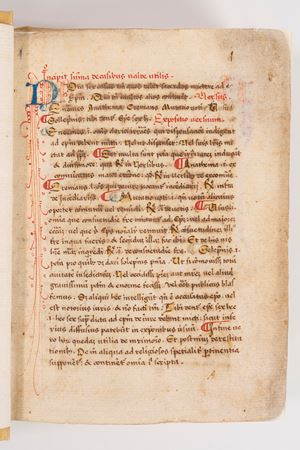
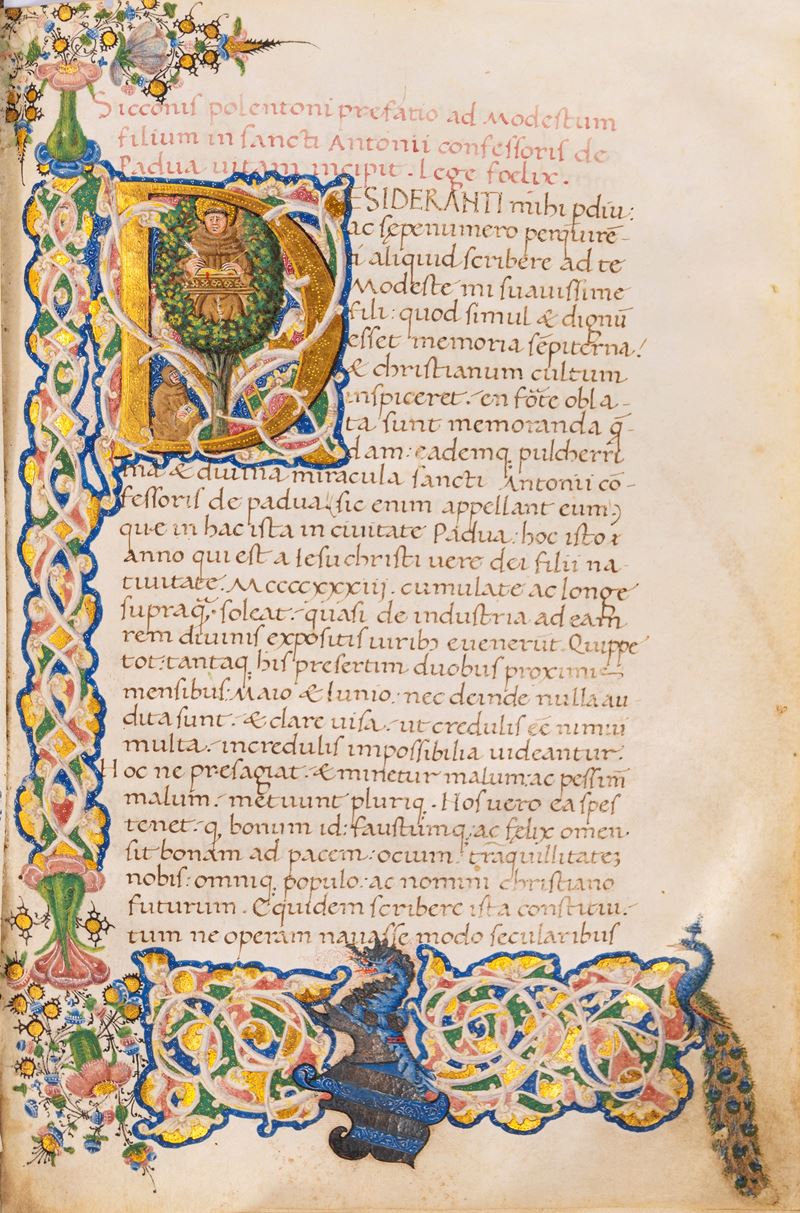
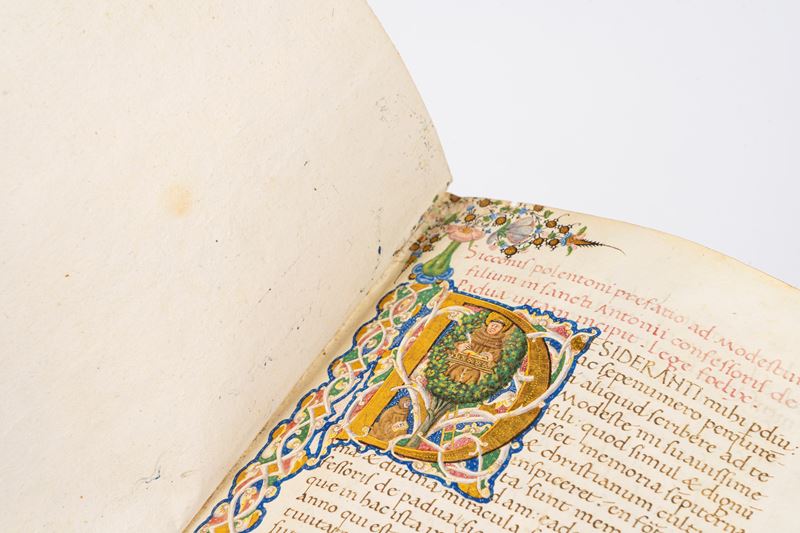
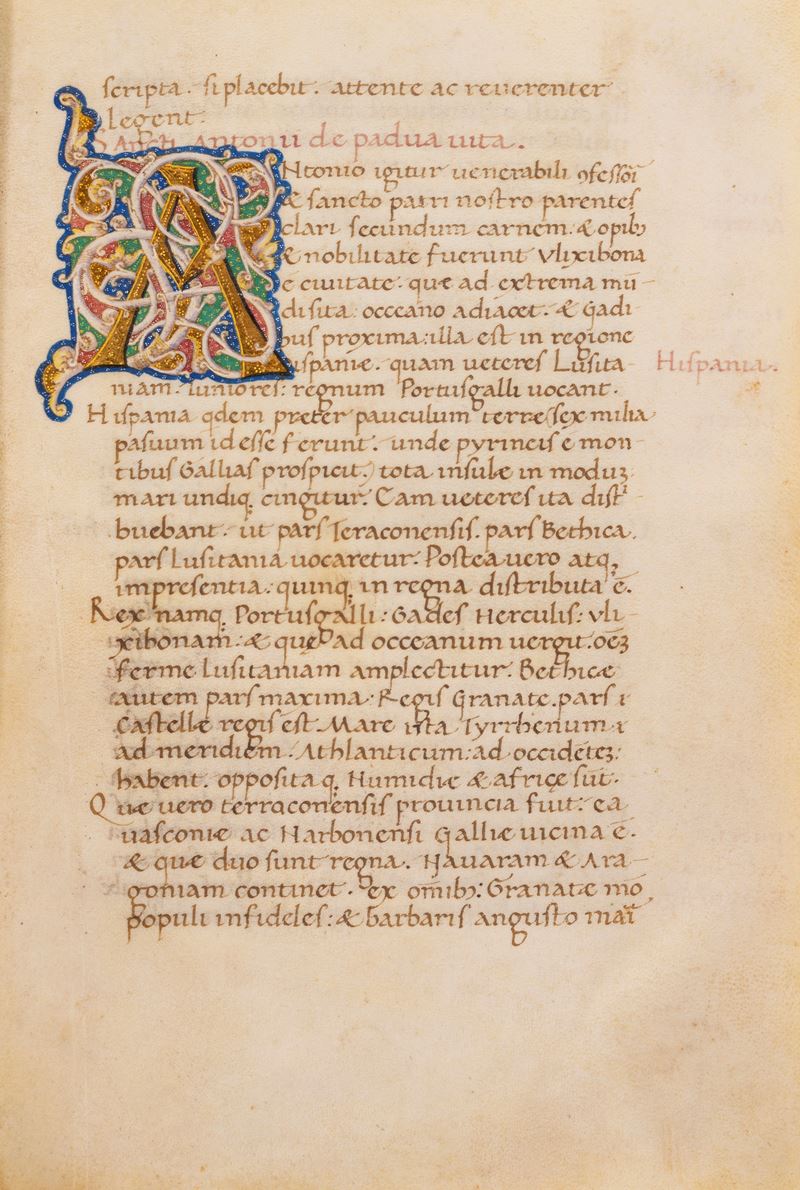
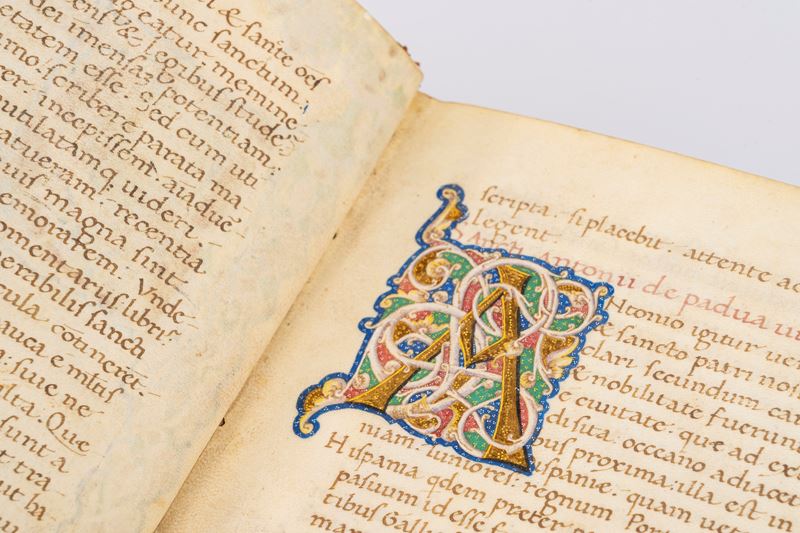
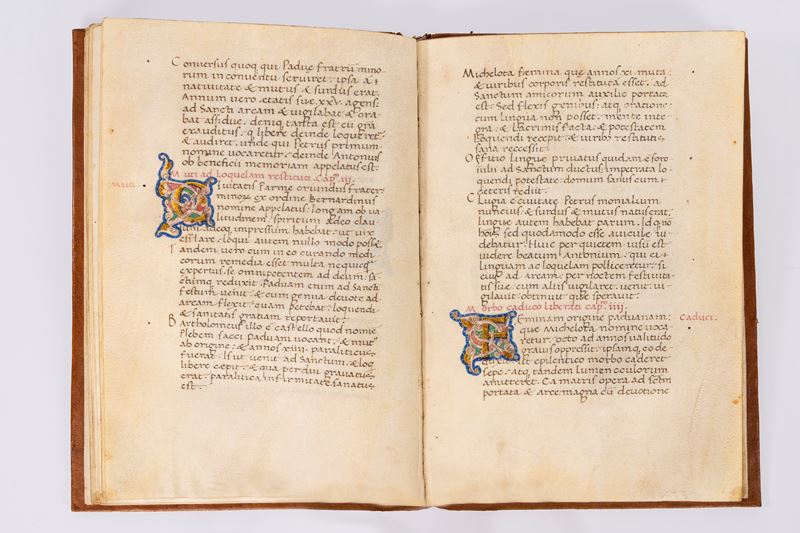
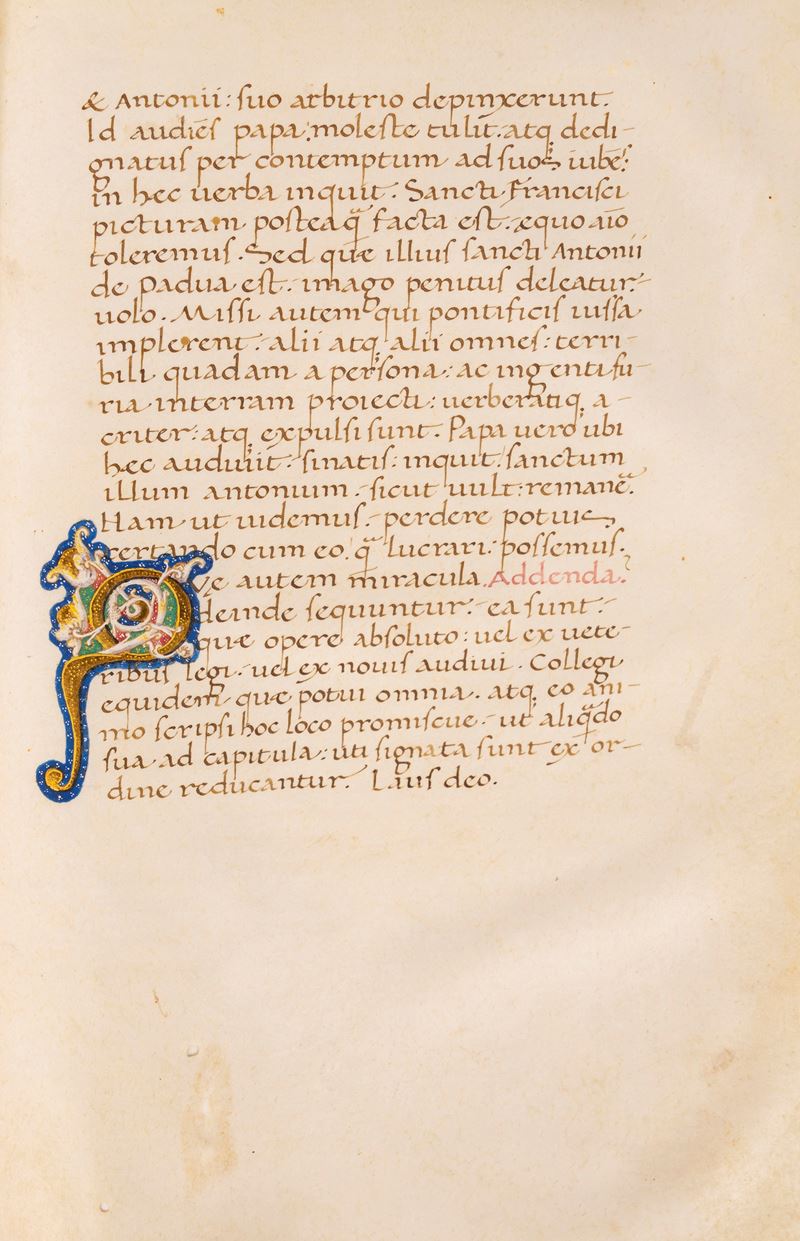
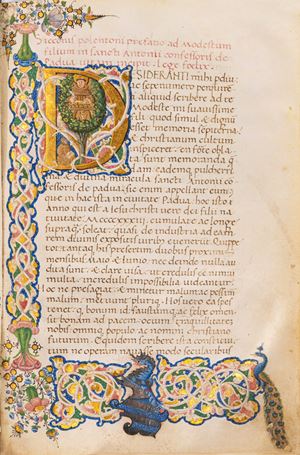
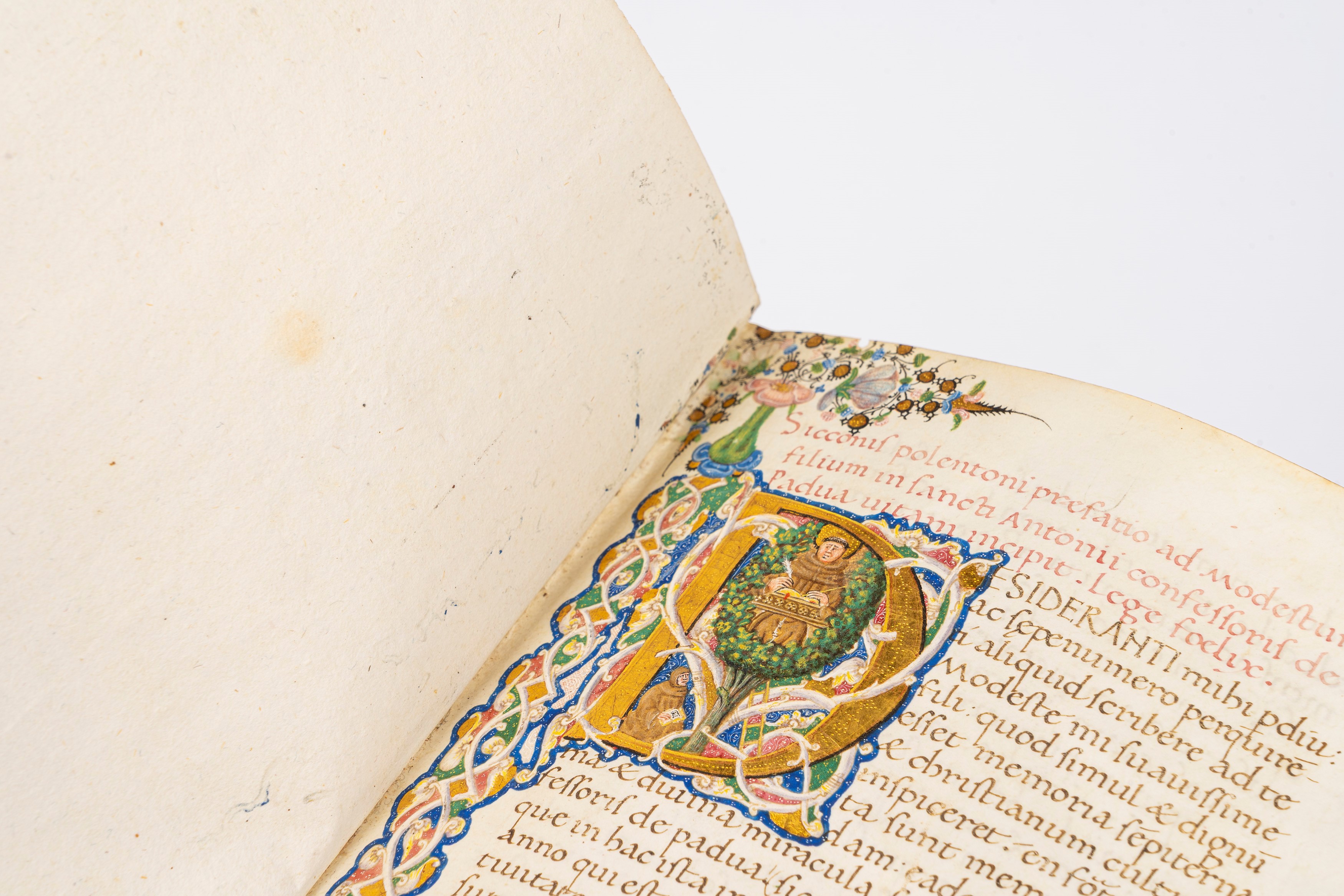
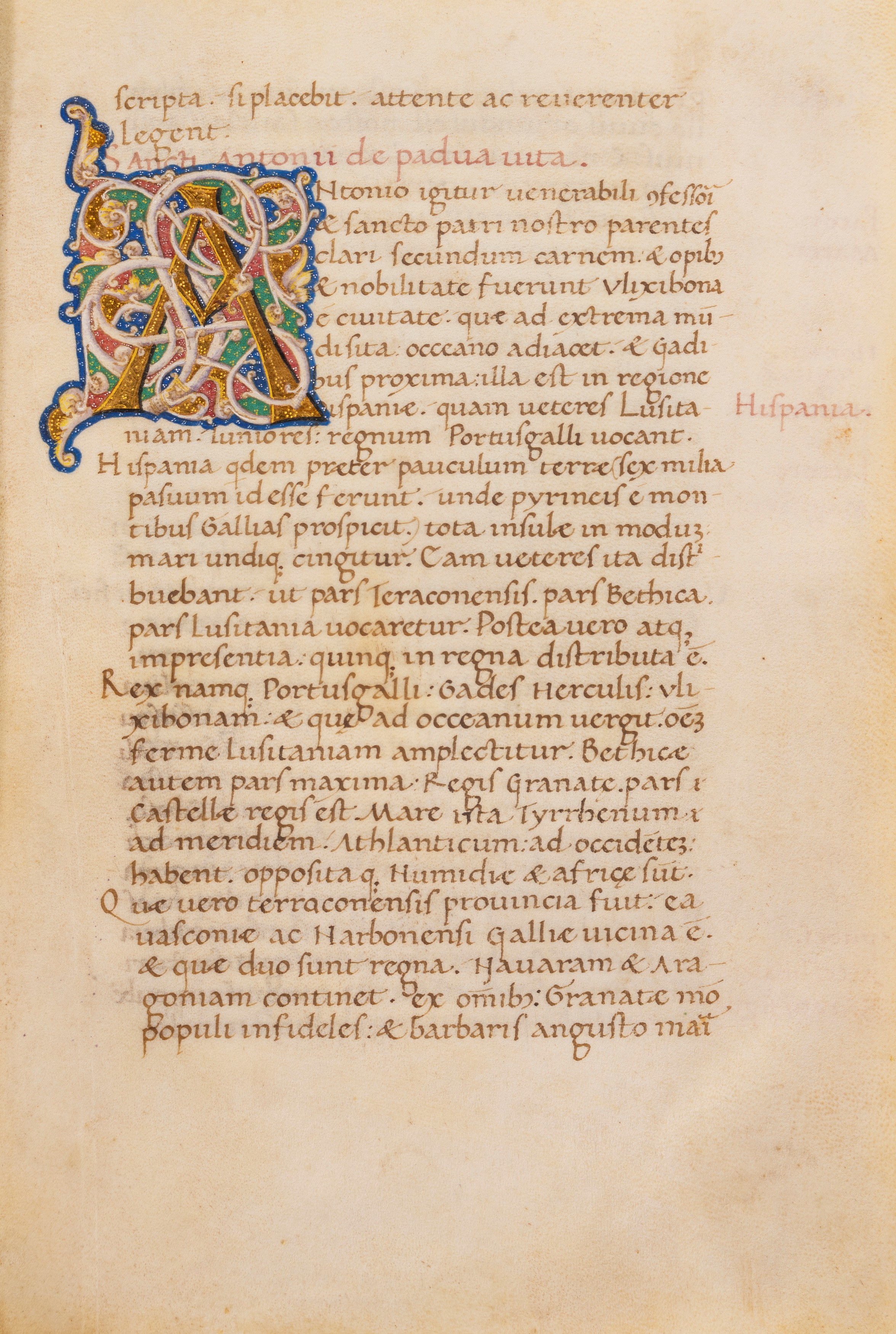
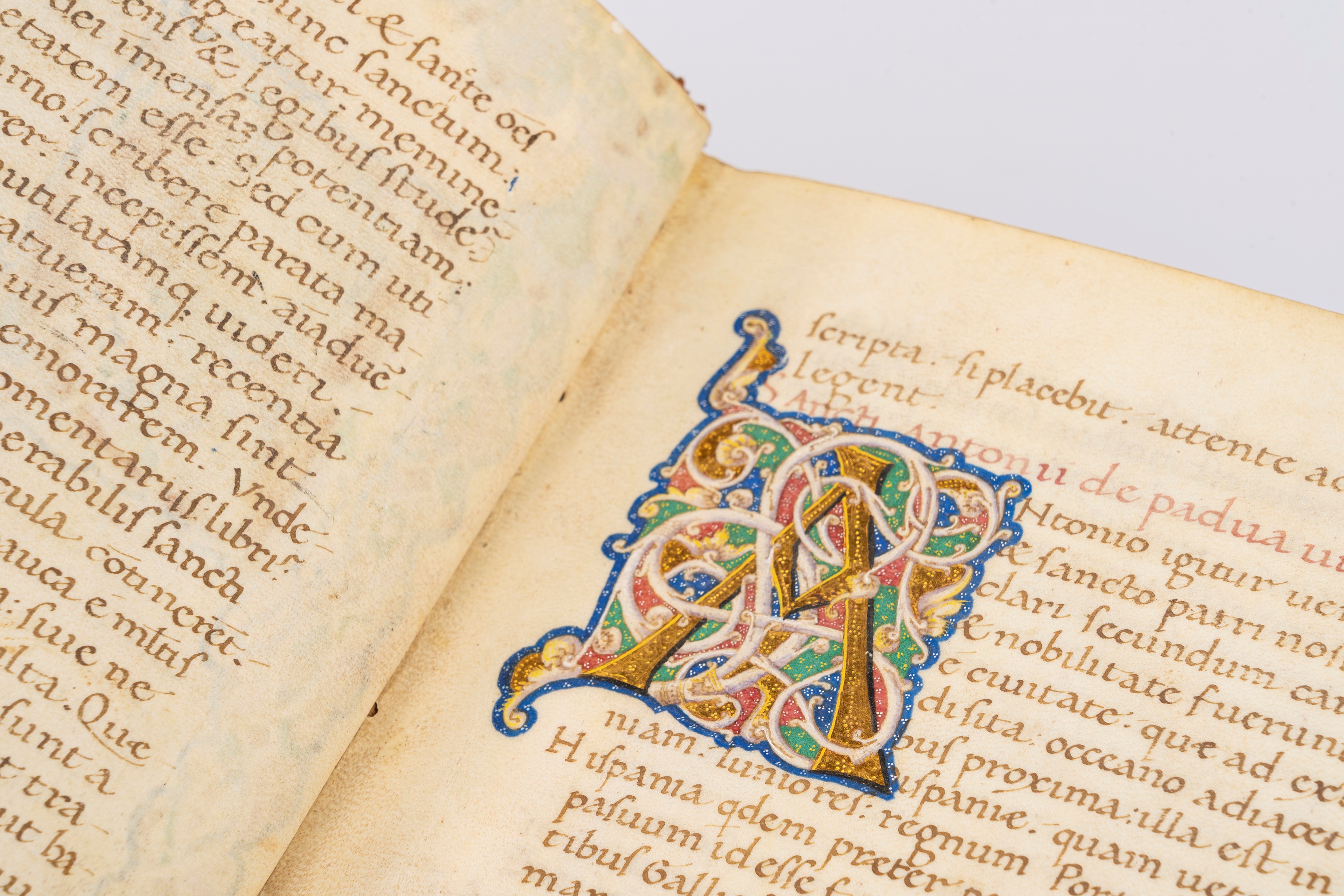
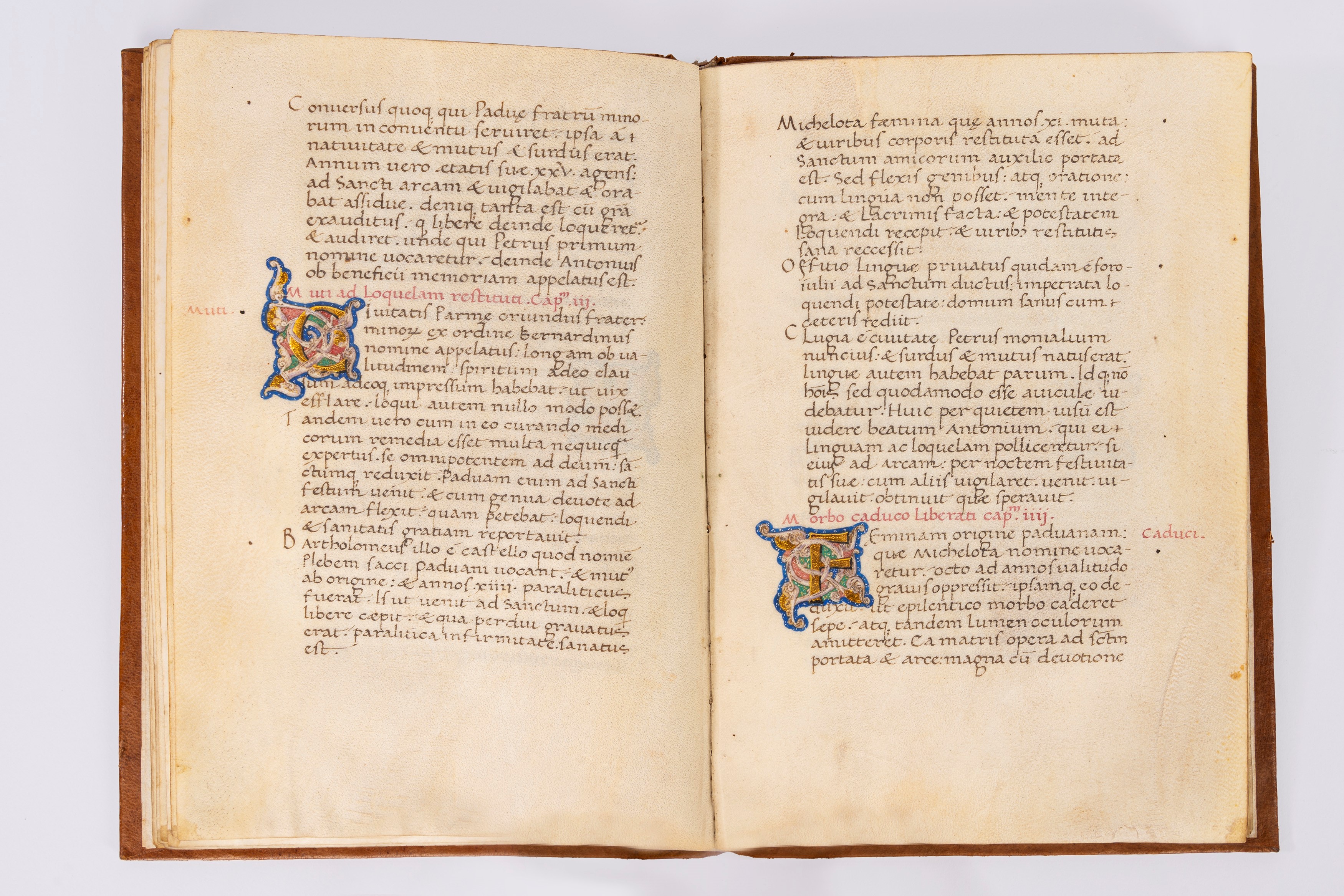
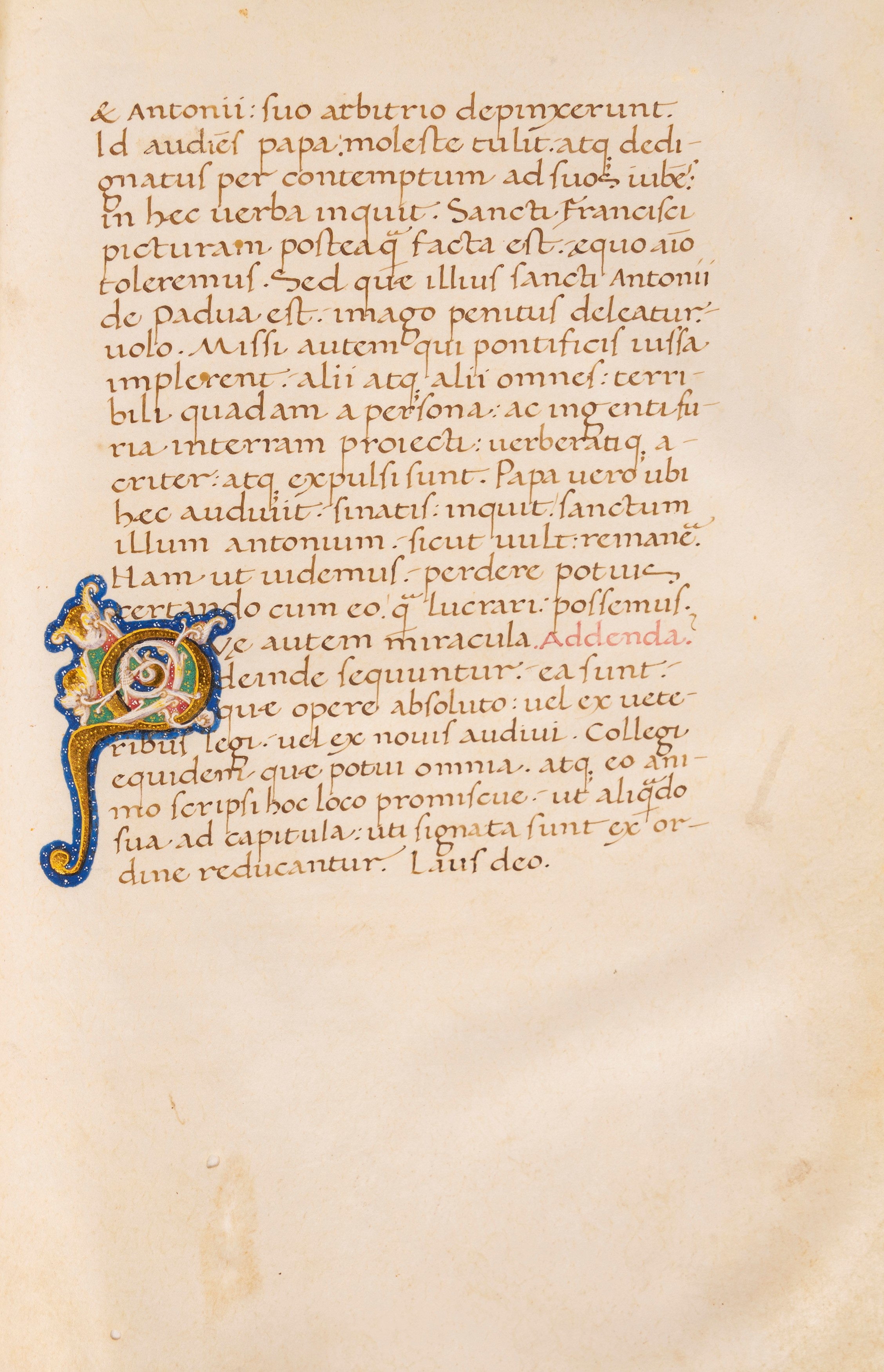
Splendid humanist parchment manuscript written in Padua in the second half of the 15th century , a famous work by Sicco Polenton: on the first leaf, a refined image of Saint Anthony on walnut within the letter D , decorated with gold leaf and white scrolls, at the bottom the coat of arms, probably of the noble Paduan Dondi dell'Orologio family, depicting a blue dragon within a white scroll decoration, and at the bottom right a refined peacock. The codex is composed of 4 quires of 10 leaves each and a final leaf . At the end of each quire is a reference. It measures 215 x 150 mm, decorated with a large initial on the recto of the second leaf (letter A for Anthony, 40 x 40 mm) and 13 small initials in gold, blue, pink, and green. 19th-century full brown leather binding with gold title on the spine, blind stamping on the covers.
Specialist Notes
A splendid example of Paduan proto-humanism .
For comparisons and bibliography, see entry no. 22 by Silvia Fumian in the Splendore della Regola catalogue on illuminated manuscripts at the University Library of Padua . In that case, it is a codex from the Library of Santa Giustina, a major manuscript production centre, where the first hand, Cristoforo Cortese, worked, and a second hand created the bianchi girari initials (those not by Cortese), perhaps a pupil of Cortese who is identical to the illuminator of this codex . The same hand, as stated in the entry, worked on two volumes of Titus Livius studied by Elisabetta Barile, which are now in the St. Gallen Kantonsbibliothek, nos. 306-308, made for the Capodilista family here in Padua, bearing the date 1442. You can find them in E-Codices. Also very interesting is the way in which the gold leaf within the bianchi girari initials was punched. The writing could also be by Michele Salvatico or Nicolò da Salvedia. See also the Oxford codex studied by A. De La Mare (Latin Th. C. 31), formerly of Major Abbey, and by Jonathan Alexander. The iconography of Saint Anthony on the walnut tree is truly original.
I sincerely thank Professor Federica Toniolo for the detailed information she provided on the manuscript.
Sicco Polenton (1375–1476) was an illustrious man of letters, chancellor, and jurist of Paduan origin, who trained under Giovanni Conversini; he is famous for having written the Scriptorum Illustrium Latinae Linguae Libri (the first history of Latin literature) and the humanist comedy Catinia . The relationship between the humanist Sicco Polenton (1375/76 – 1447) and the famous patrician family of the Dondi dall'Orologio developed mainly on two intertwined levels: the institutional-professional one (linked to his public offices in Padua) and the cultural one (linked to the flourishing of Venetian Humanism).
In 1430 he left his work as a notary and chancellor and began working as a lawyer, perhaps because it was more profitable, while he continued his literary studies, writing, between 1433 and 1434, the biographies of the most famous saints and blessed of Padua: St. Anthony, the blessed Antonio Pellegrino and the blessed Elena Enselmini, preserved, for example, in ms. 559 of the Antoniana Library in Padua and in Marc. Lat. IX, 182 (3293) of the Marciana National Library in Venice. The Sancti Antonii confessoris de Padua vita et miracula (published in Padua in 1476) is divided into two parts: the first is dedicated to the life of St. Anthony, the second to the miracles he performed.
For comparisons and bibliography, see entry no. 22 by Silvia Fumian in the Splendore della Regola catalogue on illuminated manuscripts at the University Library of Padua . In that case, it is a codex from the Library of Santa Giustina, a major manuscript production centre, where the first hand, Cristoforo Cortese, worked, and a second hand created the bianchi girari initials (those not by Cortese), perhaps a pupil of Cortese who is identical to the illuminator of this codex . The same hand, as stated in the entry, worked on two volumes of Titus Livius studied by Elisabetta Barile, which are now in the St. Gallen Kantonsbibliothek, nos. 306-308, made for the Capodilista family here in Padua, bearing the date 1442. You can find them in E-Codices. Also very interesting is the way in which the gold leaf within the bianchi girari initials was punched. The writing could also be by Michele Salvatico or Nicolò da Salvedia. See also the Oxford codex studied by A. De La Mare (Latin Th. C. 31), formerly of Major Abbey, and by Jonathan Alexander. The iconography of Saint Anthony on the walnut tree is truly original.
I sincerely thank Professor Federica Toniolo for the detailed information she provided on the manuscript.
Sicco Polenton (1375–1476) was an illustrious man of letters, chancellor, and jurist of Paduan origin, who trained under Giovanni Conversini; he is famous for having written the Scriptorum Illustrium Latinae Linguae Libri (the first history of Latin literature) and the humanist comedy Catinia . The relationship between the humanist Sicco Polenton (1375/76 – 1447) and the famous patrician family of the Dondi dall'Orologio developed mainly on two intertwined levels: the institutional-professional one (linked to his public offices in Padua) and the cultural one (linked to the flourishing of Venetian Humanism).
In 1430 he left his work as a notary and chancellor and began working as a lawyer, perhaps because it was more profitable, while he continued his literary studies, writing, between 1433 and 1434, the biographies of the most famous saints and blessed of Padua: St. Anthony, the blessed Antonio Pellegrino and the blessed Elena Enselmini, preserved, for example, in ms. 559 of the Antoniana Library in Padua and in Marc. Lat. IX, 182 (3293) of the Marciana National Library in Venice. The Sancti Antonii confessoris de Padua vita et miracula (published in Padua in 1476) is divided into two parts: the first is dedicated to the life of St. Anthony, the second to the miracles he performed.
Contact
Suggested lots
Caricamento lotti suggeriti...