
Starting bid
€ 150
Sold
€ 317
The price includes buyer's premium
Do you have a similar item you would like to sell?
Information
in silver
9.32 gr. - Diam. 37.00 mm.
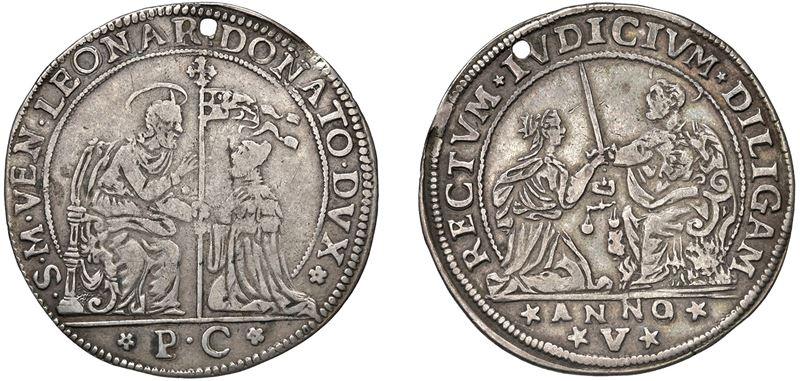
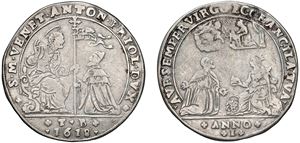
Obverse: Saint Mark seated on a throne, presents the banner to the kneeling Doge, who receives it in his hand. In the exergue are the initials PC (Paolo Contarini, massaro); - Reverse: Saint Mark, flanked by a lion, presents the sword to crowned Justice, holding scales.
9.32 gr. - Diam. 37.00 mm.
Obverse: Saint Mark seated on a throne, presents the banner to the kneeling Doge, who receives it in his hand. In the exergue are the initials PC (Paolo Contarini, massaro); - Reverse: Saint Mark, flanked by a lion, presents the sword to crowned Justice, holding scales.
Montenegro 1112. CNI 166. Paolucci II 93. Very rare.
Drilled.
m.MB.
This fascinating osella was created at a time when Venice was at the center of a fierce conflict with the Church of Rome. The Republic, jealous of its autonomy, had always established that even the clergy should be subject to the laws of the state, a position that had generated increasingly evident friction over time. At the beginning of the 17th century, these tensions translated into a series of measures aimed at limiting ecclesiastical influence: first, state control was imposed on the construction of new religious buildings, then the transfer of goods and wealth to Church entities was blocked.
In Rome, Pope Paul V interpreted these decisions as a direct challenge to his authority. The situation escalated when a Venetian cleric was arrested by civil authorities. The Pontiff reacted firmly, demanding the priest's immediate release and the repeal of laws deemed hostile to the Church. Venice, however, did not back down: indeed, the republican magistrates strengthened their position by arresting a second member of the clergy, accused of serious crimes and behavior incompatible with his role.
This clash marked an unprecedented rupture in relations between the Serenissima and the Papacy. Paul V responded by preparing two official documents addressed to the Doge, in which he reiterated his demands and challenged the Venetian state's right to judge ecclesiastics. However, unforeseen events slowed the confrontation: the death of Doge Marino Grimani forced the delivery of the papal documents to be postponed.
With the accession of Leonardo Donà, a connoisseur of Roman political instability but determined to defend the Republic's independence, the issue was addressed on both a legal and political level. The Venetian government relied on the opinion of Paolo Sarpi, a highly respected friar and scholar, charged with assessing the legitimacy of the papal claims. His conclusions convinced the Senate that Venice had acted in full compliance with its prerogatives.
Rome's response was not long in coming: in April 1606 the Pope issued a solemn decree officially condemning the Republic's attitude, bringing the conflict between civil power and religious authority to its highest point.
Contact
Suggested lots
Caricamento lotti suggeriti...
More Lots
383
Oselle di Venezia
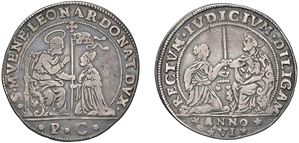
LEONARDO DONA', doge XC (1606-1612) – Osella, year VI, 1611.
Sold € 500
(buyer's premium not included)
384
Oselle di Venezia
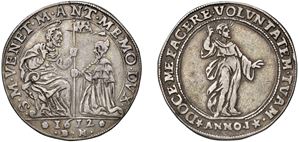
MARC'ANTONIO MEMMO, Doge XCI (1612-1615) – Osella, year I, 1612.
Sold € 700
(buyer's premium not included)
385
Oselle di Venezia
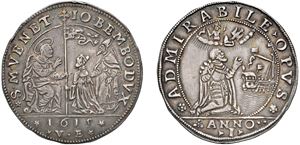
GIOVANNI BEMBO, Doge XCII (1615-1618) – Osella, year I, 1615.
Sold € 3.300
(buyer's premium not included)
386
Oselle di Venezia
ANTONIO PRIULI, Doge XCIV (1618-1623) – Osella, year I, 1618.
Sold € 380
(buyer's premium not included)