Information
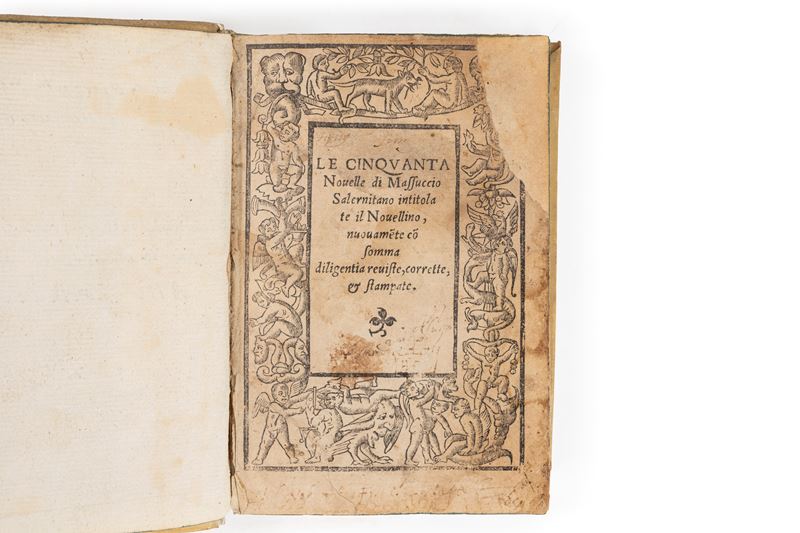
Venice, Melchiorre Sessa, 1531. In 8°. Title page within an elegant woodcut frame decorated with cherubs, animals, plants, etc., part of the upper right corner of the title page missing, restored, damp stains on the first leaves and other sporadic stains, quire EE and leaves F1 and F8 missing, 18th-century full parchment binding, gilt title on a tag on the spine, blue edges. Sporadic annotations by a contemporary hand.
Specialist Notes
EXTREMELY RARE FIRST EDITION OF MASUCCIO'S NOVELLINO
The collection reflects Boccaccio's influence in at least two respects: it opens with a Prologue and closes with a speech by the author, and is composed of five parts, each dedicated to a specific topic and consisting of ten short stories; all the short stories are preceded by an exordium and conclude with a commentary by the author. Unlike the Decameron, the Novellino lacks any exceptional narrative context; there is no real framework. The unifying force among the short stories is the author's judgment. The world of Masuccio's short stories is populated by a diverse cast of characters, but a taste for the macabre and a moralistic tone dominate, always coupled with a scathing invective against the corruption of the clergy. Thus, it was censored and placed on the Index, like the Decameron. It reappeared in 1765 in Lucca, then in Naples in 1874 in an edition edited by the patriot Luigi Settembrini and heavily Florentine.
The collection reflects Boccaccio's influence in at least two respects: it opens with a Prologue and closes with a speech by the author, and is composed of five parts, each dedicated to a specific topic and consisting of ten short stories; all the short stories are preceded by an exordium and conclude with a commentary by the author. Unlike the Decameron, the Novellino lacks any exceptional narrative context; there is no real framework. The unifying force among the short stories is the author's judgment. The world of Masuccio's short stories is populated by a diverse cast of characters, but a taste for the macabre and a moralistic tone dominate, always coupled with a scathing invective against the corruption of the clergy. Thus, it was censored and placed on the Index, like the Decameron. It reappeared in 1765 in Lucca, then in Naples in 1874 in an edition edited by the patriot Luigi Settembrini and heavily Florentine.
Contact
Condition report
To request a Condition Report, please contact libriestampe@finarte.it
The department will provide you with a general report of the condition of the property described above. Please note that what Finarte declares with respect to the state of conservation of the objects corresponds only to a qualified opinion and that we are not professional conservators or restorers.
We urge you to consult with a restorer or conservator of your choice who will be better able to provide a detailed, professional report. We always suggest prospective buyers to inspect each lot to satisfy themselves as to condition during the exhibition days as indicated in the catalog.
Suggested lots
Caricamento lotti suggeriti...
More Lots
![Speech [...] on the medals of the ancients](https://api.finarte.it/api/lotto/immagine/177186/0/300.jpg)
136
Erizzo, Sebastiano
Speech [...] on the medals of the ancients, 1571
Estimate € 400 - 600
Starting bid € 400