
Estimate
€ 2.000 - 3.000
Sold
€ 5.715
The price includes buyer's premium
Do you have a similar item you would like to sell?
Information
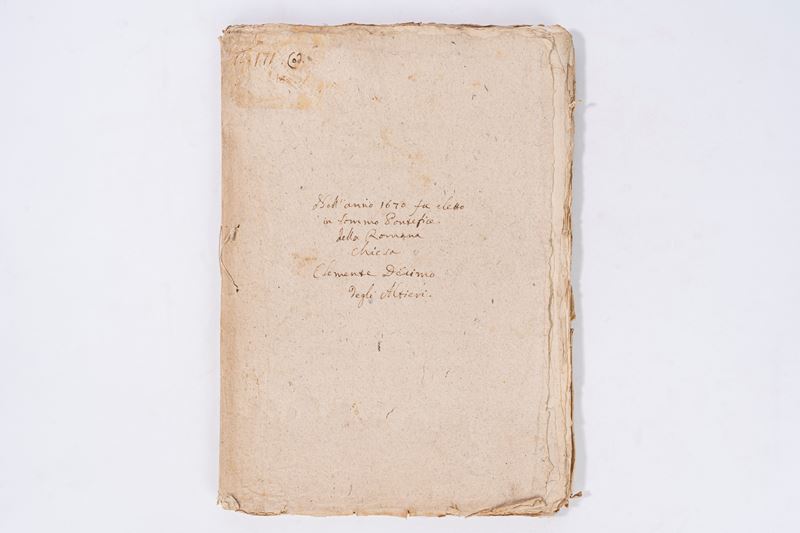
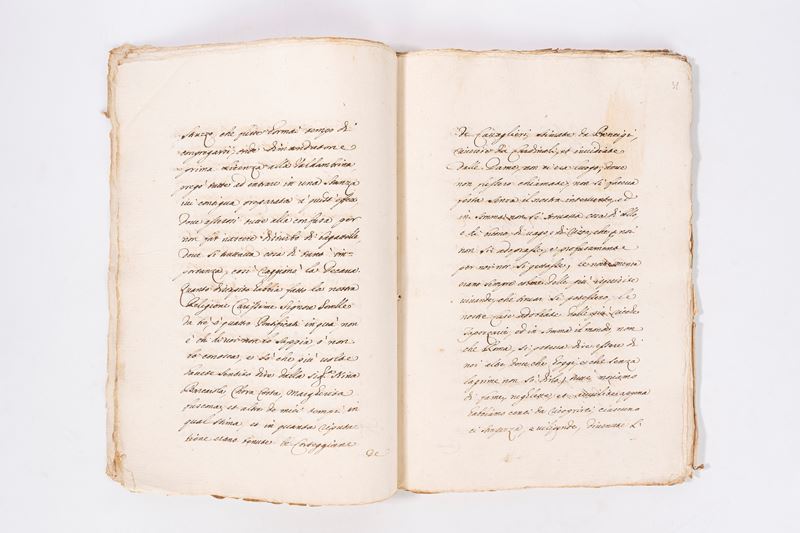
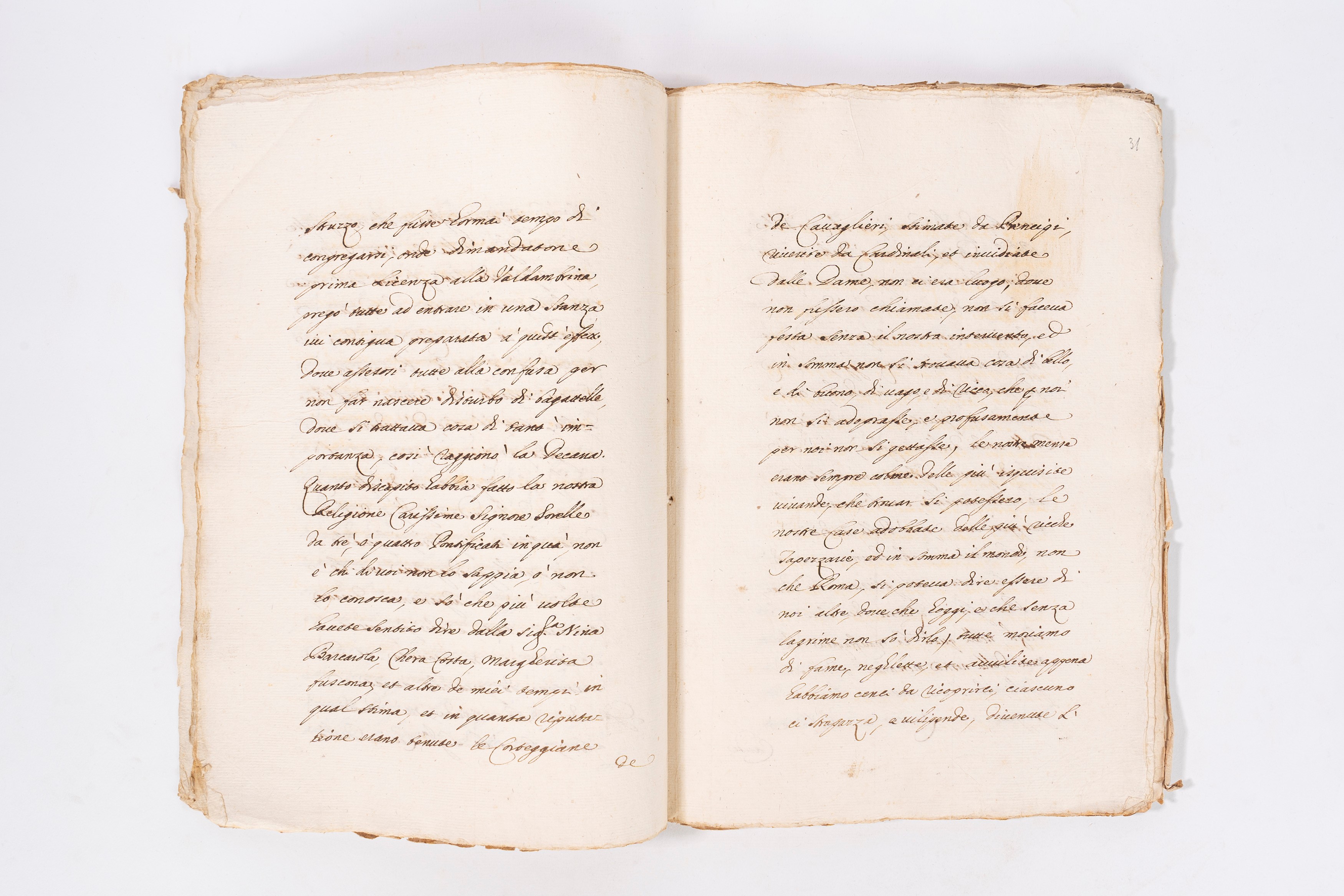
Paper manuscript of 105 unnumbered pages, plus 3 blank pages, 315 x 225 mm., second half of the 17th century, original cardboard cover. Elegant 17th-century chancery with 19 lines per page. The following note appears on the outer cover: "In the year 1670, Clement Decimus degli Altieri was elected Supreme Pontiff of the Roman Church."
Specialist Notes
THE COMPLETE, UNKNOWN AND UNKNOWN, TEXT OF ONE OF THE FAMOUS SATIRICAL TEXTS OF SEVENTEENTH-CENTURY BAROQUE ROME .
Gregorio Leti, Roman Whoredom. Critical edition edited by Danilo Romei, Lulu 2019, p. 8:
"(...) The motif of the whores' conclave was popular and took root in the Roman environment; in fact, it returns with The Congress of the Whores , of which only the First Day is preserved in file F 6424 of the State Archives of Florence. The text provides as a certain dating element the day of the congress ("Friday 17 January" [c. 81r]) and naturally the fact that we are in the time of the conclave. In consideration of this, it can only be the conclave for the death of Pope Clement IX (Giulio Rospigliosi), which occurred on 9 December 1669: the conclave took place from 20 December 1669 to 26 April 1670 (Cardinal Emilio Altieri was elected with the name of Clement X). No other conclave of the late seventeenth century is compatible with the date of 17 January. Therefore the Congress is truly linked, in strict chronological sequence, with the Conclave of women and with Whoredom. Moreover, one only needs to skim the text to see how frequently the same names and the same (or similar) circumstances recur. But the satirical verve has greatly diminished and slips into trivial gossip that after so long must have lost its bite; even the style has settled into a rather depressed colloquialism. The brilliant and scandalous idea of 1665 is becoming normalized into routine writing. But ultimately, the First Day is almost merely a prologue, and perhaps it would be unfair to expect more.
Further on, Romei, in the note to the text, focuses on the Congressional witness, declaring:
The text is preserved in a mutilated state (only the Giorna Prima is present) on pages 79r-90v of file F 6424 (formerly F 6410) in the State Archives of Florence. It is part of a miscellany of writings on curial subjects, some satirical, some simply informative. It occupies exactly one fascicle of 12 leaves (six sheets folded in two). It is written in a handwriting that is not easily datable (late 17th century?).
In reality, this manuscript reports the lesson of the second day, UNPUBLISHED AND UNKNOWN , which begins on p. 41 and concludes with the end of the text on p. 105. A manuscript to be studied in its entirety.
Gregorio Leti, Roman Whoredom. Critical edition edited by Danilo Romei, Lulu 2019, p. 8:
"(...) The motif of the whores' conclave was popular and took root in the Roman environment; in fact, it returns with The Congress of the Whores , of which only the First Day is preserved in file F 6424 of the State Archives of Florence. The text provides as a certain dating element the day of the congress ("Friday 17 January" [c. 81r]) and naturally the fact that we are in the time of the conclave. In consideration of this, it can only be the conclave for the death of Pope Clement IX (Giulio Rospigliosi), which occurred on 9 December 1669: the conclave took place from 20 December 1669 to 26 April 1670 (Cardinal Emilio Altieri was elected with the name of Clement X). No other conclave of the late seventeenth century is compatible with the date of 17 January. Therefore the Congress is truly linked, in strict chronological sequence, with the Conclave of women and with Whoredom. Moreover, one only needs to skim the text to see how frequently the same names and the same (or similar) circumstances recur. But the satirical verve has greatly diminished and slips into trivial gossip that after so long must have lost its bite; even the style has settled into a rather depressed colloquialism. The brilliant and scandalous idea of 1665 is becoming normalized into routine writing. But ultimately, the First Day is almost merely a prologue, and perhaps it would be unfair to expect more.
Further on, Romei, in the note to the text, focuses on the Congressional witness, declaring:
The text is preserved in a mutilated state (only the Giorna Prima is present) on pages 79r-90v of file F 6424 (formerly F 6410) in the State Archives of Florence. It is part of a miscellany of writings on curial subjects, some satirical, some simply informative. It occupies exactly one fascicle of 12 leaves (six sheets folded in two). It is written in a handwriting that is not easily datable (late 17th century?).
In reality, this manuscript reports the lesson of the second day, UNPUBLISHED AND UNKNOWN , which begins on p. 41 and concludes with the end of the text on p. 105. A manuscript to be studied in its entirety.
Contact
Suggested lots
Caricamento lotti suggeriti...
![Synonymies [Liber de definitionibus]- Orationes](https://api.finarte.it/api/lotto/immagine/196624/0/300.jpg)
![Of Our Lady's Office [Book of Hours]](https://api.finarte.it/api/lotto/immagine/196558/0/300.jpg)