Estimate
€ 5.000 - 7.000
Sold
€ 6.985
The price includes buyer's premium
Do you have a similar item you would like to sell?
Information
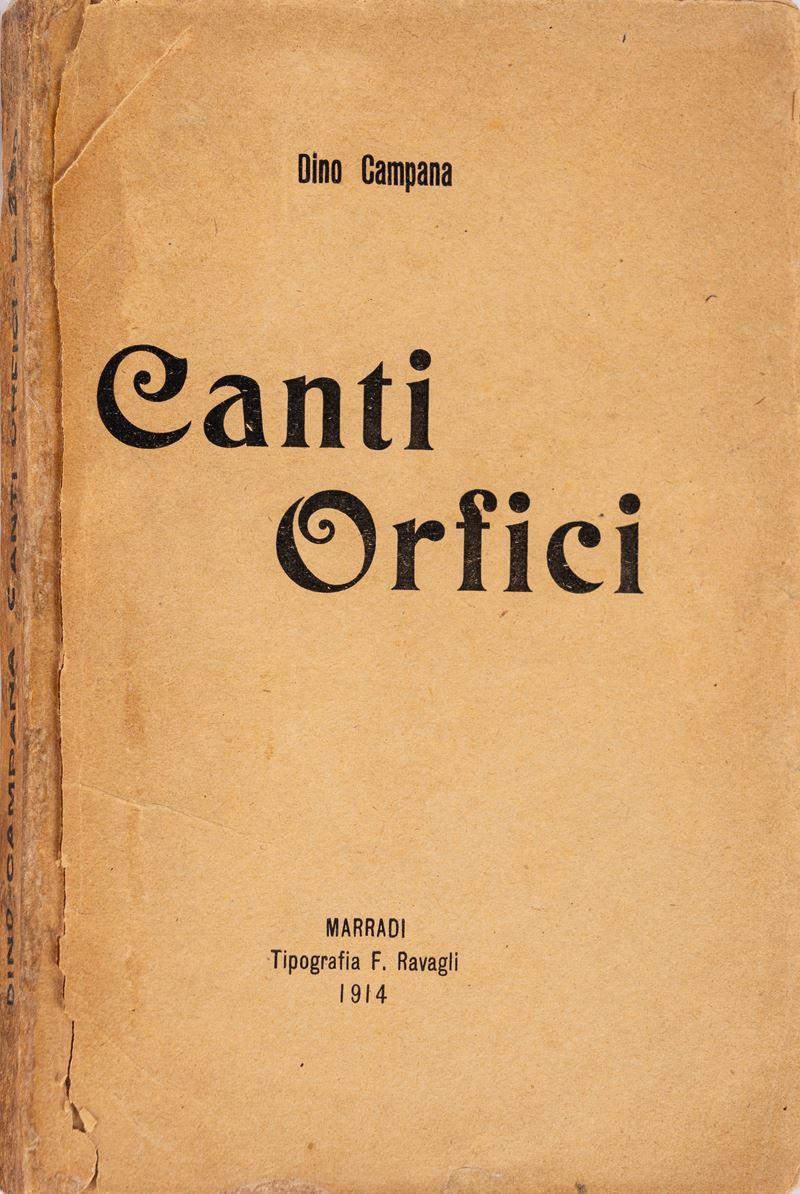
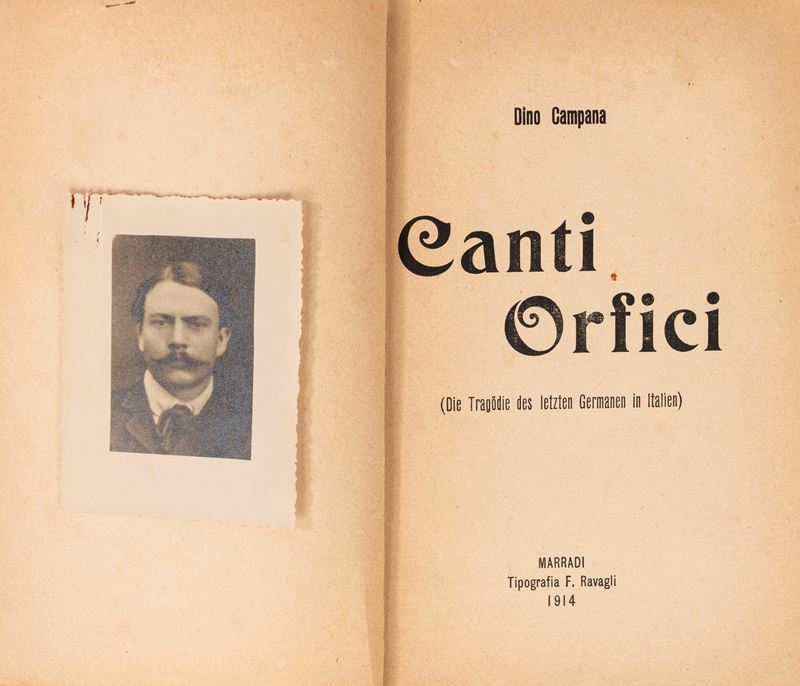
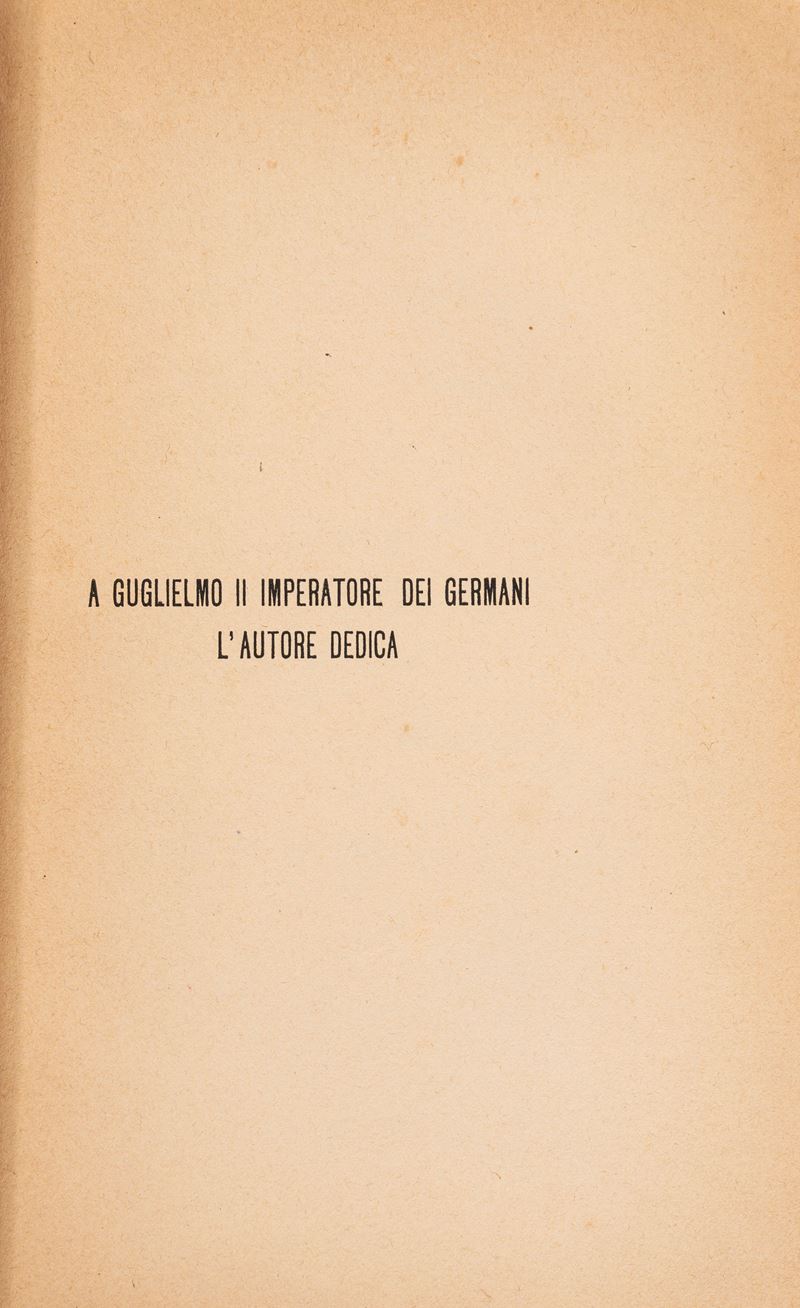
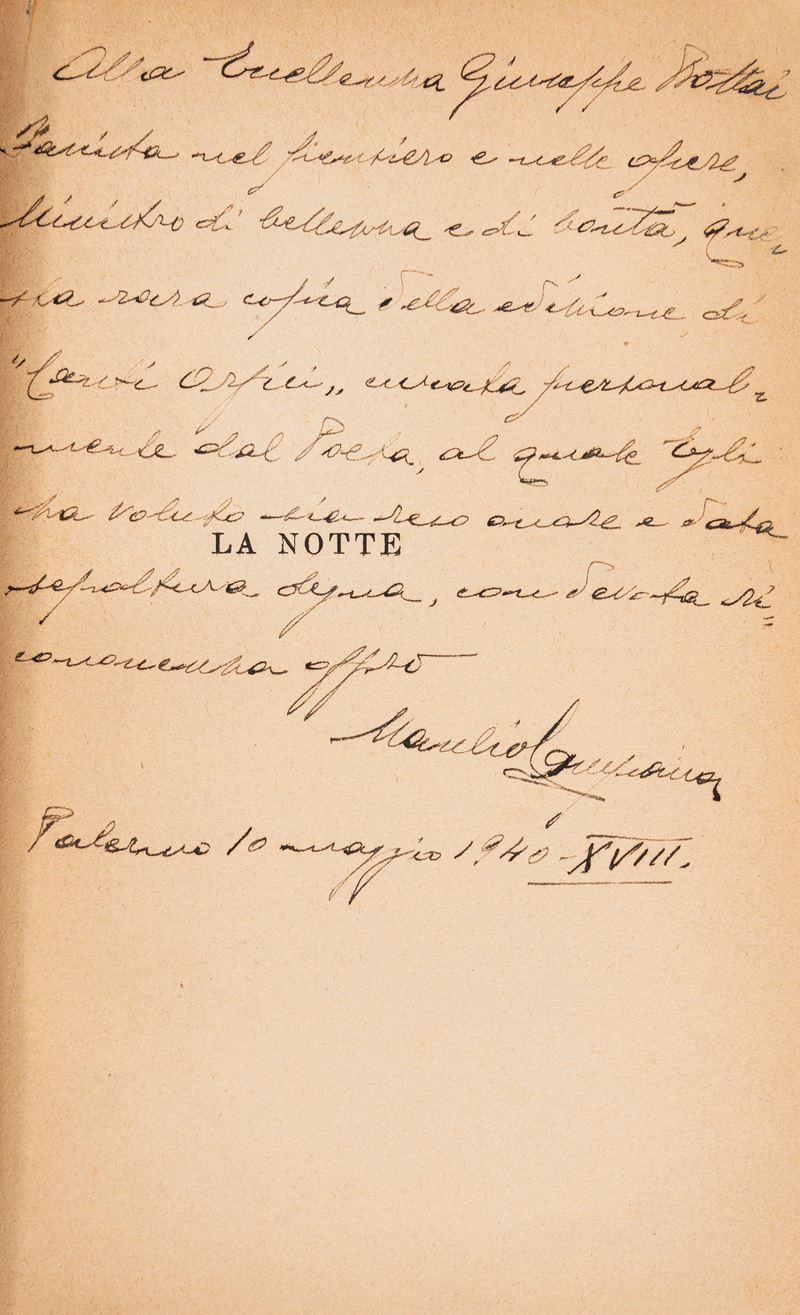
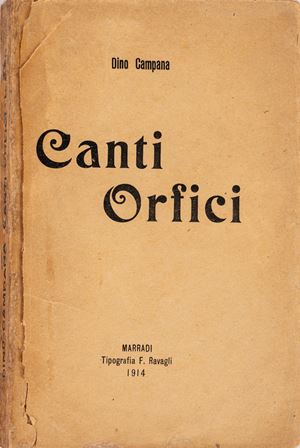
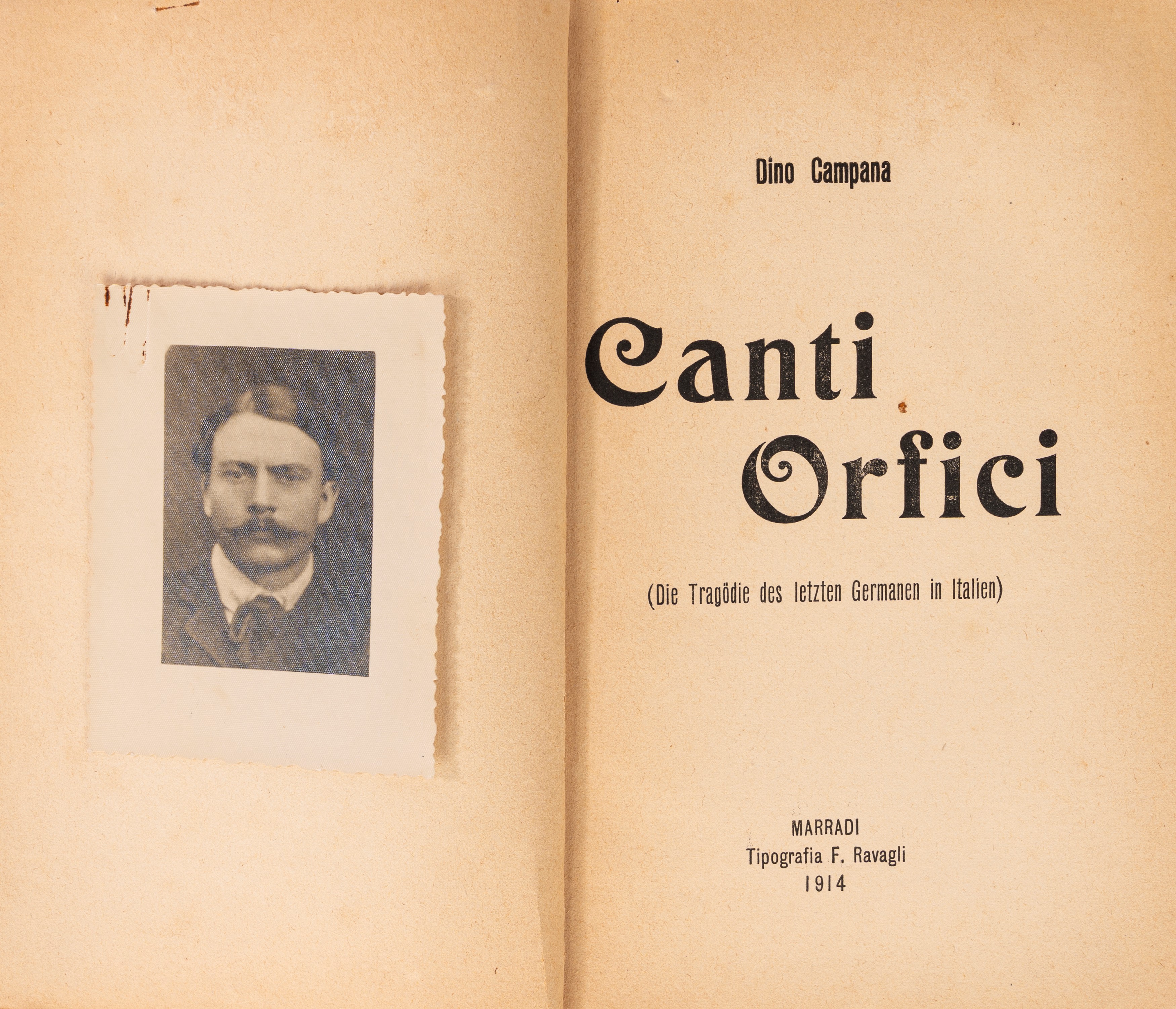
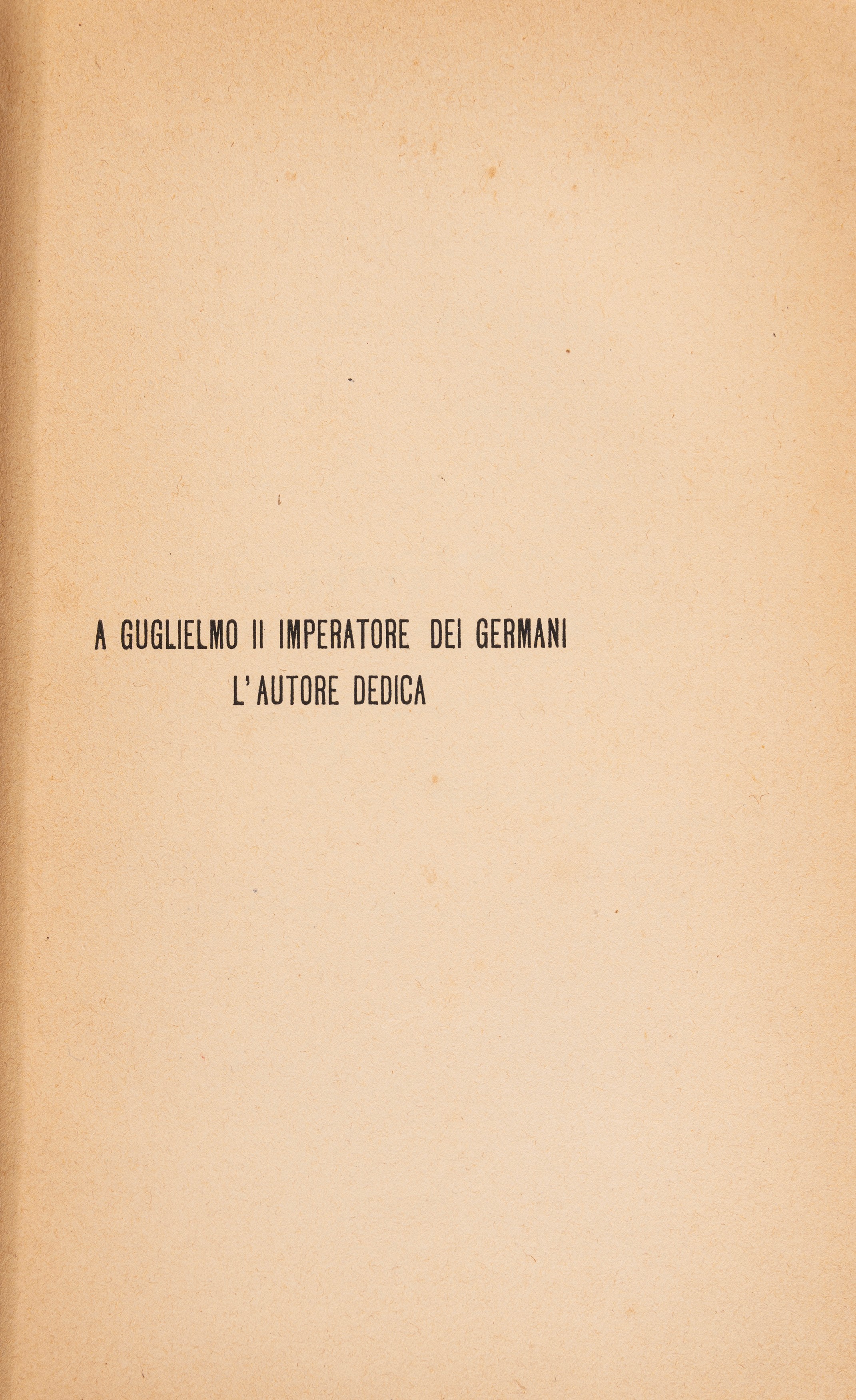
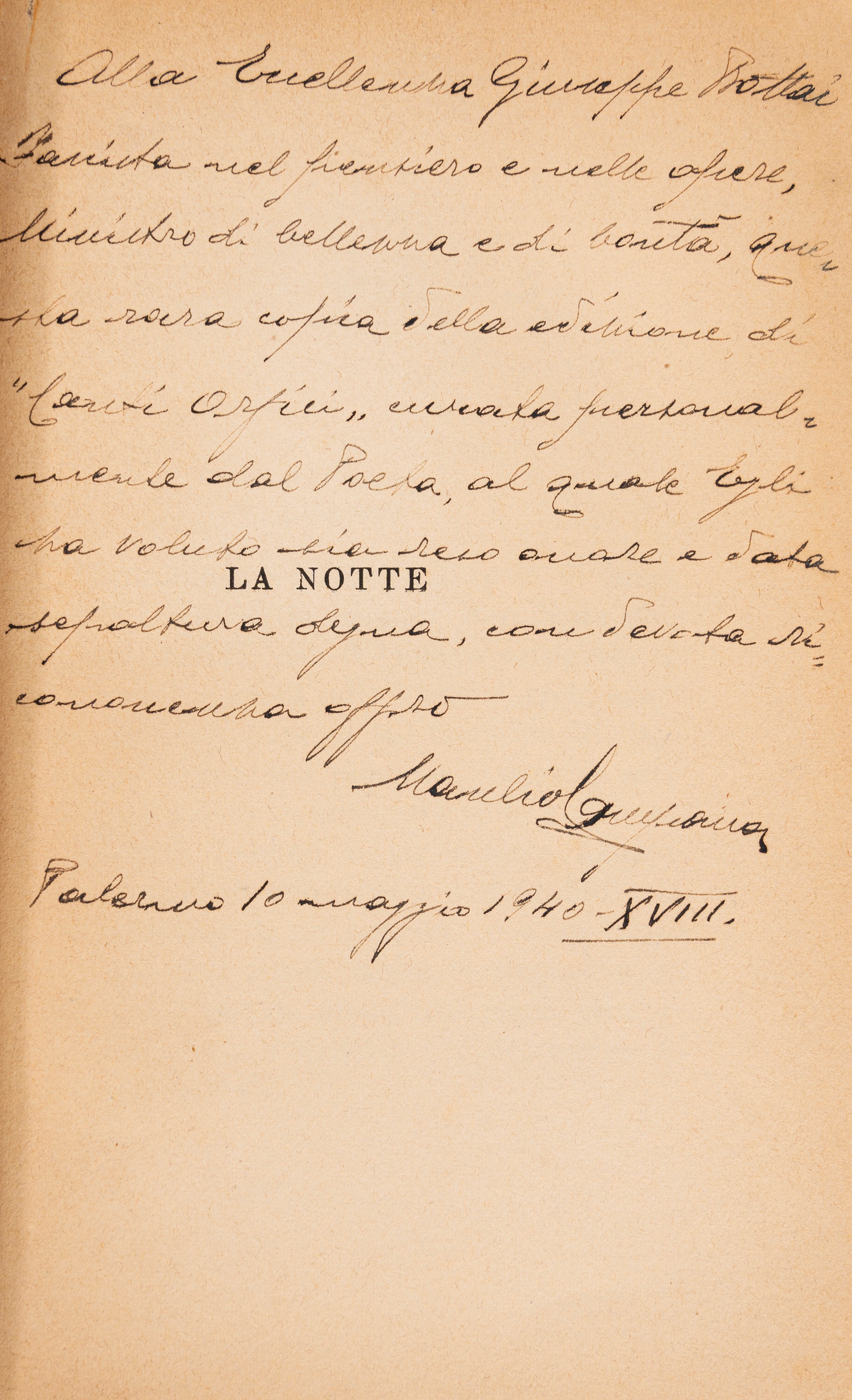
Marradi, Tipografia F. Ravagli, 1914. [2] 173 [1] pp. Size 195 x 125 mm. Present is both the dedication page to Kaiser Wilhelm II of Prussia, as well as the title page, where the words “Die Tragödie des letzten Germanen in Italien” appear. The front cover is detached but without losses, restorations on the spine. Overall, an excellent copy. Beautiful dedication to Giuseppe Bottai on the paper bearing the title "La Notte": "To His Excellency Giuseppe Bottai, Fascist in thought and in works. Minister of beauty and goodness, this rare copy of the edition of "Canti Orfici" sent personally by the Poet, to whom He wished to be honoured and given a worthy burial, with devout gratitude I offer Manlio Campana. Palermo, 10 May 1940 - XVIII." Enclosed portrait photo of the poet , 88 x 67 mm., with certification on the back: "Dino Campana poet in his year of grace 1912 - Manlio Campana".
Specialist Notes
THE INCUNABULUM OF TWENTIETH CENTURY POETRY, A COPY WITH DEDICATION
"Along the ridge of a deracinement from reality that grew between anxieties that would lead to escape and isolation in the name of a tragic authenticity, in March 1916 Dino Campana addressed to Emilio Cecchi the clear recollection of the wanderings of the manuscript which, under the title Il più lungo giorno , collected the primitive draft of the Canti Orfici. Delivered by the poet to Giovanni Papini on 12 December 1913 for a possible, and obviously partial, publication in «Lacerba», Il più lungo giorno was given by Papini to Ardengo Soffici and lost by the latter through «negligence» and indifference. «in the great upheaval» of a move: «When winter came [1913] I went to Acerba in Florence to visit Papini, whom I knew by name. He asked for my manuscript (that was all I had) and returned it to me the next day and in a café he told me that it wasn't all he had expected (?) but it was very, very good and he invited me to the red jackets for the evening. I was a poor, exhausted, dejected wretch dressed as a peasant with long hair and I spoke too well and was sometimes silent. Costetti has my portrait from that time in Florence. This went on for three or four days then Papini told me to give him back the manuscript and other things I had, and he would print it in Acerba. But he didn't print it. I left with no money left (I was sleeping at the night shelter and it was the day they were acting as prostitutes on stage at the Futurist evening, earning five or six thousand lire) and then I learned that the manuscript had passed into Soffici's hands. I wrote five or six times in vain to get it and decided to rewrite it from memory, vowing to take revenge if I lived. Those cops did so because they knew I was under close surveillance and anything was permitted against me. The police followed me and had me insulted wherever I went, and Papini and Soffici became accomplices of the murderers while I, full of trust, entrusted to them what was the only justification for my existence" (LPD, pp. 130-133 and 137-140). From here, from the rituals and wickedness of the literary clique and the "dear jackals of the Florentine dome," begins the myth of the loss of the "old notebook covered in rough and dirty paper," destined to become the emblem of a poetic truth derided and exiled in the world. Mario Luzi reported the discovery of the legendary notebook in the house in Poggio a Caiano by Soffici's daughter, Valeria, in the "Corriere della Sera" of June 17, 1971 ( An exceptional discovery among Soffici's papers. Dino Campana's notebook, p. 12; now, in the important monograph Desire for truth and other unpublished and rare writings, edited by Eugenio De Signoribus, Enrico Capodaglio, and Feliciano Paoli, with a foreword by Stefano Verdino, in "istmi", 33, 2014, pp. 82-84). Franco Contorbia, starting in 1981, raised several doubts regarding the circumstances surrounding the discovery of Campana's autograph, likely discovered by Soffici around 1953 (or even earlier?) and hidden for unfathomable reasons of expediency. This was expressed in his never-published paper, "The Longest Day": A Lost Manuscript?", delivered on Saturday, October 3, during the XXXII Conference on Romagnoli Studies (Marradi, October 3-4, 10-11), and revisited, with some variations, at the conferences "Liguria for Dino Campana. The Journey, the Mystery, the Sea, the Mediterranean" (Genoa-La Spezia, June 11-12-13, 1992) and "O Poetry You Will Never Return. Modern Campana" (Macerata, October 25-26, 2002). In fact, already in the chapter Dino Campana in Florence of the Ricordi di vita artistica e letteraria (Florence, Vallecchi, 1931, pp. 109-129), which first appeared in the «Gazzetta del Popolo» on 16 and 30 October 1930, Soffici precisely referred to the «scrapbook written in all verses, where on the same stained and crumpled page one could see passages of songs, travel notes and ancient arithmetic operations erased», just as, in a «private testimony» given to Enrico Falqui twenty years later, only a prodigious memory could have supported him in recalling with precision the two epigraphs from Nietzsche and Gide placed by Campana «on the front of a manuscript of the Canti Orfici» ( For a history of the relationship between Nietzsche and Campana , in Galleria degli scrittori italiani. Dino Campana, edited by Mario Costanzo and Luigi Capelli, in «La Fiera» literary», VIII, 24, June 14, 1953, p. 5; now, under the title Dino Campana. In the showcase with Nietzsche, in Novecento letterario. Fourth series, Florence, Vallecchi, 1954, pp. 88-97). Gabriel Cacho Millet would have reached the same conclusions as Contorbia in the article The Campana manuscript: lost, rediscovered and sold («Wuz», III, 3, May-June 2004, p. 37), supported by a previous testimony by Luigi Cavallo who had already glimpsed the manuscript in 1965 among the papers of Soffici, who died in Vittoria Apuana on 19 August 1964 (How in '65 I found the lost copy among Soffici's papers in Poggio a Caiano, in «il Giornale», 13 September 2002, p. 29). The Longest Day was exhibited in March 1973 at the Gabinetto Vieusseux during the bio-bibliographical exhibition on Dino Campana, curated by Maura Del Serra, and twelve years later in the Municipal Council Hall of Marradi on the occasion of the centenary of the poet's birth. It then reappeared in Rome at Christie's in 2004, after being inaccessible for thirty years, and was purchased for €213,425 by the Ente Cassa di Risparmio di Firenze, which ultimately entrusted it to the Biblioteca Marucelliana. In 1973, it was published in a critical edition (with a facsimile reproduction) by Domenico De Robertis, with a preface by Enrico Falqui (Rome-Florence, Archivi Arte e cultura dell'età moderna in agreement with Vallecchi, 1973); Stefano Giovannuzzi recently published a new edition (Florence, Le Càriti, 2004), "revised and corrected" in 2011. Since 2006, the Marucelliana Library has made the manuscript available for digital consultation online. (Francesca Castellano. THE LONGEST DAY: A SHORT STORY OF A LOST AND FOUND MANUSCRIPT . on campanadino.it).
For the publishing history of the Canti Orfici and a census of the copies, see in particular: Maini-Scapecchi, I Need to Be Printed. A Twentieth-Century Incunabulum: Dino Campana's 'Canti Orfici'. Part One: Printing - Part Two: The Copies, in Rara Volumina, nos. 2/1995 and 2/1996.
"Along the ridge of a deracinement from reality that grew between anxieties that would lead to escape and isolation in the name of a tragic authenticity, in March 1916 Dino Campana addressed to Emilio Cecchi the clear recollection of the wanderings of the manuscript which, under the title Il più lungo giorno , collected the primitive draft of the Canti Orfici. Delivered by the poet to Giovanni Papini on 12 December 1913 for a possible, and obviously partial, publication in «Lacerba», Il più lungo giorno was given by Papini to Ardengo Soffici and lost by the latter through «negligence» and indifference. «in the great upheaval» of a move: «When winter came [1913] I went to Acerba in Florence to visit Papini, whom I knew by name. He asked for my manuscript (that was all I had) and returned it to me the next day and in a café he told me that it wasn't all he had expected (?) but it was very, very good and he invited me to the red jackets for the evening. I was a poor, exhausted, dejected wretch dressed as a peasant with long hair and I spoke too well and was sometimes silent. Costetti has my portrait from that time in Florence. This went on for three or four days then Papini told me to give him back the manuscript and other things I had, and he would print it in Acerba. But he didn't print it. I left with no money left (I was sleeping at the night shelter and it was the day they were acting as prostitutes on stage at the Futurist evening, earning five or six thousand lire) and then I learned that the manuscript had passed into Soffici's hands. I wrote five or six times in vain to get it and decided to rewrite it from memory, vowing to take revenge if I lived. Those cops did so because they knew I was under close surveillance and anything was permitted against me. The police followed me and had me insulted wherever I went, and Papini and Soffici became accomplices of the murderers while I, full of trust, entrusted to them what was the only justification for my existence" (LPD, pp. 130-133 and 137-140). From here, from the rituals and wickedness of the literary clique and the "dear jackals of the Florentine dome," begins the myth of the loss of the "old notebook covered in rough and dirty paper," destined to become the emblem of a poetic truth derided and exiled in the world. Mario Luzi reported the discovery of the legendary notebook in the house in Poggio a Caiano by Soffici's daughter, Valeria, in the "Corriere della Sera" of June 17, 1971 ( An exceptional discovery among Soffici's papers. Dino Campana's notebook, p. 12; now, in the important monograph Desire for truth and other unpublished and rare writings, edited by Eugenio De Signoribus, Enrico Capodaglio, and Feliciano Paoli, with a foreword by Stefano Verdino, in "istmi", 33, 2014, pp. 82-84). Franco Contorbia, starting in 1981, raised several doubts regarding the circumstances surrounding the discovery of Campana's autograph, likely discovered by Soffici around 1953 (or even earlier?) and hidden for unfathomable reasons of expediency. This was expressed in his never-published paper, "The Longest Day": A Lost Manuscript?", delivered on Saturday, October 3, during the XXXII Conference on Romagnoli Studies (Marradi, October 3-4, 10-11), and revisited, with some variations, at the conferences "Liguria for Dino Campana. The Journey, the Mystery, the Sea, the Mediterranean" (Genoa-La Spezia, June 11-12-13, 1992) and "O Poetry You Will Never Return. Modern Campana" (Macerata, October 25-26, 2002). In fact, already in the chapter Dino Campana in Florence of the Ricordi di vita artistica e letteraria (Florence, Vallecchi, 1931, pp. 109-129), which first appeared in the «Gazzetta del Popolo» on 16 and 30 October 1930, Soffici precisely referred to the «scrapbook written in all verses, where on the same stained and crumpled page one could see passages of songs, travel notes and ancient arithmetic operations erased», just as, in a «private testimony» given to Enrico Falqui twenty years later, only a prodigious memory could have supported him in recalling with precision the two epigraphs from Nietzsche and Gide placed by Campana «on the front of a manuscript of the Canti Orfici» ( For a history of the relationship between Nietzsche and Campana , in Galleria degli scrittori italiani. Dino Campana, edited by Mario Costanzo and Luigi Capelli, in «La Fiera» literary», VIII, 24, June 14, 1953, p. 5; now, under the title Dino Campana. In the showcase with Nietzsche, in Novecento letterario. Fourth series, Florence, Vallecchi, 1954, pp. 88-97). Gabriel Cacho Millet would have reached the same conclusions as Contorbia in the article The Campana manuscript: lost, rediscovered and sold («Wuz», III, 3, May-June 2004, p. 37), supported by a previous testimony by Luigi Cavallo who had already glimpsed the manuscript in 1965 among the papers of Soffici, who died in Vittoria Apuana on 19 August 1964 (How in '65 I found the lost copy among Soffici's papers in Poggio a Caiano, in «il Giornale», 13 September 2002, p. 29). The Longest Day was exhibited in March 1973 at the Gabinetto Vieusseux during the bio-bibliographical exhibition on Dino Campana, curated by Maura Del Serra, and twelve years later in the Municipal Council Hall of Marradi on the occasion of the centenary of the poet's birth. It then reappeared in Rome at Christie's in 2004, after being inaccessible for thirty years, and was purchased for €213,425 by the Ente Cassa di Risparmio di Firenze, which ultimately entrusted it to the Biblioteca Marucelliana. In 1973, it was published in a critical edition (with a facsimile reproduction) by Domenico De Robertis, with a preface by Enrico Falqui (Rome-Florence, Archivi Arte e cultura dell'età moderna in agreement with Vallecchi, 1973); Stefano Giovannuzzi recently published a new edition (Florence, Le Càriti, 2004), "revised and corrected" in 2011. Since 2006, the Marucelliana Library has made the manuscript available for digital consultation online. (Francesca Castellano. THE LONGEST DAY: A SHORT STORY OF A LOST AND FOUND MANUSCRIPT . on campanadino.it).
For the publishing history of the Canti Orfici and a census of the copies, see in particular: Maini-Scapecchi, I Need to Be Printed. A Twentieth-Century Incunabulum: Dino Campana's 'Canti Orfici'. Part One: Printing - Part Two: The Copies, in Rara Volumina, nos. 2/1995 and 2/1996.
Contact
Suggested lots
Caricamento lotti suggeriti...
More Lots
239
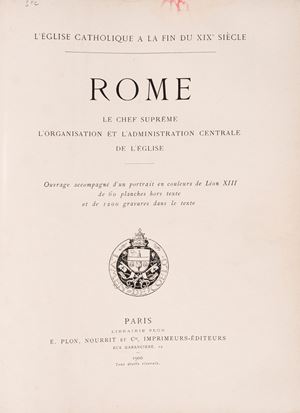
Rome le Chef Suprême. Central organization and administration of the church, 1900
Estimate € 60 - 150
Starting bid € 60
240
D'Annunzio, Gabriele
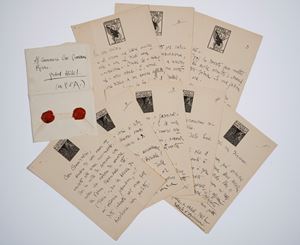
Correspondence between Gabriele d'Annunzio and Giovanni Rizzo, 83 letters, 1923
Estimate € 20.000 - 22.000
Starting bid € 20.000