Information
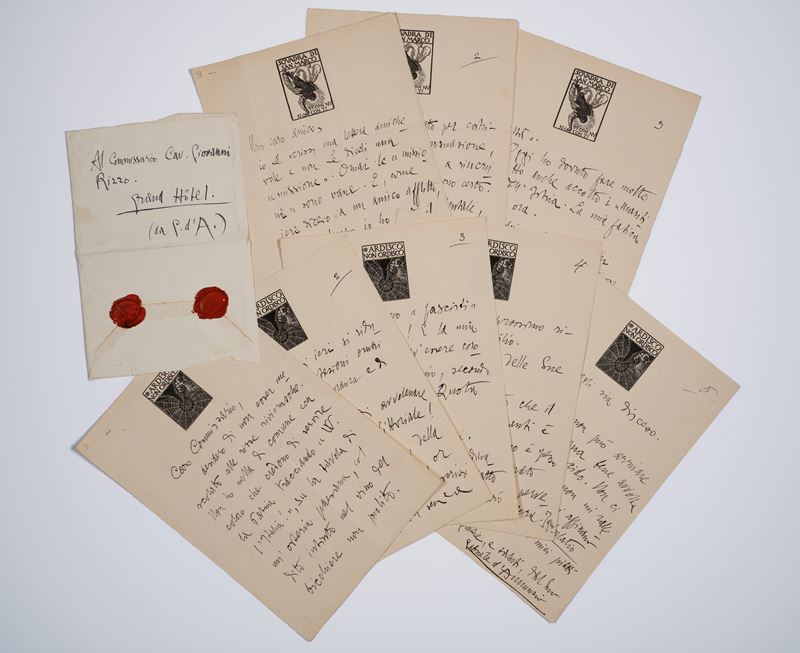
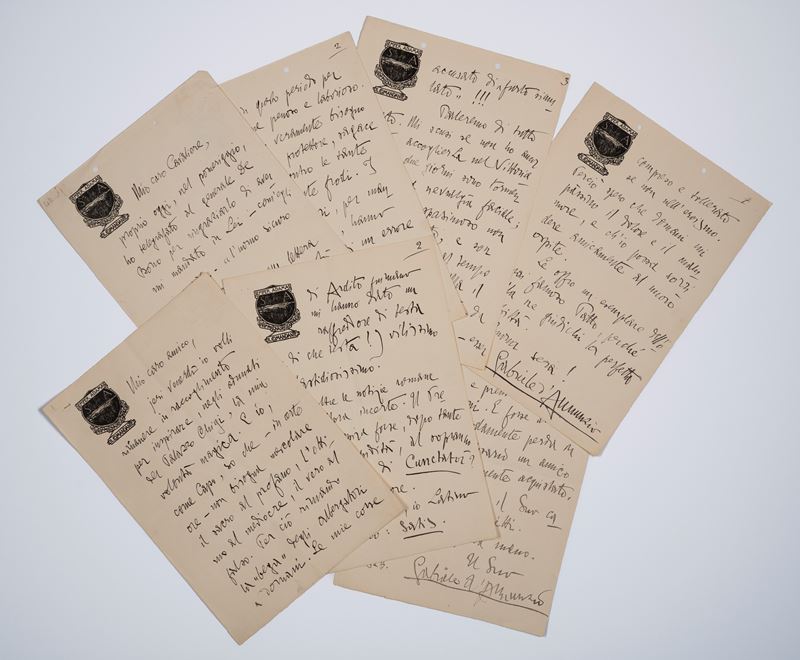
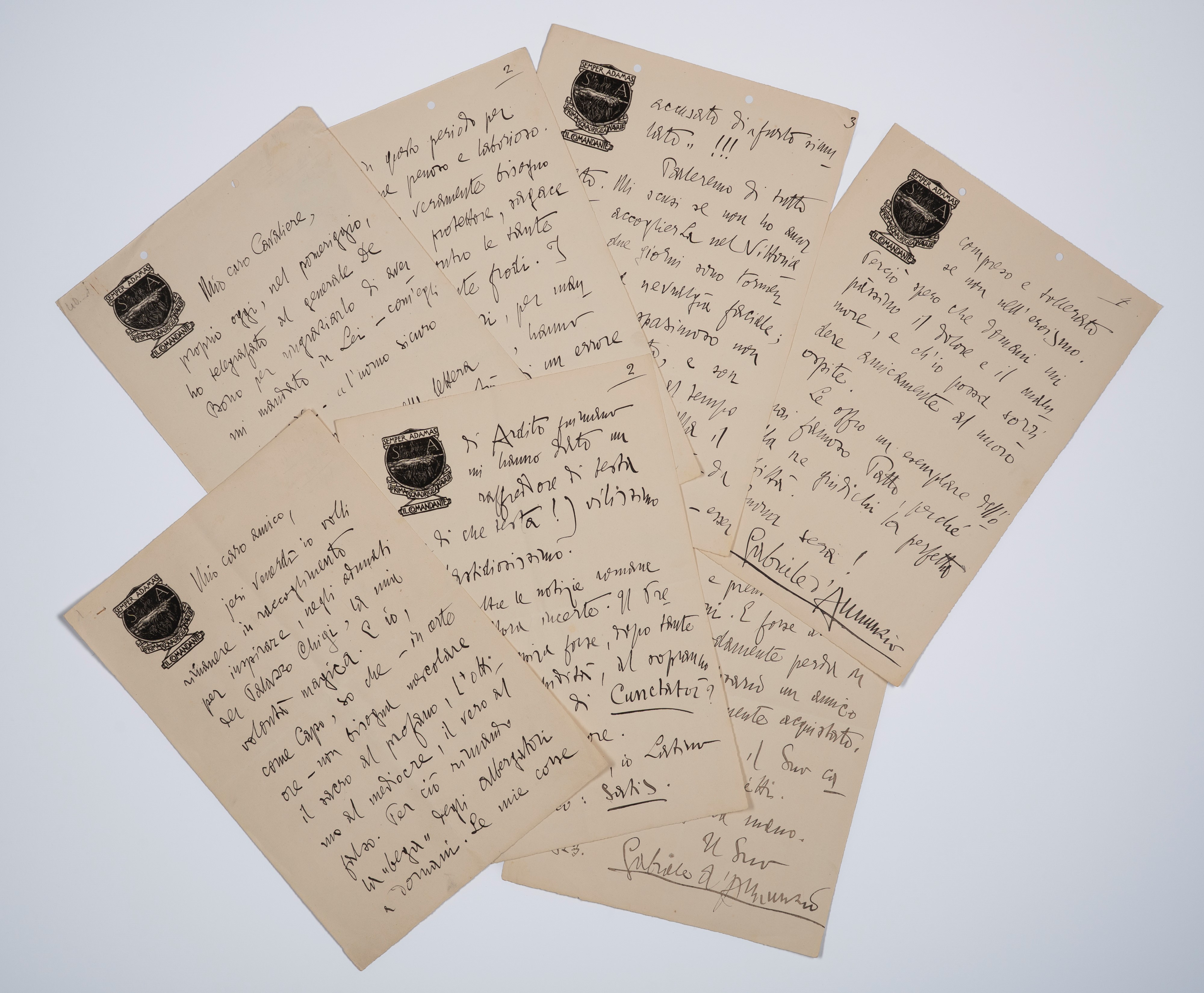
Important unpublished correspondence between Gabriele D'Annunzio and Giovanni Rizzo , consisting of 83 signed autograph letters from the years 1923 to 1937 .
Specialist Notes
This is the extensive correspondence with the man the Poet ended up calling the “watchful jailer”, the police commissioner and later prefect Rizzo who, on the orders of the fascist government, controlled the activities of the Vittoriale in the last years of D'Annunzio's life.
Although most of the letters begin colloquially with a "Dear Friend," the relationship between the two is clearly tense. At first, the Poet is still courtly and dreamy, as in October 1923: "Yesterday I wanted to remain in recollection to inspire my magical will in the gatherings at Palazzo Chigi. And I, as Chief, know that—at certain times—one must not mix the sacred with the profane, the excellent with the mediocre, the true with the false." In a letter from February 1928, D'Annunzio writes: "You have repeatedly declared that you are here at my disposal, indeed, at my command. If you were here only to keep an eye on me as a 'dangerous individual,' I would be able to protest your presence with my well-known energy." D'Annunzio often uses Rizzo as a mouthpiece for his feelings, conveying messages to the head of government. Some letters focus on the issues of the so-called "Marine Pact," which was so dear to him, or comment on current political situations at the time, both in Italy and abroad. References to the King, Ciano, the Duke of Aosta, Volpi, and Justice Minister Alfredo Rocco are constant. "Tell this to our Chief," that is, Mussolini, toward whom D'Annunzio has alternating feelings, ranging from hatred to tenderness, as when he declares himself "torn to pieces by the unexpected announcement" of Arnaldo Mussolini's death and continues, "I will send a word to Benito, but even my word is vain.' Sometimes he is poetic (in a letter from 1923 he writes some verses in Sicilian!), in many references are made to the relationship with Gabriellino, 'degenerate' or 'wayward son,' while Baccara is often described as 'the admirable Luisa' or 'flower of patience'. Some letters from 1924 speak of the mysterious disappearance of the manuscript of The Virgin of the Rocks, later fortuitously found on a train: 'everything that touches me turns into an incredible tale. The adventure of the manuscript is truly extraordinary.' Other letters highlight the poet's aversion to public ceremonies, but in all of them his need to be heard shines through: 'The Vittoriale is, even in its silence, a crystal fortress.' Magnificent together. The lot is subject to the procedure for the declaration of cultural interest of the Ministry of Cultural Heritage
Although most of the letters begin colloquially with a "Dear Friend," the relationship between the two is clearly tense. At first, the Poet is still courtly and dreamy, as in October 1923: "Yesterday I wanted to remain in recollection to inspire my magical will in the gatherings at Palazzo Chigi. And I, as Chief, know that—at certain times—one must not mix the sacred with the profane, the excellent with the mediocre, the true with the false." In a letter from February 1928, D'Annunzio writes: "You have repeatedly declared that you are here at my disposal, indeed, at my command. If you were here only to keep an eye on me as a 'dangerous individual,' I would be able to protest your presence with my well-known energy." D'Annunzio often uses Rizzo as a mouthpiece for his feelings, conveying messages to the head of government. Some letters focus on the issues of the so-called "Marine Pact," which was so dear to him, or comment on current political situations at the time, both in Italy and abroad. References to the King, Ciano, the Duke of Aosta, Volpi, and Justice Minister Alfredo Rocco are constant. "Tell this to our Chief," that is, Mussolini, toward whom D'Annunzio has alternating feelings, ranging from hatred to tenderness, as when he declares himself "torn to pieces by the unexpected announcement" of Arnaldo Mussolini's death and continues, "I will send a word to Benito, but even my word is vain.' Sometimes he is poetic (in a letter from 1923 he writes some verses in Sicilian!), in many references are made to the relationship with Gabriellino, 'degenerate' or 'wayward son,' while Baccara is often described as 'the admirable Luisa' or 'flower of patience'. Some letters from 1924 speak of the mysterious disappearance of the manuscript of The Virgin of the Rocks, later fortuitously found on a train: 'everything that touches me turns into an incredible tale. The adventure of the manuscript is truly extraordinary.' Other letters highlight the poet's aversion to public ceremonies, but in all of them his need to be heard shines through: 'The Vittoriale is, even in its silence, a crystal fortress.' Magnificent together. The lot is subject to the procedure for the declaration of cultural interest of the Ministry of Cultural Heritage
Contact
Condition report
To request a Condition Report, please contact libriestampe@finarte.it
The department will provide you with a general report of the condition of the property described above. Please note that what Finarte declares with respect to the state of conservation of the objects corresponds only to a qualified opinion and that we are not professional conservators or restorers.
We urge you to consult with a restorer or conservator of your choice who will be better able to provide a detailed, professional report. We always suggest prospective buyers to inspect each lot to satisfy themselves as to condition during the exhibition days as indicated in the catalog.
Suggested lots
Caricamento lotti suggeriti...