Estimate
€ 2.000 - 3.000
Sold
€ 2.286
The price includes buyer's premium
Do you have a similar item you would like to sell?
Information
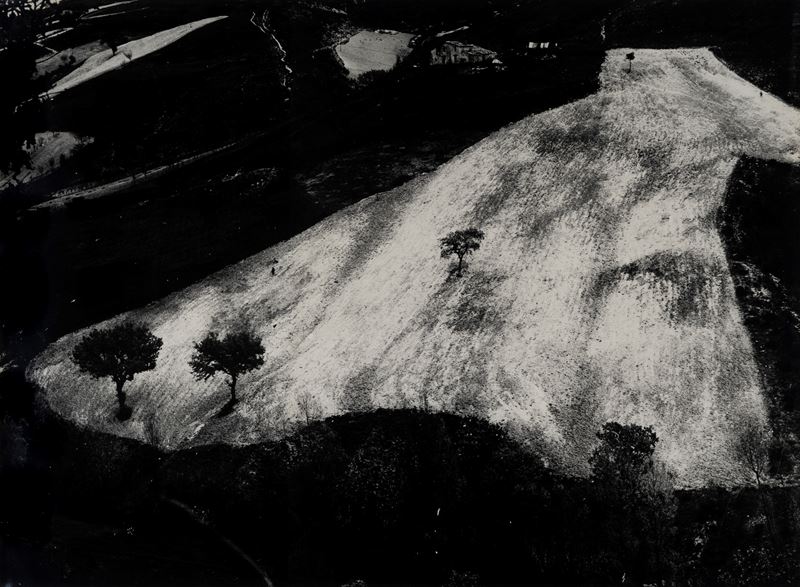
Vintage gelatin silver print, printed in 1973
cm 47,6 x 64,6 | 18.7 x 25,4 in.
Signed and dated in pencil on the verso
cm 47,6 x 64,6 | 18.7 x 25,4 in.
Signed and dated in pencil on the verso
Literature
A. Crawford (edited by), Mario Giacomelli, Phaidon, Londra, 2001, p. 318
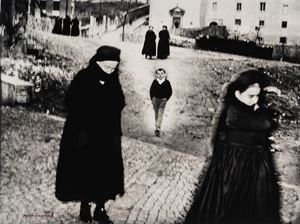
Mario Giacomelli (Senigallia, Ancona 1925-2000), fatherless at a very young age, worked as an assistant in the print shop that he bought after the war. In 1953 he took his first photograph with a simple Bencini Comet, immediately realising that he could express himself through photography. The support and guidance of Giuseppe Cavalli, Paolo Monti, Luigi Crocenzi and Giuseppe Turroni made him known as a breath of fresh air thanks to a style based on the contrasts of his black and white and a sensibility that led him to an expressionist vision of the landscape and a very intense way of interpreting the lyrics of great poets such as Leopardi, Cardarelli, Turoldo and Lee Masters. He has had many exhibitions all over the world and has produced many books.“Io non ho mani che mi accarezzino il volto” is his best-known and most highly regarded work because, in the blinding white of the snow against which the black of the seminarians’ robes stands out, it embodies the most striking features of Giacomelli’s style. However, this image must be studied carefully, for the contrast is metaphorical rather than merely aesthetic, juxtaposing the carefree cheerfulness of the subjects with the emotional loneliness that awaits them. Nor should we forget that here the true spirit of the photographer from Senigallia is revealed: that of being a refined interpreter of poetry, in this case of the eponymous poem by David Maria Turoldo. Truly fascinating. “Scanno” (the only Italian photograph featured in the 1964 exhibition “The Photographer’s Eye” at MoMA) is a veritable exercise in compositional style: the two women in the foreground, crossing the space diagonally, are contrasted, in a brilliant shift of perspective, by the figure of the child advancing directly towards the lens. Alongside these two masterpieces, we finally find one of his highly original landscapes, which is even more distinctive here thanks to the composition that emphasises the stark contrast between the shaded areas and the brighter ones, which seem to stand guard over that intensely worked land.
Contact
Suggested lots
Caricamento lotti suggeriti...