Estimate
€ 800 - 1.200
Sold
€ 1.397
The price includes buyer's premium
Do you have a similar item you would like to sell?
Information
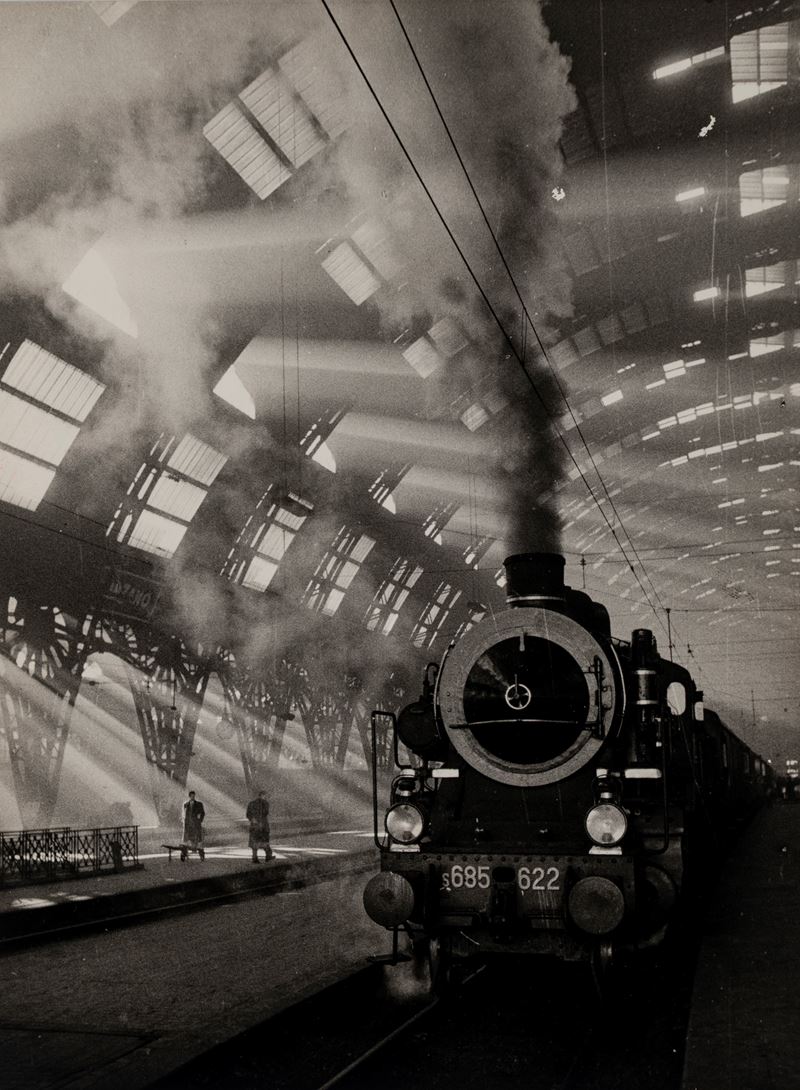
Vintage gelatin silver print
cm 24,3 x 18,1 | 9.6 x 7.1 in.
Photographer's credit stamp on the verso
Mario De Biasi (Sois, Bolzano 1923 - Milan 2013) began photographing in Germany, where he had been deported during World War II. In 1948 he presented his first solo exhibition at the Circolo Fotografico Milanese, and in 1953 he became a professional working in the staff of the magazine Epoca to which he would remain bound until its closure in 1997 and for which he would publish more than a hundred covers and countless photo shoots making several trips around the world. Extremely versatile, he produced countless exhibitions and published books on a wide variety of subjects.
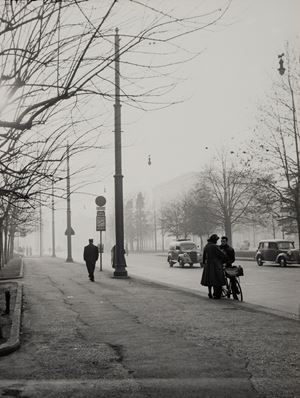
Looking at photographs of a past that seems more distant than it actually is is a particularly intriguing exercise, because it prompts us not only to analyse the photographic technique or the – admittedly impressive – quality of the analogue prints that have survived, but also to observe the world that De Biasi depicted. The photograph of the Milanese landscape, for example, tells us of a somewhat gloomy city with patched-up pavements and, surprisingly, just two passing cars and none parked at the roadside. Then, however, there is that couple next to the bicycle, talking to each other, and suddenly Milan seems less grey. The other photograph captures the station from a low angle, giving it a vigour that the little train lacked – a train the Milanese had nicknamed “gamba de legn” because it chugged along, puffing and panting, to connect the city with neighbouring towns and villages.
cm 24,3 x 18,1 | 9.6 x 7.1 in.
Photographer's credit stamp on the verso
Mario De Biasi (Sois, Bolzano 1923 - Milan 2013) began photographing in Germany, where he had been deported during World War II. In 1948 he presented his first solo exhibition at the Circolo Fotografico Milanese, and in 1953 he became a professional working in the staff of the magazine Epoca to which he would remain bound until its closure in 1997 and for which he would publish more than a hundred covers and countless photo shoots making several trips around the world. Extremely versatile, he produced countless exhibitions and published books on a wide variety of subjects.
Looking at photographs of a past that seems more distant than it actually is is a particularly intriguing exercise, because it prompts us not only to analyse the photographic technique or the – admittedly impressive – quality of the analogue prints that have survived, but also to observe the world that De Biasi depicted. The photograph of the Milanese landscape, for example, tells us of a somewhat gloomy city with patched-up pavements and, surprisingly, just two passing cars and none parked at the roadside. Then, however, there is that couple next to the bicycle, talking to each other, and suddenly Milan seems less grey. The other photograph captures the station from a low angle, giving it a vigour that the little train lacked – a train the Milanese had nicknamed “gamba de legn” because it chugged along, puffing and panting, to connect the city with neighbouring towns and villages.
Contact
Suggested lots
Caricamento lotti suggeriti...