1030
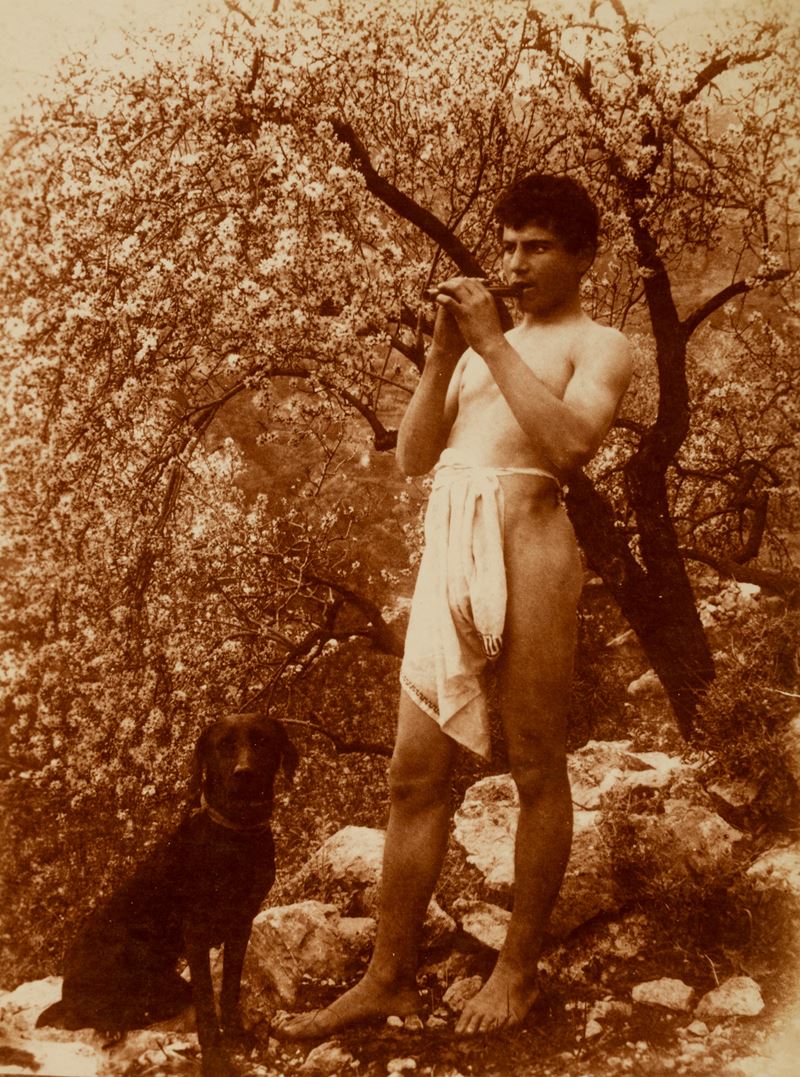
Baron Wilhelm von Gloeden, Gaetano D'Agata
(1856 - 1931 & 1883 - 1949)
Untitled (Young sicilian boy), 1900s
Estimate
€ 700 - 1.000
Sold
€ 889
The price includes buyer's premium
Do you have a similar item you would like to sell?
Information
Salt print
cm 23 x 17,5 (cm 21,4 x 16,2 picture) | 9.1 x 6.9 in. (8.4 x 6.4 in. picture)
Photographers' credit stamp on the verso
Gaetano D'Agata (Aci Sant'Antonio CT 1883 – Taormina 1949) has always been a decidedly unusual author: although he carried out his activity in his famous studio located in the center of Taormina, the city chosen after marrying a local girl, he traveled to Spain, Ireland, India and the United States where, in New York, he opened, albeit for a short time, a studio. He achieved success, especially economically, with genre scenes (the classic characters wearing traditional clothes or exhibiting their trades) and with Sicilian landscapes, all themes aimed at tourists and destined to appear in postcards. He has also dedicated himself with dedication to the male nude.
cm 23 x 17,5 (cm 21,4 x 16,2 picture) | 9.1 x 6.9 in. (8.4 x 6.4 in. picture)
Photographers' credit stamp on the verso
Gaetano D'Agata (Aci Sant'Antonio CT 1883 – Taormina 1949) has always been a decidedly unusual author: although he carried out his activity in his famous studio located in the center of Taormina, the city chosen after marrying a local girl, he traveled to Spain, Ireland, India and the United States where, in New York, he opened, albeit for a short time, a studio. He achieved success, especially economically, with genre scenes (the classic characters wearing traditional clothes or exhibiting their trades) and with Sicilian landscapes, all themes aimed at tourists and destined to appear in postcards. He has also dedicated himself with dedication to the male nude.
Although some scientific evidence is lacking, it seems that D'Agata was Wilhelm von Gloeden's assistant for some time. The fact is that, for obvious reasons of proximity, he must have been well acquainted with the work of the German photographer but, while he does not seem interested in following his tracks on the theme of the landscape, it is that of the male nude that he is decisively inspired by. As it should always be, one should never directly compare the authors with each other, but in the case of the two photographs proposed here the analogy between the ways in which both posed their models is evident, which in one case allude to a strong sensuality and in the other evoke the atmospheres of that Magna Graecia that still fascinated despite the fact that, let's face it, some Kitsch drift.
Contact
Suggested lots
Caricamento lotti suggeriti...