Estimate
€ 300 - 400
Sold
€ 305
The price includes buyer's premium
Do you have a similar item you would like to sell?
Information
Vintage gelatin silver print
cm 30,3 x 40,5 (cm 25,4 x 38 picture) | 11.9 x 15.9 in. (10 x 15 in. picture)
Titled and signed in black ink on the verso
Mario Dondero (Milan 1928 – Petritoli 2015), a truly great photojournalist with a past as a partisan in his youth, frequented the famous Bar Giamaica with his photographer friends Ugo Mulas, Alfa Castaldi, Uliano Lucas and Carlo Bavagnoli, with whom he shared progressive ideals. In 1955, he realised his dream of moving to Paris, where he became part of the local intellectual scene, collaborating from then on with Le Monde and Le Nouvel Observateur, and in Italy with L’Espresso, L’Illustrazione Italiana, Vie Nuove, L’Unità, L’Europeo, Epoca, Jeune Afrique, il Manifesto and, in later years, Diario. Always socially conscious (he had been named an honorary docker by the dockworkers of Genoa, a city he loved dearly), he loved to travel to experience first-hand the reality he wished to photograph, without neglecting his literary interests, which led him, in 1959, to join the ranks of the Nouveau Roman writers, who posed for a famous group photograph taken in front of the headquarters of Éditions de Minuit, their publisher. Despite the disarray of his archive, which he paid little attention to, friends and critics managed to help him organise beautiful exhibitions and produce several fine volumes that attest both to his curiosity and communicative skills and to his unwavering political and civic commitment.
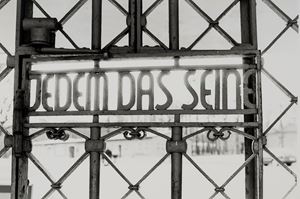
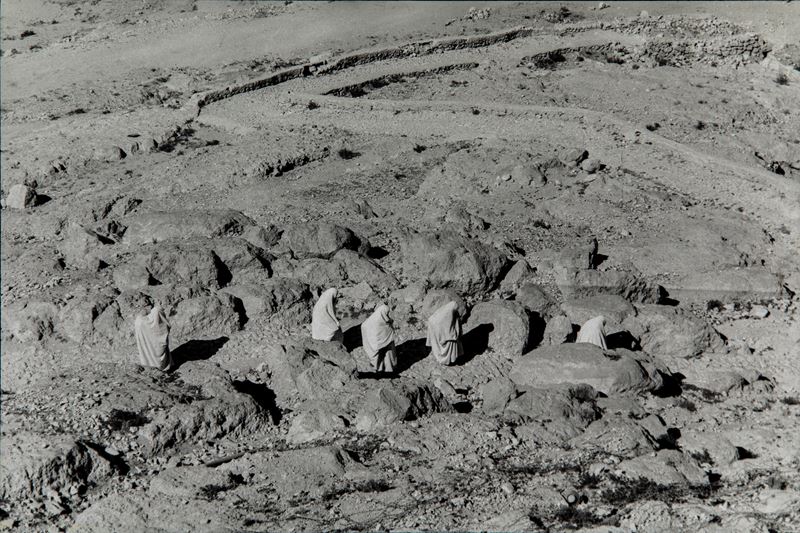
Two aspects of Mario Dondero’s reality are juxtaposed here. On the one hand, there is his love for Africa, a continent that was freeing itself from brutal European colonisation and seeking the path to emancipation. The people occupy the space, as in this case, in an almost symbolic manner, and their clothes seem to interact with the contortions of the rocks. On the other hand, this image points to political commitment and the preservation of memory: the cold and seemingly neutral German phrase – meaning ‘to each his own’ – was on the gate of the Buchenwald extermination camp and was directed with contempt at the interned Jews.
cm 30,3 x 40,5 (cm 25,4 x 38 picture) | 11.9 x 15.9 in. (10 x 15 in. picture)
Titled and signed in black ink on the verso
Mario Dondero (Milan 1928 – Petritoli 2015), a truly great photojournalist with a past as a partisan in his youth, frequented the famous Bar Giamaica with his photographer friends Ugo Mulas, Alfa Castaldi, Uliano Lucas and Carlo Bavagnoli, with whom he shared progressive ideals. In 1955, he realised his dream of moving to Paris, where he became part of the local intellectual scene, collaborating from then on with Le Monde and Le Nouvel Observateur, and in Italy with L’Espresso, L’Illustrazione Italiana, Vie Nuove, L’Unità, L’Europeo, Epoca, Jeune Afrique, il Manifesto and, in later years, Diario. Always socially conscious (he had been named an honorary docker by the dockworkers of Genoa, a city he loved dearly), he loved to travel to experience first-hand the reality he wished to photograph, without neglecting his literary interests, which led him, in 1959, to join the ranks of the Nouveau Roman writers, who posed for a famous group photograph taken in front of the headquarters of Éditions de Minuit, their publisher. Despite the disarray of his archive, which he paid little attention to, friends and critics managed to help him organise beautiful exhibitions and produce several fine volumes that attest both to his curiosity and communicative skills and to his unwavering political and civic commitment.
Two aspects of Mario Dondero’s reality are juxtaposed here. On the one hand, there is his love for Africa, a continent that was freeing itself from brutal European colonisation and seeking the path to emancipation. The people occupy the space, as in this case, in an almost symbolic manner, and their clothes seem to interact with the contortions of the rocks. On the other hand, this image points to political commitment and the preservation of memory: the cold and seemingly neutral German phrase – meaning ‘to each his own’ – was on the gate of the Buchenwald extermination camp and was directed with contempt at the interned Jews.
Contact
Suggested lots
Caricamento lotti suggeriti...