
Information
Two albumen prints, mounted on cardboard, recto and verso
cm 17 x 22,5 each (cm 31,5 x 41 cardboard) | 6.7 x 8.9 in. (12.4 x 16.1 in. cardboard)
Title and photographer's credit from negative on the image of each print
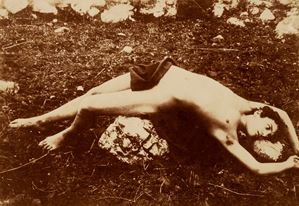
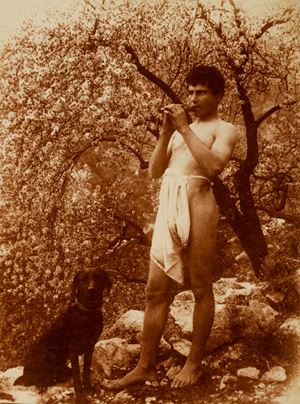
Giovanni Crupi (Taormina 1861 -1925) began out of passion as a pupil of Giuseppe Bruno, then he understood that he could practice photography as a profession and so, in 1885, he opened his studio "Fotografia Artistica Giovanni Crupi" in Via Teatro Greco in Taormina, far away, as was customary, from the workshop located in Via Fratelli Bandiera. His main subject is the views of the archaeological sites of Taormina, Agrigento, Syracuse. In his city it was inevitable to meet Wilhelm von Gloeden and a friendship and collaboration was born between the two because probably for a certain period Crupi distributed the photographs of the German baron. In 1900 he left his studio and workshop to his nephew Francesco Galifi to move to Heliopolis in Egypt where he worked for ten years before returning to Taormina no longer dedicating himself to filming but to the marketing of his archive.
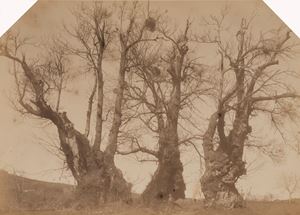
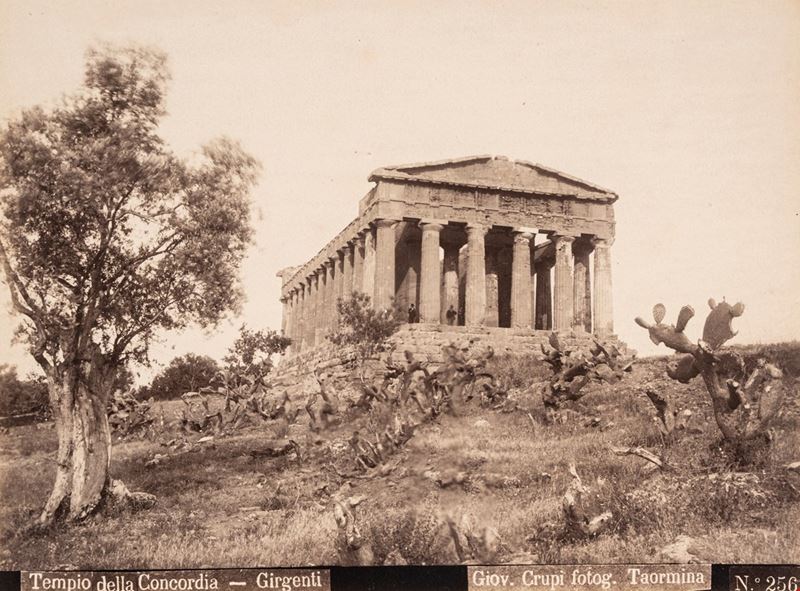
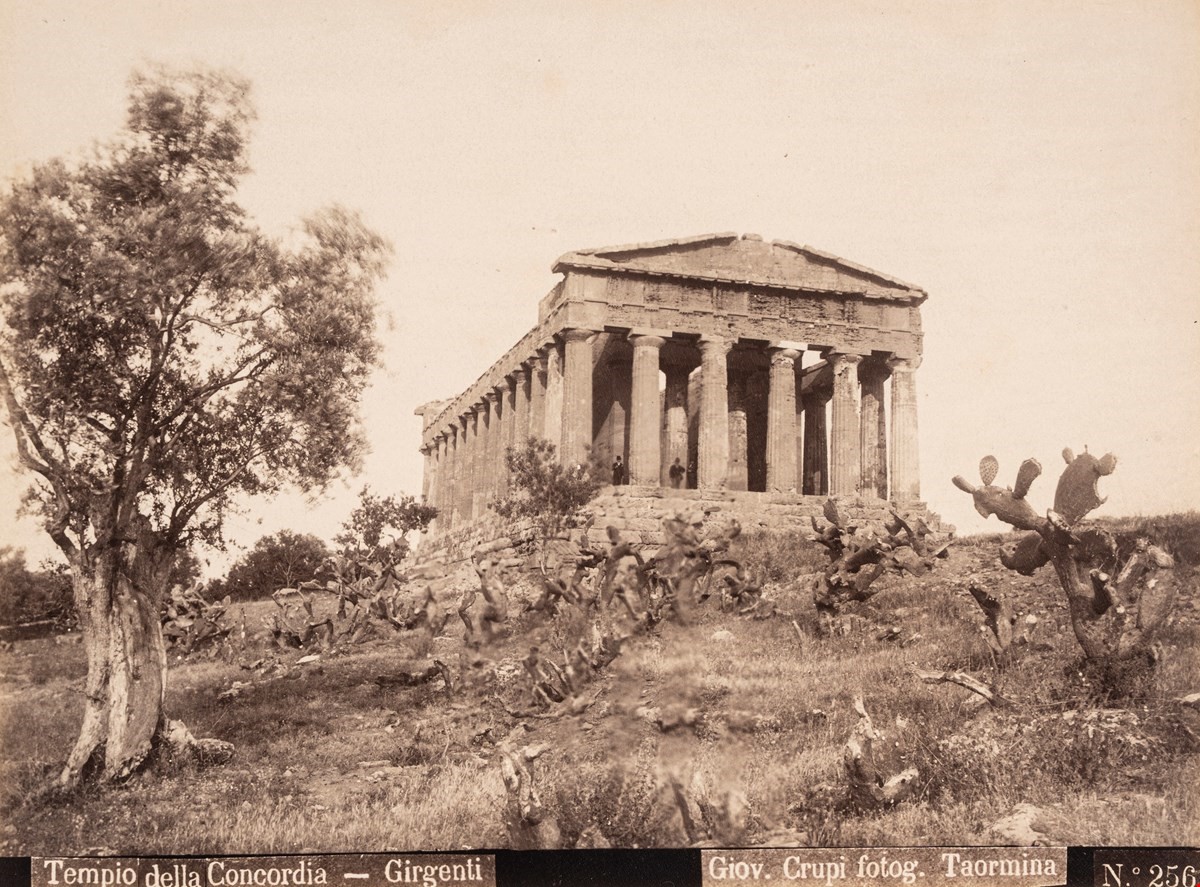
Before moving to Egypt, as many photographers of the time did, Giovanni Crupi made these two spectacular architectural shots, a genre for which he stands out for his originality. In fact, if he captures the Temple of Concordia in Girgenti from bottom to top to emphasize the raised place from which it dominates the landscape by inserting olive trees and prickly pears to create a theatrical atmosphere, in front of the Syracuse Amphitheater he completely changes perspective. Here we are faced with a surprisingly very modern, almost cinematographic shot where the circularity of the theater is captured as a whole while the figure of the man with the peplos (and here you can feel the influence of Von Gloeden) allows us to measure the grandeur of the place. Very different, and this with a reference to the ancient classicism of Fox Talbot, is the shot of three soaring trees that the choice of printing on salted paper makes even more precious.
cm 17 x 22,5 each (cm 31,5 x 41 cardboard) | 6.7 x 8.9 in. (12.4 x 16.1 in. cardboard)
Title and photographer's credit from negative on the image of each print
Giovanni Crupi (Taormina 1861 -1925) began out of passion as a pupil of Giuseppe Bruno, then he understood that he could practice photography as a profession and so, in 1885, he opened his studio "Fotografia Artistica Giovanni Crupi" in Via Teatro Greco in Taormina, far away, as was customary, from the workshop located in Via Fratelli Bandiera. His main subject is the views of the archaeological sites of Taormina, Agrigento, Syracuse. In his city it was inevitable to meet Wilhelm von Gloeden and a friendship and collaboration was born between the two because probably for a certain period Crupi distributed the photographs of the German baron. In 1900 he left his studio and workshop to his nephew Francesco Galifi to move to Heliopolis in Egypt where he worked for ten years before returning to Taormina no longer dedicating himself to filming but to the marketing of his archive.
Before moving to Egypt, as many photographers of the time did, Giovanni Crupi made these two spectacular architectural shots, a genre for which he stands out for his originality. In fact, if he captures the Temple of Concordia in Girgenti from bottom to top to emphasize the raised place from which it dominates the landscape by inserting olive trees and prickly pears to create a theatrical atmosphere, in front of the Syracuse Amphitheater he completely changes perspective. Here we are faced with a surprisingly very modern, almost cinematographic shot where the circularity of the theater is captured as a whole while the figure of the man with the peplos (and here you can feel the influence of Von Gloeden) allows us to measure the grandeur of the place. Very different, and this with a reference to the ancient classicism of Fox Talbot, is the shot of three soaring trees that the choice of printing on salted paper makes even more precious.
Contact
Condition report
To request a Condition Report, please contact fotografia@finarte.it
The department will provide you with a general report of the condition of the property described above. Please note that what Finarte declares with respect to the state of conservation of the objects corresponds only to a qualified opinion and that we are not professional conservators or restorers.
We urge you to consult with a restorer or conservator of your choice who will be better able to provide a detailed, professional report. We always suggest prospective buyers to inspect each lot to satisfy themselves as to condition during the exhibition days as indicated in the catalog.
Suggested lots
Caricamento lotti suggeriti...