Estimate
€ 250 - 350
Sold
€ 330
The price includes buyer's premium
Do you have a similar item you would like to sell?
Information
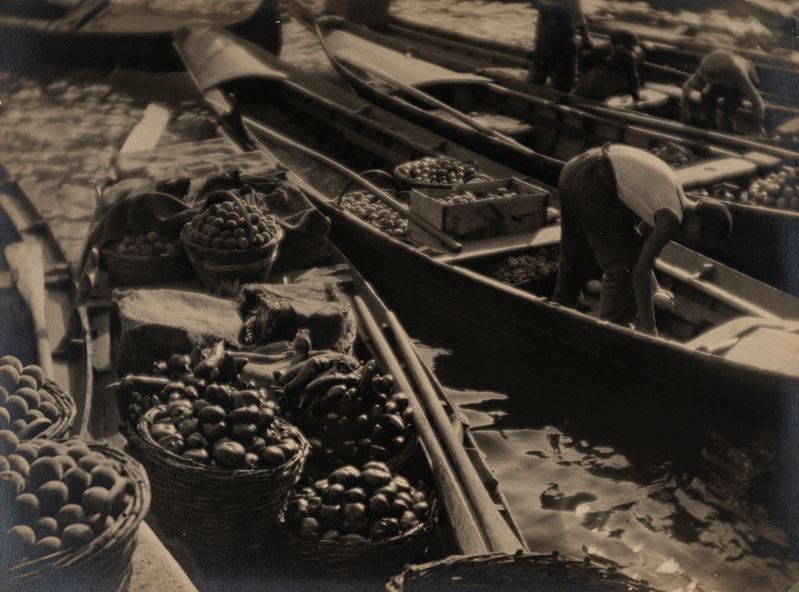
Vintage gelatin silver print
cm 29,4 x 39,4 | 11.6 x 15.5 in.
Photographer's credit stamp and exhibition label on the verso
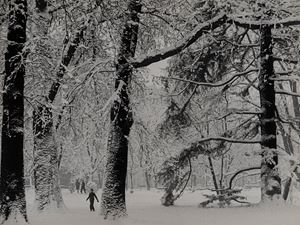
If in his professional work Bruno Stefani stood out for the innovative way in which, first using black and white and then color, he approached industrial photography, his personal research is often characterized by the attention with which he made impeccable prints in the darkroom. The two works presented here are real exercises in style because in one he investigated the reality of one of the most photographed places in the world, and he does so with a shot that decisively avoids rhetoric because here the city of water is not that of gondolas and more or less true romantic narration, but that of the tope used for the local transport of goods as the close recovery reminds us. In the second, Stefani focuses, on the spectacularity of the situation that we can imagine because it is evoked here: the sudden snowfall, which may hinder traffic, here creates an oasis of silence in a park isolated from the rest of the city. It is an image that, given the author's knowledge of the history of photography, echoes certain visions made by Ansel Adams. The care of the print should not be surprising: in the field of amateur photography it was a fundamental trait and Stefani did his best to demonstrate that he could obtain valuable results because in those years those who used 35 mm film were looked at with suspicion by those who preached the indispensability of medium format.
cm 29,4 x 39,4 | 11.6 x 15.5 in.
Photographer's credit stamp and exhibition label on the verso
Exhibition
Quarto "Salon" Internazionale di Fotografia Artistica fra Dilettanti, Turin, 1933
Bruno Stefani (Forlì 1901 - Milan 1978) moved in 1925 to Milan because of the frequent clashes with the fascists, he works professionally for the publisher Rizzoli and in the studios Aragozzini and Camuzzi but also carries out personal research close to pictorialism. The transition, among the first in Italy, to Leica suggests a new style close to Constructivism and the Bauhaus lesson that brings both in the amateur world (in 1930 founded with Giuseppe Cavalli, Secco D'Aragona, Ferruccio Leiss, Alfredo Ornano, Giò Ponti, Emilio Sommariva and Federico Vender the Milanese Photographic Circle) both in the professional world, working for the TCI and, with the innovative Studio Boggeri, for Dalmine, Olivetti, Pirelli. His archive is deposited at the CSAC in Parma.If in his professional work Bruno Stefani stood out for the innovative way in which, first using black and white and then color, he approached industrial photography, his personal research is often characterized by the attention with which he made impeccable prints in the darkroom. The two works presented here are real exercises in style because in one he investigated the reality of one of the most photographed places in the world, and he does so with a shot that decisively avoids rhetoric because here the city of water is not that of gondolas and more or less true romantic narration, but that of the tope used for the local transport of goods as the close recovery reminds us. In the second, Stefani focuses, on the spectacularity of the situation that we can imagine because it is evoked here: the sudden snowfall, which may hinder traffic, here creates an oasis of silence in a park isolated from the rest of the city. It is an image that, given the author's knowledge of the history of photography, echoes certain visions made by Ansel Adams. The care of the print should not be surprising: in the field of amateur photography it was a fundamental trait and Stefani did his best to demonstrate that he could obtain valuable results because in those years those who used 35 mm film were looked at with suspicion by those who preached the indispensability of medium format.
Contact
Suggested lots
Caricamento lotti suggeriti...
More Lots
1091
Bruno Stefani
Nevicata nel parco del Castello, Milano, 1940s
Estimate € 200 - 300
Starting bid € 170