30
Autografi
Puccini, Giacomo / Zingarelli, Italo / Pareto, Vilfredo
Correspondence for newspapers, letters and correspondence, 1920
Estimate
€ 4.000 - 6.000
Sold
€ 5.080
The price includes buyer's premium
Do you have a similar item you would like to sell?
Information
A large collection of letters, correspondence, and documents, dating from approximately 1920 to 1970. Collected in various folders and envelopes.
Specialist Notes
Italo Zingarelli remains a decidedly little-known figure in the Italian cultural landscape, perhaps known only to journalists. In reality, he was one of the most authoritative Italian correspondents of the twentieth century, specializing in Central and Eastern Europe and international politics, as well as the editor of important postwar newspapers.
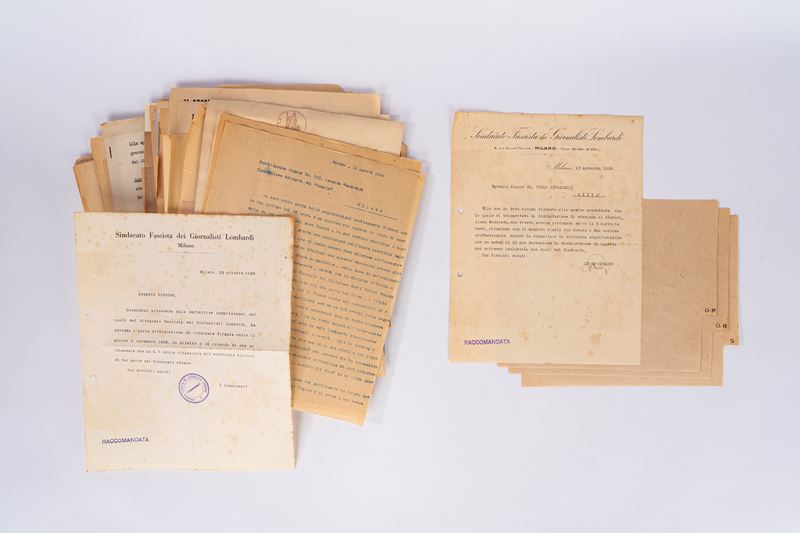
The archive presented here, unfortunately partial, portrays a multifaceted personality, lively, and insightful, attentive to the world around him with rare acumen. A very young reporter for L'Ora di Palermo, in 1912 he moved to Corriere della Sera, which sent him as a foreign correspondent. In the 1920s, he was editor of Il Secolo di Milano and later correspondent for La Stampa in Eastern Europe, an area on which he became one of Italy's leading experts. A substantial green folder contains the extensive correspondence dating from 1926 to 1928 between Zingarelli and Giulio Benedetti, co-editor of Il Secolo di Milano from 1926. It is an almost daily correspondence, in which Zingarelli reports on the articles in preparation, his travels in central and eastern Europe, and the international political issues he observes from his privileged observatory in Vienna, where he lived from 1918 to 1938. Unlike his Italian colleagues, whose style tended to be literary and brilliant, Zingarelli developed an analytical and logical prose, which is also clearly evident in the present correspondence. “As for the trip to Russia, it could be done as soon as the newspaper wanted it and, of course, if I wasn't held back by the military situation [the risk of being called up to Italy for compulsory military service]. I'd like to do some politics, but not too much, only from Moscow and Leningrad and then go and look for some variety in the interior, or along the Volga, or in Ukraine, or perhaps towards Siberia. (…)”. Seeking variety: this was the meaning of journalism for Zingarelli, beyond timely political reporting, the desire to represent a world and its contradictions. Journalistic rigor combined with a subtle diplomatic balance, which led him to be considered in every way "our" diplomat in Vienna. And when other newspapers, or his own, write untrue things, his reaction is furious: "But I must tell you that since I live and work in these countries, I absolutely cannot support the newspaper when such outrages occur: the author of the correspondence in question said fantastic things, and he must be asked to refrain from discussing issues concerning my countries in the future." Zingarelli knew everything about his homeland, and not just politically. He was the most profound and esteemed Italian figure in Austria and Central Europe, so everyone had to deal with him and with him. Some professional relationships were decidedly deeper and more intense, one of which was with the actor Alexander Moissi . The actor Alexander Moissi (also Alessandro Moissi in Italian, Aleksandër Moisiu in Albanian) was one of the most celebrated figures in European theatre between the late nineteenth and early twentieth centuries . Born in Trieste in 1879, then part of the Austro-Hungarian Empire, he was the son of an Albanian merchant and an Arbëreshë mother of Italian culture. After a difficult beginning at the Burgtheater in Vienna, he was discovered by the great actor Josef Kainz, who recognized his talent and encouraged him. He subsequently worked in Prague and especially in Berlin under the guidance of the director Max Reinhardt, becoming one of the stars of German-language theatre. Moissi embodied the ideal of a European and international actor. He was admired throughout Europe and the United States for his ability to combine tragic force and poetic sensitivity. Many critics of the time considered him one of the greatest stage performers of his time. He did not adhere to the new expressionist and political theater movements of the 1920s and 1930s, remaining committed to a more humanistic and poetic conception of performing arts. After the rise of Nazism, he left Germany and spent his final years between Austria, Italy, and Albania. He died in 1935. The friendship between Zingarelli and Moissi was deep and intense, dating back to the early 1920s and evidenced here by a substantial correspondence of hundreds of letters. For a certain period, Zingarelli acted almost as an agent for Moissi, introducing him to the world of Italian theatre and introducing him to figures such as Puccini and Pirandello (who wrote a play for him).
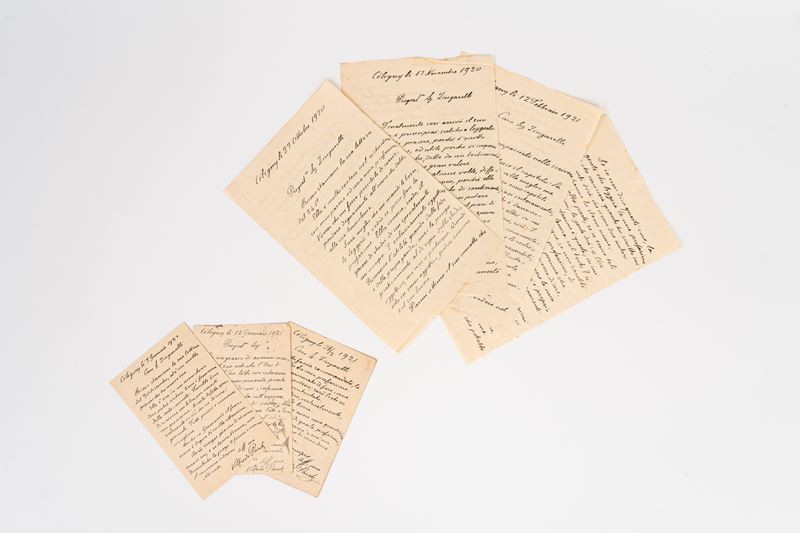
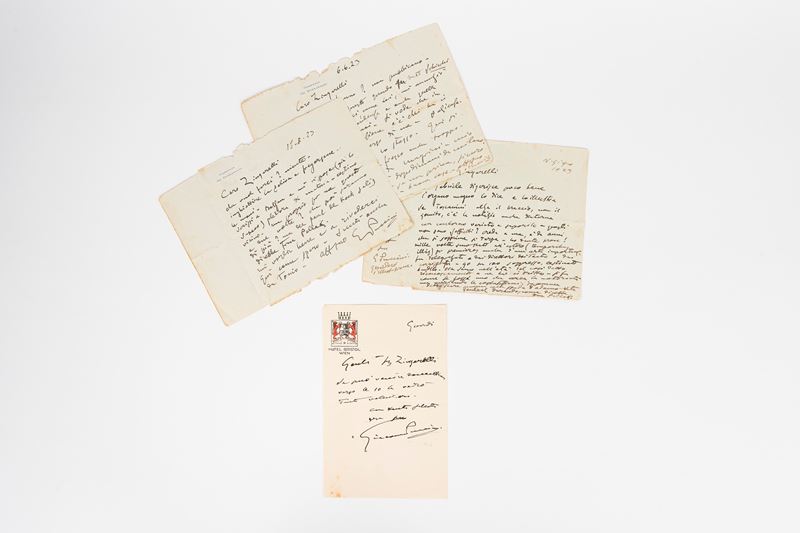
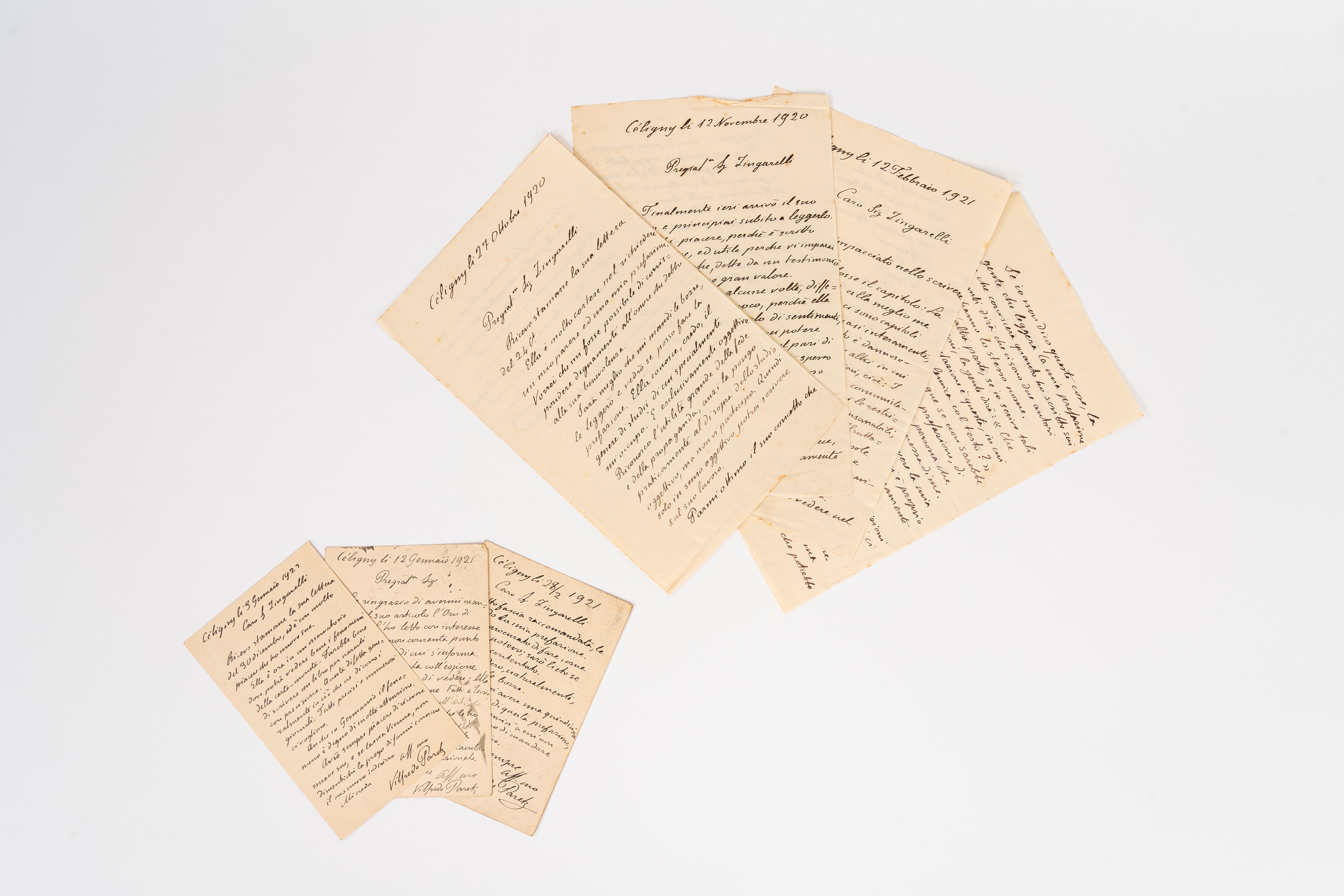
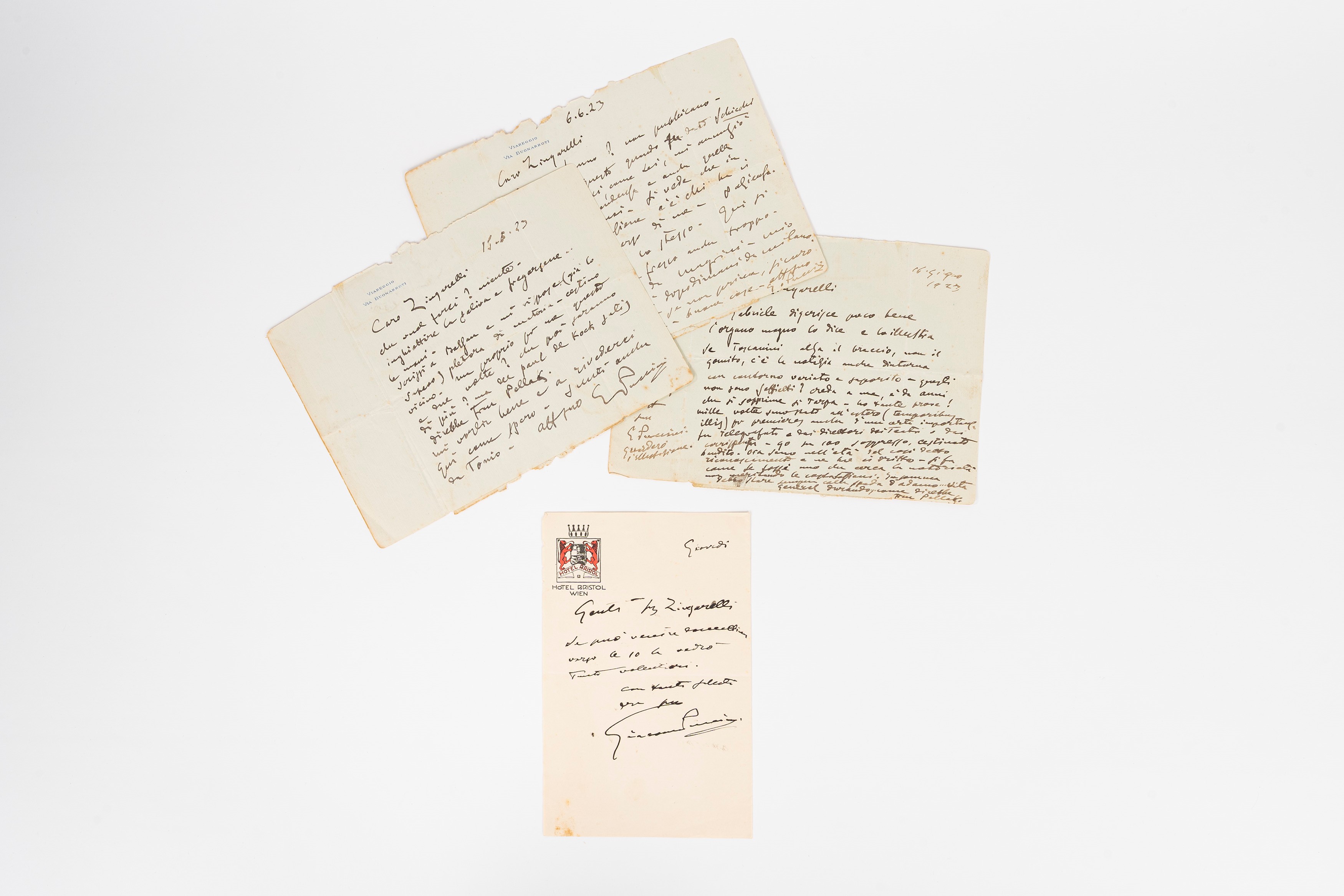
Giacomo Puccini himself has three beautiful letters, a postcard, a telegram, and two invitations. In one of the letters, he complains to Zingarelli about the lack of press coverage surrounding his Austrian tour: “If Gabriele [D'Annunzio] doesn't like the great organ, he says so and illustrates it. If Toscanini raises his arm, not his elbow, there's the news even daily with varied and tasty side dishes. Aren't these bellows? Believe me, it's been suppressed and clipped for years. I have plenty of proof! A thousand times I've been abroad (temporibus illis) for premieres, even of a certain importance, it was telegraphed by theater directors and correspondents—90 out of 100 suppressed, censored, immediately. Now I'm at the age of so-called recognition…. (…)” (Viareggio, June 16, 1923). Among the various preserved correspondence, five letters and three postcards by Prezzolini are worth mentioning, but especially noteworthy is the highly interesting correspondence with Vilfredo Pareto . Vilfredo Pareto was an Italian economist, sociologist, and engineer, fundamental to twentieth-century European thought thanks to his revolutionary theory of elites and his pioneering contributions to welfare economics. His intellectual legacy redefined the social sciences, profoundly influencing contemporary political philosophy and economic theory. Here are preserved four letters from Pareto to Zingarelli, dated 1920-21, and nine postcards from the same two-year period . The reason for their friendship is linked to the preface Pareto wrote in 1921 to Zingarelli's book, Sotto la maschera del bolscevismo (Under the Mask of Bolshevism) , published by Mondadori in 1921 in the series "Uomini fatti e idee del giorno" (Men, Facts and Ideas of the Day). The comparison between the two was not accidental. By 1921, Pareto was already the most authoritative Italian critic of revolutionary socialism and Bolshevism. Zingarelli, who had closely followed events in Central and Eastern Europe as a correspondent, published this pamphlet to analyze the Soviet reality and debunk what he considered the revolutionary mythology widespread in the West. Pareto's preface served to lend theoretical authority to the work and was part of the political climate following the Biennio Rosso (Red Biennium). These are non-trivial, intense, conceptual letters, full of ideas and reflections between two true intellectuals. “On our judgments, we sometimes differ a little, perhaps because you put a light veil of sentiment on them, which objectively I would like to be able to remove. (…). You may think that this is nitpicking; but for me, from a purely scientific point of view, it is a matter of great importance. Look, for example, today all the bourgeois newspapers in Italy express joy for the “victories” of the “party of order” in the municipal and provincial elections. Sentiment would push me to agree with them; but reason warns me that the “liberals” felt the same satisfaction at the beginning of the French Revolution, and in many other similar cases, including the recent Russian revolution with Kerensky. Today, in Italy, we have the Kerensky period. How long will it last? I see the rocks towards which the ship is heading; perhaps the captain's ingenuity will save it, but that is unlikely. At the height of Napoleon I's power, one could see the rocks where he could shipwreck, it was hoped that the "genius of the Emperor" would be enough to avoid them. It was not enough. (…). It is November 12, 1920, just two years later, in October 1922, a Party will come to power…and this ending Pareto already seems to foreshadow here. Alongside these great figures of our twentieth-century history, there are Zingarelli's correspondents, now less well-known, but certainly relevant and valuable for reconstructing his figure as a journalist, writer, and intellectual who lived at the heart of Europe and at the center of History.
The archive presented here, unfortunately partial, portrays a multifaceted personality, lively, and insightful, attentive to the world around him with rare acumen. A very young reporter for L'Ora di Palermo, in 1912 he moved to Corriere della Sera, which sent him as a foreign correspondent. In the 1920s, he was editor of Il Secolo di Milano and later correspondent for La Stampa in Eastern Europe, an area on which he became one of Italy's leading experts. A substantial green folder contains the extensive correspondence dating from 1926 to 1928 between Zingarelli and Giulio Benedetti, co-editor of Il Secolo di Milano from 1926. It is an almost daily correspondence, in which Zingarelli reports on the articles in preparation, his travels in central and eastern Europe, and the international political issues he observes from his privileged observatory in Vienna, where he lived from 1918 to 1938. Unlike his Italian colleagues, whose style tended to be literary and brilliant, Zingarelli developed an analytical and logical prose, which is also clearly evident in the present correspondence. “As for the trip to Russia, it could be done as soon as the newspaper wanted it and, of course, if I wasn't held back by the military situation [the risk of being called up to Italy for compulsory military service]. I'd like to do some politics, but not too much, only from Moscow and Leningrad and then go and look for some variety in the interior, or along the Volga, or in Ukraine, or perhaps towards Siberia. (…)”. Seeking variety: this was the meaning of journalism for Zingarelli, beyond timely political reporting, the desire to represent a world and its contradictions. Journalistic rigor combined with a subtle diplomatic balance, which led him to be considered in every way "our" diplomat in Vienna. And when other newspapers, or his own, write untrue things, his reaction is furious: "But I must tell you that since I live and work in these countries, I absolutely cannot support the newspaper when such outrages occur: the author of the correspondence in question said fantastic things, and he must be asked to refrain from discussing issues concerning my countries in the future." Zingarelli knew everything about his homeland, and not just politically. He was the most profound and esteemed Italian figure in Austria and Central Europe, so everyone had to deal with him and with him. Some professional relationships were decidedly deeper and more intense, one of which was with the actor Alexander Moissi . The actor Alexander Moissi (also Alessandro Moissi in Italian, Aleksandër Moisiu in Albanian) was one of the most celebrated figures in European theatre between the late nineteenth and early twentieth centuries . Born in Trieste in 1879, then part of the Austro-Hungarian Empire, he was the son of an Albanian merchant and an Arbëreshë mother of Italian culture. After a difficult beginning at the Burgtheater in Vienna, he was discovered by the great actor Josef Kainz, who recognized his talent and encouraged him. He subsequently worked in Prague and especially in Berlin under the guidance of the director Max Reinhardt, becoming one of the stars of German-language theatre. Moissi embodied the ideal of a European and international actor. He was admired throughout Europe and the United States for his ability to combine tragic force and poetic sensitivity. Many critics of the time considered him one of the greatest stage performers of his time. He did not adhere to the new expressionist and political theater movements of the 1920s and 1930s, remaining committed to a more humanistic and poetic conception of performing arts. After the rise of Nazism, he left Germany and spent his final years between Austria, Italy, and Albania. He died in 1935. The friendship between Zingarelli and Moissi was deep and intense, dating back to the early 1920s and evidenced here by a substantial correspondence of hundreds of letters. For a certain period, Zingarelli acted almost as an agent for Moissi, introducing him to the world of Italian theatre and introducing him to figures such as Puccini and Pirandello (who wrote a play for him).
Giacomo Puccini himself has three beautiful letters, a postcard, a telegram, and two invitations. In one of the letters, he complains to Zingarelli about the lack of press coverage surrounding his Austrian tour: “If Gabriele [D'Annunzio] doesn't like the great organ, he says so and illustrates it. If Toscanini raises his arm, not his elbow, there's the news even daily with varied and tasty side dishes. Aren't these bellows? Believe me, it's been suppressed and clipped for years. I have plenty of proof! A thousand times I've been abroad (temporibus illis) for premieres, even of a certain importance, it was telegraphed by theater directors and correspondents—90 out of 100 suppressed, censored, immediately. Now I'm at the age of so-called recognition…. (…)” (Viareggio, June 16, 1923). Among the various preserved correspondence, five letters and three postcards by Prezzolini are worth mentioning, but especially noteworthy is the highly interesting correspondence with Vilfredo Pareto . Vilfredo Pareto was an Italian economist, sociologist, and engineer, fundamental to twentieth-century European thought thanks to his revolutionary theory of elites and his pioneering contributions to welfare economics. His intellectual legacy redefined the social sciences, profoundly influencing contemporary political philosophy and economic theory. Here are preserved four letters from Pareto to Zingarelli, dated 1920-21, and nine postcards from the same two-year period . The reason for their friendship is linked to the preface Pareto wrote in 1921 to Zingarelli's book, Sotto la maschera del bolscevismo (Under the Mask of Bolshevism) , published by Mondadori in 1921 in the series "Uomini fatti e idee del giorno" (Men, Facts and Ideas of the Day). The comparison between the two was not accidental. By 1921, Pareto was already the most authoritative Italian critic of revolutionary socialism and Bolshevism. Zingarelli, who had closely followed events in Central and Eastern Europe as a correspondent, published this pamphlet to analyze the Soviet reality and debunk what he considered the revolutionary mythology widespread in the West. Pareto's preface served to lend theoretical authority to the work and was part of the political climate following the Biennio Rosso (Red Biennium). These are non-trivial, intense, conceptual letters, full of ideas and reflections between two true intellectuals. “On our judgments, we sometimes differ a little, perhaps because you put a light veil of sentiment on them, which objectively I would like to be able to remove. (…). You may think that this is nitpicking; but for me, from a purely scientific point of view, it is a matter of great importance. Look, for example, today all the bourgeois newspapers in Italy express joy for the “victories” of the “party of order” in the municipal and provincial elections. Sentiment would push me to agree with them; but reason warns me that the “liberals” felt the same satisfaction at the beginning of the French Revolution, and in many other similar cases, including the recent Russian revolution with Kerensky. Today, in Italy, we have the Kerensky period. How long will it last? I see the rocks towards which the ship is heading; perhaps the captain's ingenuity will save it, but that is unlikely. At the height of Napoleon I's power, one could see the rocks where he could shipwreck, it was hoped that the "genius of the Emperor" would be enough to avoid them. It was not enough. (…). It is November 12, 1920, just two years later, in October 1922, a Party will come to power…and this ending Pareto already seems to foreshadow here. Alongside these great figures of our twentieth-century history, there are Zingarelli's correspondents, now less well-known, but certainly relevant and valuable for reconstructing his figure as a journalist, writer, and intellectual who lived at the heart of Europe and at the center of History.
Contact
Suggested lots
Caricamento lotti suggeriti...
![Leonardus de Berta Palia praticha [Surgery]](https://api.finarte.it/api/lotto/immagine/196605/0/300.jpg)