81
Giovanni Battista Guarini
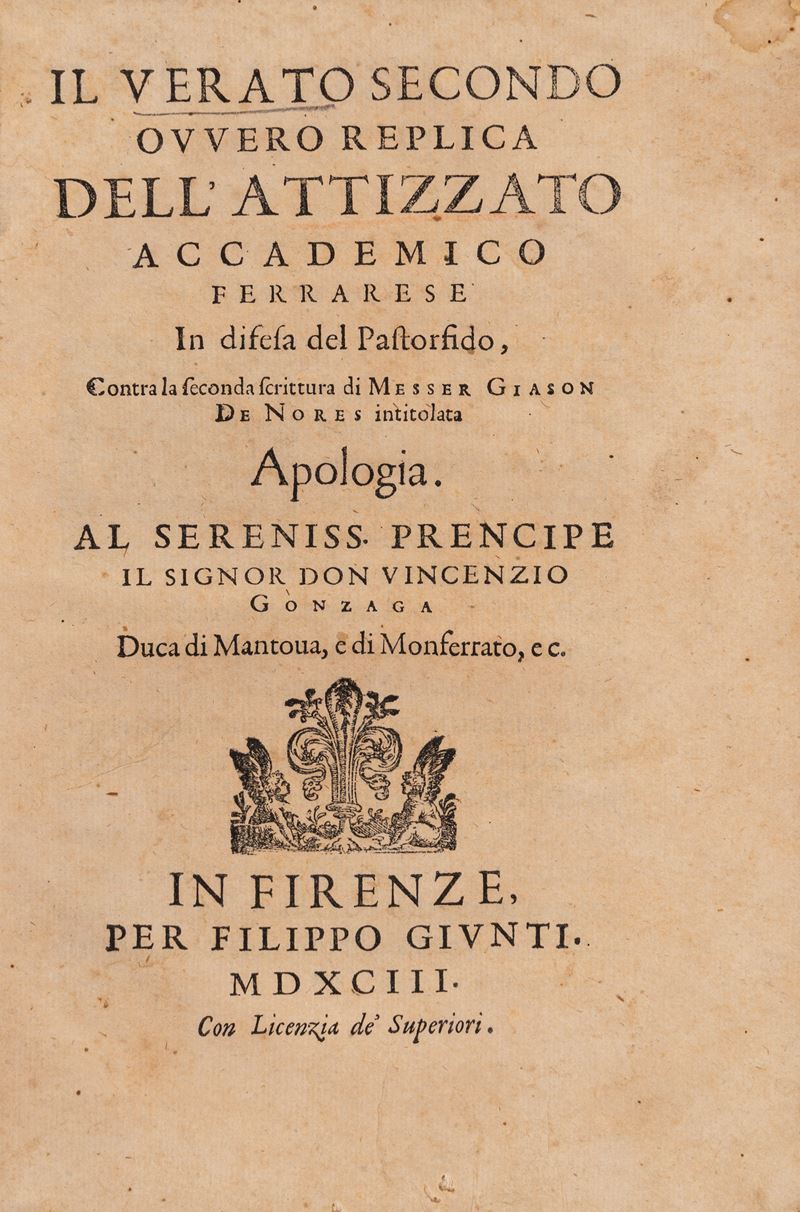
The second Verato, or Reply of the Attizzato [...] in defense of the faithful Pastor against the second writing of Sir Giason de Nores, 1593
Estimate
€ 100 - 200
Sold
€ 152
The price includes buyer's premium
Do you have a similar item you would like to sell?
Information
Florence, Filippi Giunti, 1593. In 8°. Printer's device on the title page, woodcut initials and decorations, some manuscript marks, some reddening, small woodworm damage on the last two leaves, rear binding in half parchment and marbled paper, gold titles within inserts on the spine.
Specialist Notes
Extremely rare Guarini edition.
The second Verato, or Replica dell'Attizzato (1593) is a polemical and critical work by Battista Guarini, author of the famous Il pastor fido. It was printed in Florence in 1593 by Filippo Giunti and represents one of the most important interventions in the so-called "querelle del Pastor Fido", one of the great literary disputes of the late Italian Renaissance. The work was conceived as a response to Giasone De Nores, who had attacked Pastor Fido and, more generally, the genre of pastoral tragicomedy. De Nores argued that the mixture of tragic and comic elements violated Aristotelian rules and produced a poetically "monstrous" work.
Verato Segundo is not merely a personal polemical response. It is one of the fundamental theoretical texts for understanding late Renaissance aesthetics; the birth of modern tragicomedy; the debate between "ancients" and "moderns"; and the success of Pastor Fido, which became one of the most influential plays in Europe between the 16th and 17th centuries.
The second Verato, or Replica dell'Attizzato (1593) is a polemical and critical work by Battista Guarini, author of the famous Il pastor fido. It was printed in Florence in 1593 by Filippo Giunti and represents one of the most important interventions in the so-called "querelle del Pastor Fido", one of the great literary disputes of the late Italian Renaissance. The work was conceived as a response to Giasone De Nores, who had attacked Pastor Fido and, more generally, the genre of pastoral tragicomedy. De Nores argued that the mixture of tragic and comic elements violated Aristotelian rules and produced a poetically "monstrous" work.
Verato Segundo is not merely a personal polemical response. It is one of the fundamental theoretical texts for understanding late Renaissance aesthetics; the birth of modern tragicomedy; the debate between "ancients" and "moderns"; and the success of Pastor Fido, which became one of the most influential plays in Europe between the 16th and 17th centuries.
Contact
Suggested lots
Caricamento lotti suggeriti...
![The History of Italy [...] Again reprinted with the utmost diligence, and corrected from many errors.](https://api.finarte.it/api/lotto/immagine/195544/0/300.jpg)