Estimate
€ 800 - 1.200
Sold
€ 889
The price includes buyer's premium
Do you have a similar item you would like to sell?
Information
Gelatin silver print on polycoated paper
cm 17,8 x 24 (cm 16,3 x 22,4 picture) | 7 x 9,4 in. (6.4 x 8.8 in. picture)
Signed, dated and titled in black ink on the verso
Mario Cresci (Chiavari, Genoa 1942) attended the Advanced Course in Industrial Design in Venice where he met Italo Zannier who introduced him to photography. He moved to Basilicata first in 1967 when he made his debut with visionary photographic work on Tricarico and then in 1968 where he opened the region's first graphic design studio in Matera. A multifaceted photographer, he moves from conceptual research (his is in 1969, at the gallery Il Diaframma in Milan, the first photographic environement) to that of anthropological taste, from the investigation of the landscape with which he participates in “Viaggio in Italia” to recent considerations on the relationship between works and their representation. Intense also his teaching experience in various cities and the direction from 1991 to 2000 of the Accademia Carrara in Bergamo, where he lives.
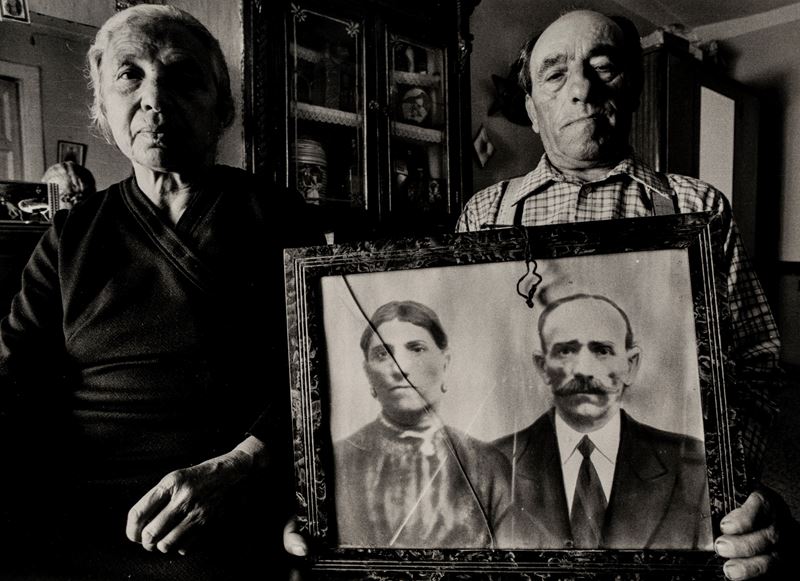
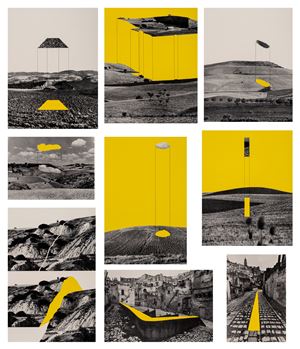
He could, operating in one of the regions of what was once called the deep South, resume the thread of the otherwise great reportage tradition, but Mario Cresci has fortunately always been a restless spirit, always looking for that something not taken for granted that so often flows under the veins of reality. So he entered the homes of his new fellow citizens and they showed him the photographs kept at home and often from those of their relatives who had emigrated to distant countries. The result is a visual short-circuit in the contrast, clearly visible here, between the poverty of the protagonist's house witnessed by the wall behind her and the exhibited elegance of those who put on the party clothes for the portrait. On the landscape, which he has investigated differently, he has not stopped at representation but has repeatedly reflected with different results: here his investigation is in dialogue with graphics with an evocative outcome that unfolds in a crescendo that involves photography as the language of research.
cm 17,8 x 24 (cm 16,3 x 22,4 picture) | 7 x 9,4 in. (6.4 x 8.8 in. picture)
Signed, dated and titled in black ink on the verso
Mario Cresci (Chiavari, Genoa 1942) attended the Advanced Course in Industrial Design in Venice where he met Italo Zannier who introduced him to photography. He moved to Basilicata first in 1967 when he made his debut with visionary photographic work on Tricarico and then in 1968 where he opened the region's first graphic design studio in Matera. A multifaceted photographer, he moves from conceptual research (his is in 1969, at the gallery Il Diaframma in Milan, the first photographic environement) to that of anthropological taste, from the investigation of the landscape with which he participates in “Viaggio in Italia” to recent considerations on the relationship between works and their representation. Intense also his teaching experience in various cities and the direction from 1991 to 2000 of the Accademia Carrara in Bergamo, where he lives.
He could, operating in one of the regions of what was once called the deep South, resume the thread of the otherwise great reportage tradition, but Mario Cresci has fortunately always been a restless spirit, always looking for that something not taken for granted that so often flows under the veins of reality. So he entered the homes of his new fellow citizens and they showed him the photographs kept at home and often from those of their relatives who had emigrated to distant countries. The result is a visual short-circuit in the contrast, clearly visible here, between the poverty of the protagonist's house witnessed by the wall behind her and the exhibited elegance of those who put on the party clothes for the portrait. On the landscape, which he has investigated differently, he has not stopped at representation but has repeatedly reflected with different results: here his investigation is in dialogue with graphics with an evocative outcome that unfolds in a crescendo that involves photography as the language of research.
Contact
Suggested lots
Caricamento lotti suggeriti...
More Lots
1027