
Starting bid
€ 300
Sold
€ 671
The price includes buyer's premium
Do you have a similar item you would like to sell?
Information
in silver
9.28 gr. - Diam. 35.00 mm.
9.28 gr. - Diam. 35.00 mm.
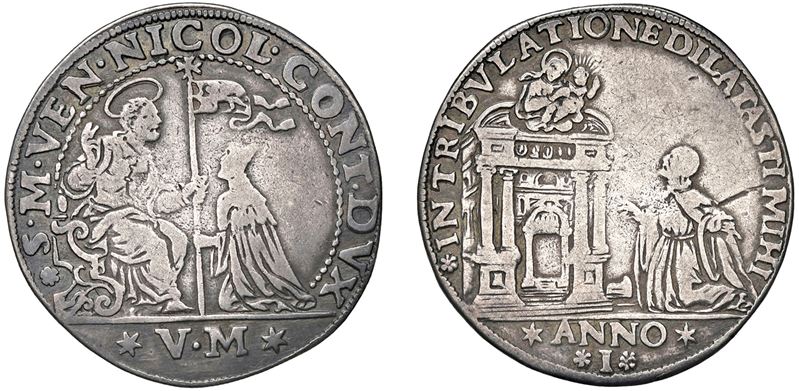
Obverse: Saint Mark seated on a throne, offering the banner to the kneeling Doge, who receives it in his hand. In the exergue are the initials VM (Urbano Malipiero, farmer); - Reverse: The Doge kneeling before the portal of a Renaissance church; above the portal is the Virgin and Child.
Montenegro 1499. CNI 83. Paolucci II 113. Very rare.
MB.
"The plague that the health tribunal had feared might enter the Milanese area with the German troops had indeed entered, as is well known; and it is equally well known that it did not stop there, but invaded and depopulated a good part of Italy."
With these words Alessandro Manzoni opens chapter XXXI of his masterpiece The Betrothed, the one in which he recounts the tragedy of the plague that struck Milan starting at the end of 1629, known to most as the “Manzonian plague”.
Following the outbreak of the War of Succession of Mantua and Montferrat, the imperial troops composed of the lansquenets spread the disease in the Duchy of Milan, which was initially its epicenter.
In 1630 the city of Venice was also hit by the devastating bubonic plague epidemic which caused the death of over 40,000 inhabitants, about a third of the population.
By order of Doge Nicolò Contarini, Patriarch Giovanni Tiepolo, and a decree of the Senate, it was decided to erect a votive church dedicated to Our Lady of Health, invoking her intercession for the cessation of the disease.
Designed to be built at the confluence of the Grand Canal and the Giudecca Canal, the project was entrusted to architect Baldassarre Longhena. The work, begun in 1631, was completed in 1687, becoming one of the city's most evocative symbols.
Contact
Suggested lots
Caricamento lotti suggeriti...
More Lots
393
Oselle di Venezia
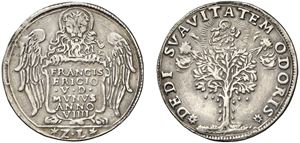
FRANCESCO ERIZZO, Doge XCVIII (1631-1646) - Osella, year IX, 1639.
Sold € 650
(buyer's premium not included)
394
Oselle di Venezia
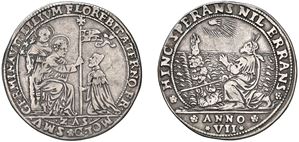
FRANCESCO MOLIN, Doge XCIX (1646-1655) - Osella, year VII, 1652.
Sold € 1.000
(buyer's premium not included)
395
Oselle di Venezia
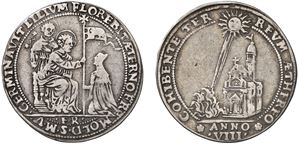
FRANCESCO MOLIN, Doge XCIX (1646-1655) - Osella, year VIII, 1653.
Sold € 750
(buyer's premium not included)
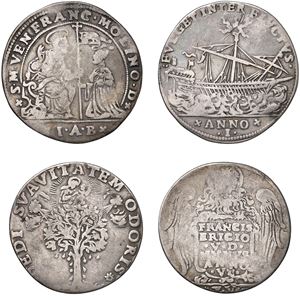
396
Oselle di Venezia
VARIOUS DOGES (Francesco Erizzo, Francesco Molin) – Lot of two Oselle (1636 and 1646).
Sold € 550
(buyer's premium not included)