
Starting bid
€ 5.000
Sold
€ 12.200
The price includes buyer's premium
Do you have a similar item you would like to sell?
Information
in gold
6.69 gr. - Diam. 26.00 mm.
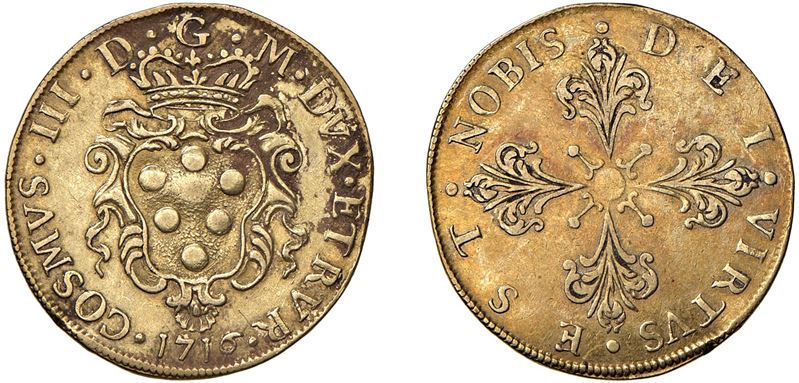
Obverse: Crowned coat of arms of a special shape with six balls, the upper one with three small lilies in relief, within a scroll decorated with volutes and a shell at the bottom; - Reverse: Cross with lilies, flanked by four small globes.
6.69 gr. - Diam. 26.00 mm.
Obverse: Crowned coat of arms of a special shape with six balls, the upper one with three small lilies in relief, within a scroll decorated with volutes and a shell at the bottom; - Reverse: Cross with lilies, flanked by four small globes.
MIR 323/2. CNI 83. Of the utmost rarity.
Probable mount removed. Light deposits on the obverse.
BB.
Cosimo III de' Medici (1642-1723), eldest son of Ferdinand II and Vittoria della Rovere, was Grand Duke of Tuscany from 1670 until his death and led one of the longest reigns in Tuscan history. Raised in a climate of profound religiosity and rigorous moral education, he developed an austere and introverted personality that profoundly influenced his governance. Having ascended to the throne at a time when the Grand Duchy had already lost much of the political and economic role it had held in previous centuries, he was unable to reverse this trend, despite several attempts at reform and commercial revival.
His rule was characterized by strong moral and religious control of society, with a tightening of norms regarding customs and civil life, which contributed to a more closed political and cultural climate than in the Medici past. On the international level, he had to confront the crucial issue of succession: the lack of lasting male heirs raised the question of the end of the Medici dynasty, which would effectively come a few years after his death in 1737. Despite these limitations, the Grand Duke was able to leave a lasting mark in certain specific areas: for example, his famous proclamation of 1716 officially demarcating the production areas of wines such as Chianti, Carmignano, and Pomino, an act considered a fundamental precedent for modern designations of origin.
The coinage of Cosimo III's long reign reflects this final phase of the Medici family's history well, with numerous issues but often limited mintages, especially for gold coins. Among these, the 1716 double stands out, a rare specimen of which only a few examples have appeared on the market.
Contact
Suggested lots
Caricamento lotti suggeriti...
More Lots
54
Granducato di Toscana
COSIMO III DE MEDICI (1670 - 1723) – Piastra 1677, Florence.
Sold € 350
(buyer's premium not included)
55
Granducato di Toscana
GIOVANNI GASTONE DE MEDICI (1723 - 1737) – Zecchino or gold florin 1731, Florence.
Sold € 700
(buyer's premium not included)
56
Granducato di Toscana
FRANCIS II OF LORRAINE (1737 - 1765) - Francescone 1747, II type, Florence.
Sold € 240
(buyer's premium not included)
57
Granducato di Toscana
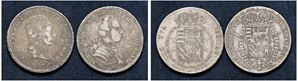
VARIOUS ISSUING AUTHORITIES (18th century) - Lot of two Francesconi, 1778 and 1793, Florence.
Sold € 200
(buyer's premium not included)