Information
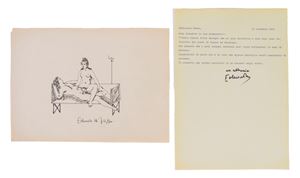
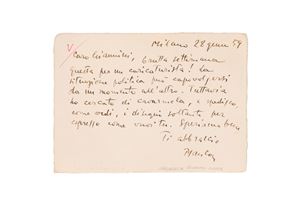
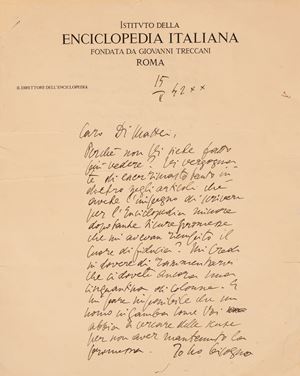
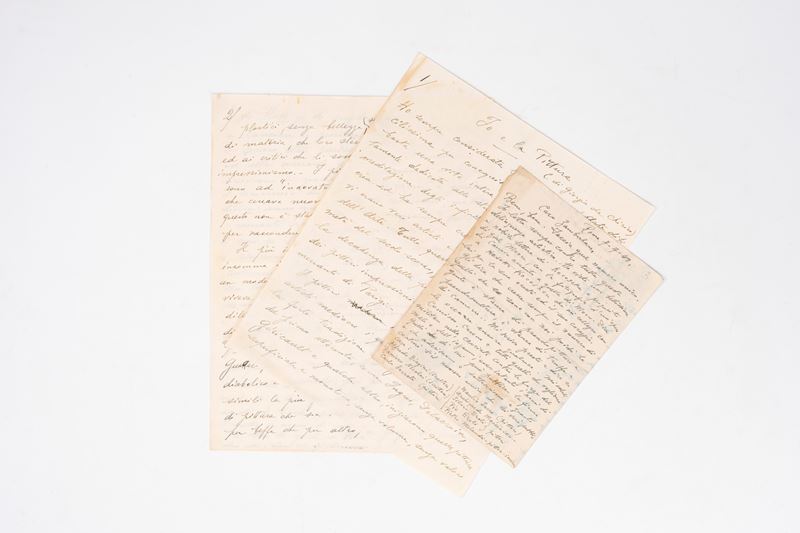
Blue cardboard binder containing autographed documents by Giorgio De Chirico, addressed to Giorgio and Uccia Zamberlan: three autographed notes, a poem, two postcards, three multi-page articles/essays, 15 autographed and signed letters, some multi-page. Dated: 1948-1975.
Specialist Notes
"...So in our time you see individuals who have a serious and normal appearance, repeating like so many monkeys and parrots, the grimaces, slogans, and clichés they hear around them or read in books, magazines, and newspapers. Unlike this kind of person, Giorgio Zamberlan saw with his own eyes and judged with his own mind, and he rebelled and reacted violently if someone, in good faith or bad, tried to convince him to accept or admit something that he, Giorgio Zamberlan, did not want to accept or admit...." (G. De Chirico, Preface to G. Zamberlan's autobiography, p. IX)
Who Giorgio De Chirico was is obviously well known and well known, but who Giorgio Zamberlan was is less obvious. Indeed, he is probably obscure to most, even among art experts. Yet, without Mr. Zamberlan from Treviso, De Chirico himself would not have been and become the great artist we all know. Because Zamberlan and his family accompanied the great painter on his artistic and professional journey, promoting and disseminating his work for a long time, with affection, mutual respect, and, I would say, heartfelt friendship. The role of the gallery owner, and Zamberlan always was, is delicate, precious, and indispensable, especially in a pre-internet and pre-social media era. From his Venetian studio, Zamberlan accompanied De Chirico over the years, following his artistic growth, his national and international success, and together they conceived projects, such as the Anti-Biennials, of devastating modernity. Far from simple provocations, but counter-exhibitions organized down to the smallest detail, even with the publication of precious and rare flyers full of programmatic texts. Giorgio Zamberlan's autobiography exists in the form of short stories, truly enthralling and captivating to read (G. Zamberlan, Il mercante in camera , Edizioni My Monkey, 2021). One must look back with regret at the men of that generation, who survived devastating wars yet were capable of an absolutely extraordinary desire to live, to smile, to engage in and for the world. Zamberlan was a social man, a man of relationships, perhaps not an easy character but an undisputed leader. He lived surrounded by artists of varying degrees of fame, and from all of them he drew inspiration to grow, both personally and professionally. He played football in his native Treviso with Arturo Martini, fraternally frequented people like Comisso, De Pisis, and Morandi, but then chose his chosen companions: and Giorgio de Chirico was one of these, perhaps the first. This deep friendship, much more than a professional collaboration, is evidenced by the 24 letters, articles, notes, and notes in the lot, sent by the painter to his Venetian friend over a period of nearly 25 years.
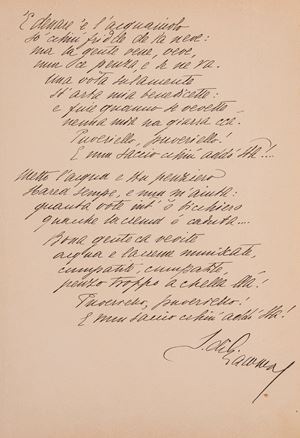
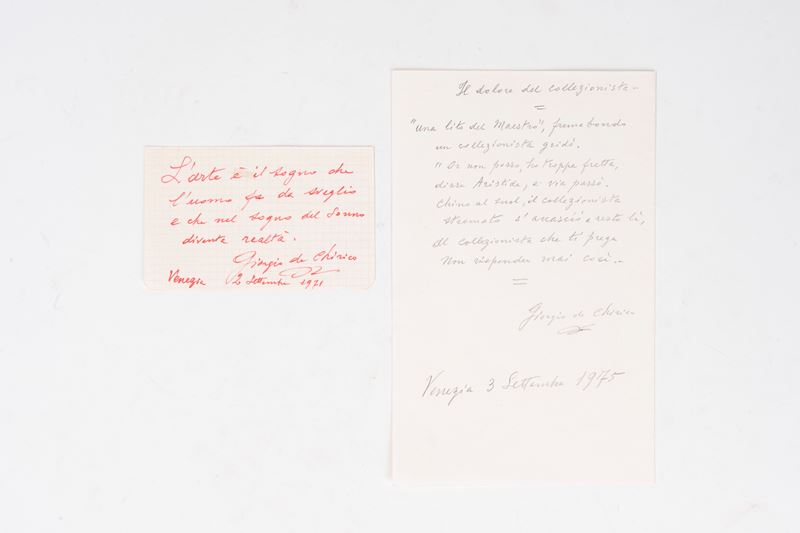
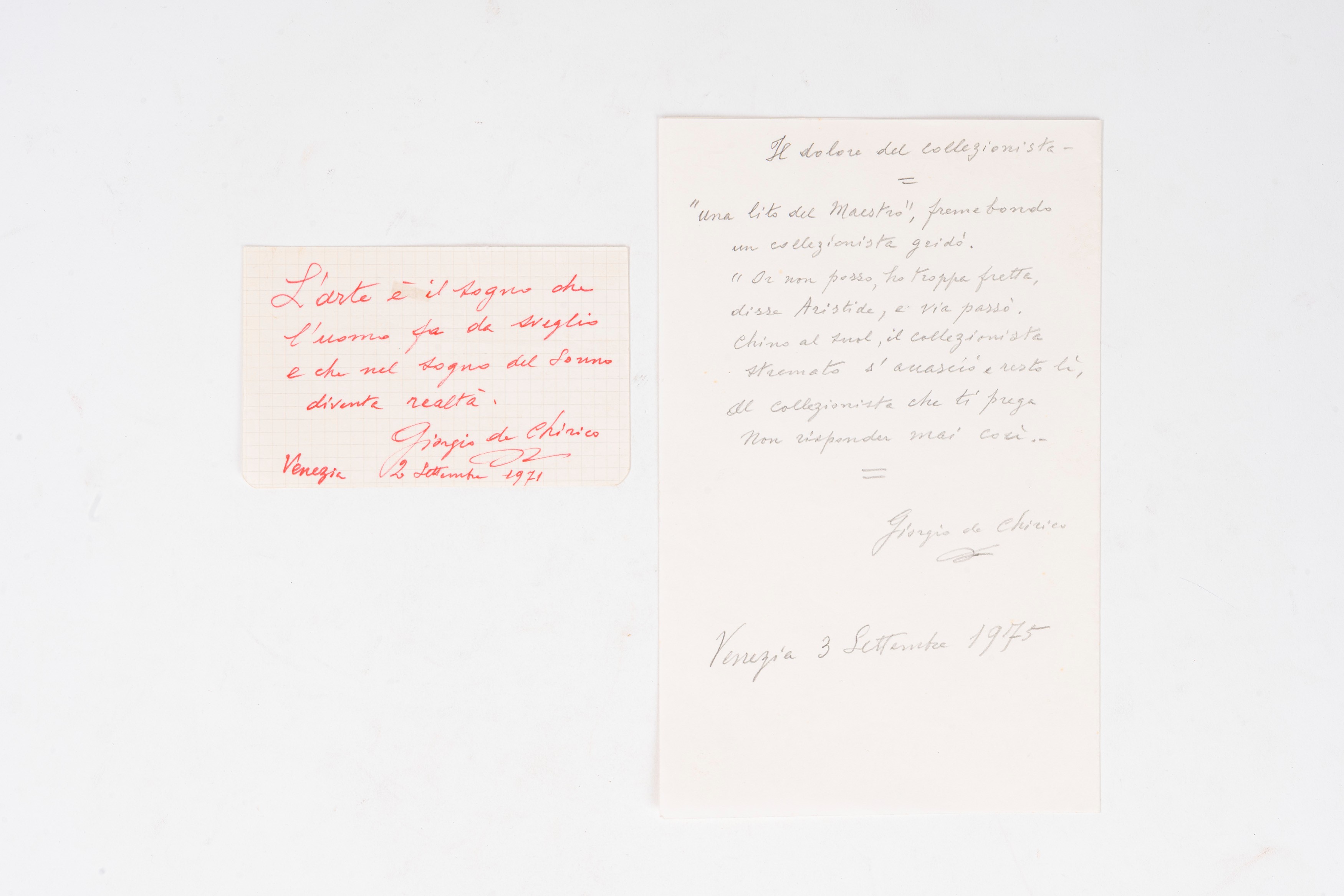
The correspondence and essays/articles are concentrated in the years of the Anti-Biennale, and take on the value of programmatic, ideological missives, clarifying a radical thought that was evident to all. We begin with the first article, opening the album, with the emblematic title: "I and Painting," three dense folders in which De Chirico expresses, in those years, his vision of the pictorial world. "I have always considered painting to be a very difficult art, and mastering it often requires more than a lifetime, even a long one, completely dedicated to study, work, and meditation on the infinite problems that painting creates and has always created as long as there were true artists and true lovers and devotees of art among men. All this ended in the second half of the last century, when the decline of painting began with the valorization of French Impressionist painters by Parisian dealers. (...)" Following this is a stunning note in red ink, dated Venice, September 2, 1971: "Art is the dream that man has while awake and which becomes reality in the dream of sleep." And how could we not mention a funny poem in alternating rhymes entitled The Collector's Pain, dated Venice, September 3, 1975.
The lot alternates between "service communications" for his trusted gallery owner and friend Zamberlan and contributions of great cultural and ideological significance, a small collection of documents that deserves study, appreciation, and contextualization by those who recognize De Chirico as one of the pillars of modern Italian art.
Who Giorgio De Chirico was is obviously well known and well known, but who Giorgio Zamberlan was is less obvious. Indeed, he is probably obscure to most, even among art experts. Yet, without Mr. Zamberlan from Treviso, De Chirico himself would not have been and become the great artist we all know. Because Zamberlan and his family accompanied the great painter on his artistic and professional journey, promoting and disseminating his work for a long time, with affection, mutual respect, and, I would say, heartfelt friendship. The role of the gallery owner, and Zamberlan always was, is delicate, precious, and indispensable, especially in a pre-internet and pre-social media era. From his Venetian studio, Zamberlan accompanied De Chirico over the years, following his artistic growth, his national and international success, and together they conceived projects, such as the Anti-Biennials, of devastating modernity. Far from simple provocations, but counter-exhibitions organized down to the smallest detail, even with the publication of precious and rare flyers full of programmatic texts. Giorgio Zamberlan's autobiography exists in the form of short stories, truly enthralling and captivating to read (G. Zamberlan, Il mercante in camera , Edizioni My Monkey, 2021). One must look back with regret at the men of that generation, who survived devastating wars yet were capable of an absolutely extraordinary desire to live, to smile, to engage in and for the world. Zamberlan was a social man, a man of relationships, perhaps not an easy character but an undisputed leader. He lived surrounded by artists of varying degrees of fame, and from all of them he drew inspiration to grow, both personally and professionally. He played football in his native Treviso with Arturo Martini, fraternally frequented people like Comisso, De Pisis, and Morandi, but then chose his chosen companions: and Giorgio de Chirico was one of these, perhaps the first. This deep friendship, much more than a professional collaboration, is evidenced by the 24 letters, articles, notes, and notes in the lot, sent by the painter to his Venetian friend over a period of nearly 25 years.
The correspondence and essays/articles are concentrated in the years of the Anti-Biennale, and take on the value of programmatic, ideological missives, clarifying a radical thought that was evident to all. We begin with the first article, opening the album, with the emblematic title: "I and Painting," three dense folders in which De Chirico expresses, in those years, his vision of the pictorial world. "I have always considered painting to be a very difficult art, and mastering it often requires more than a lifetime, even a long one, completely dedicated to study, work, and meditation on the infinite problems that painting creates and has always created as long as there were true artists and true lovers and devotees of art among men. All this ended in the second half of the last century, when the decline of painting began with the valorization of French Impressionist painters by Parisian dealers. (...)" Following this is a stunning note in red ink, dated Venice, September 2, 1971: "Art is the dream that man has while awake and which becomes reality in the dream of sleep." And how could we not mention a funny poem in alternating rhymes entitled The Collector's Pain, dated Venice, September 3, 1975.
The lot alternates between "service communications" for his trusted gallery owner and friend Zamberlan and contributions of great cultural and ideological significance, a small collection of documents that deserves study, appreciation, and contextualization by those who recognize De Chirico as one of the pillars of modern Italian art.
Contact
Condition report
To request a Condition Report, please contact libriestampe@finarte.it
The department will provide you with a general report of the condition of the property described above. Please note that what Finarte declares with respect to the state of conservation of the objects corresponds only to a qualified opinion and that we are not professional conservators or restorers.
We urge you to consult with a restorer or conservator of your choice who will be better able to provide a detailed, professional report. We always suggest prospective buyers to inspect each lot to satisfy themselves as to condition during the exhibition days as indicated in the catalog.
Suggested lots
Caricamento lotti suggeriti...