Information
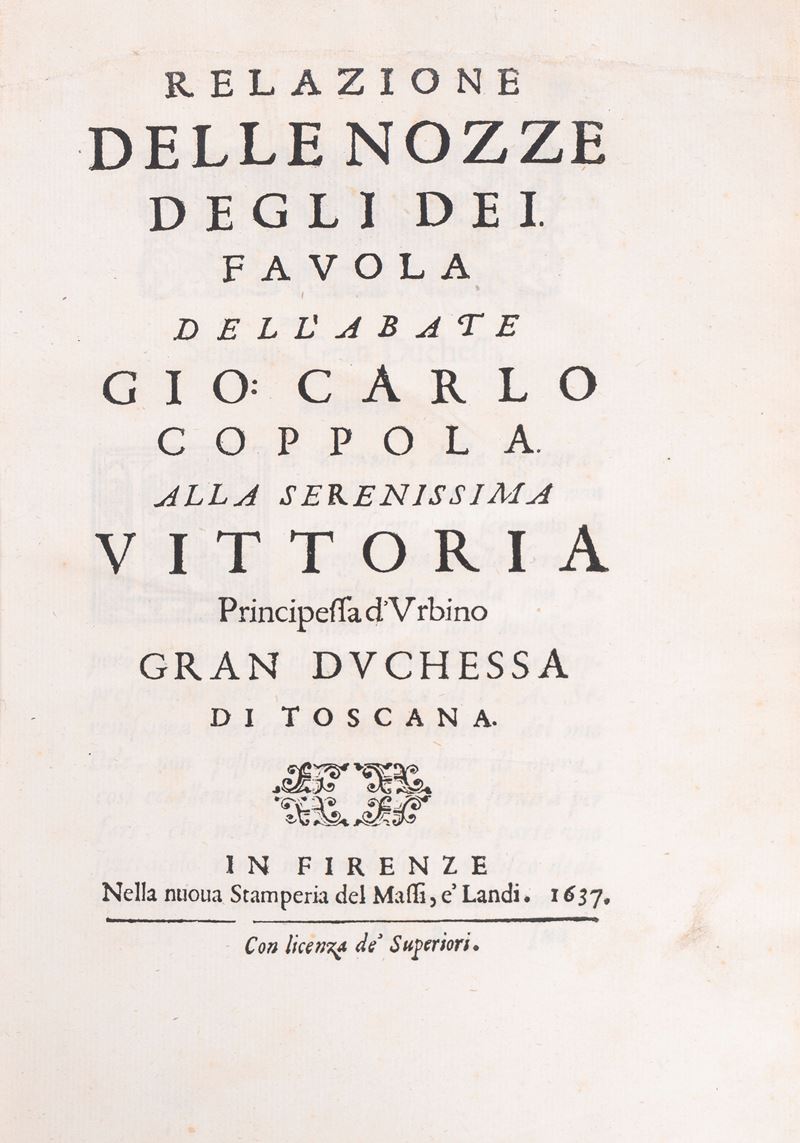
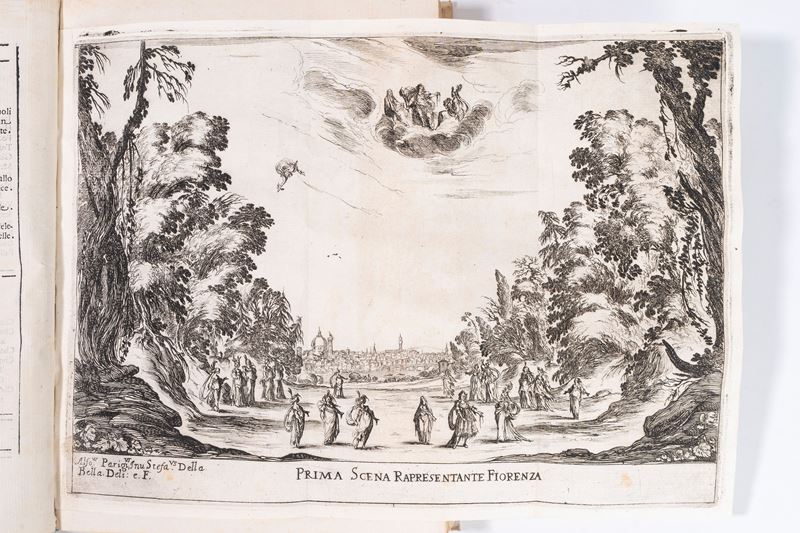
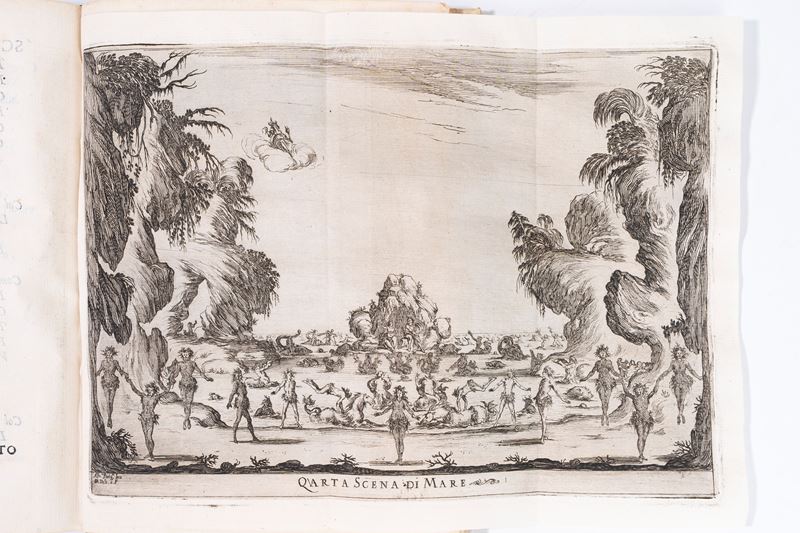
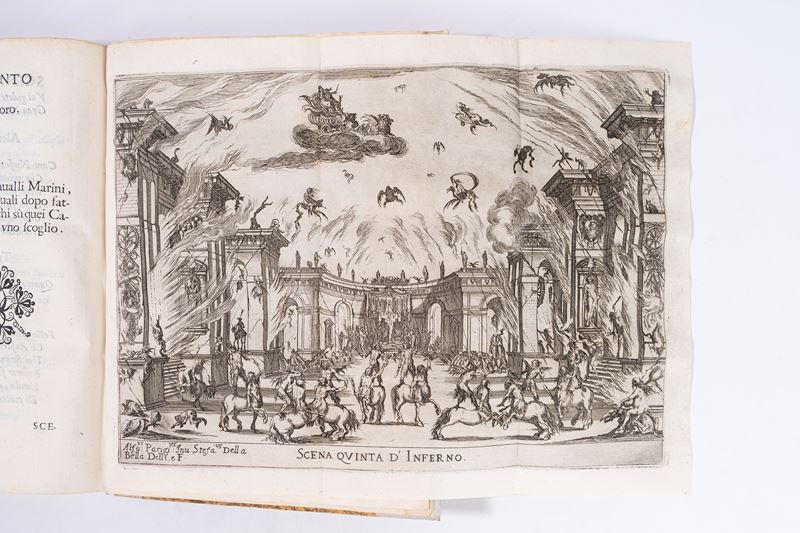
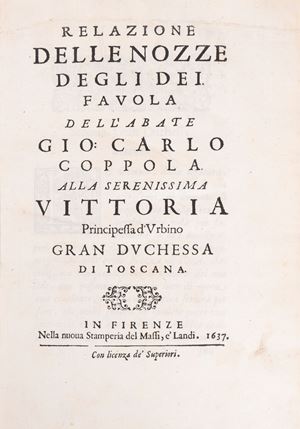
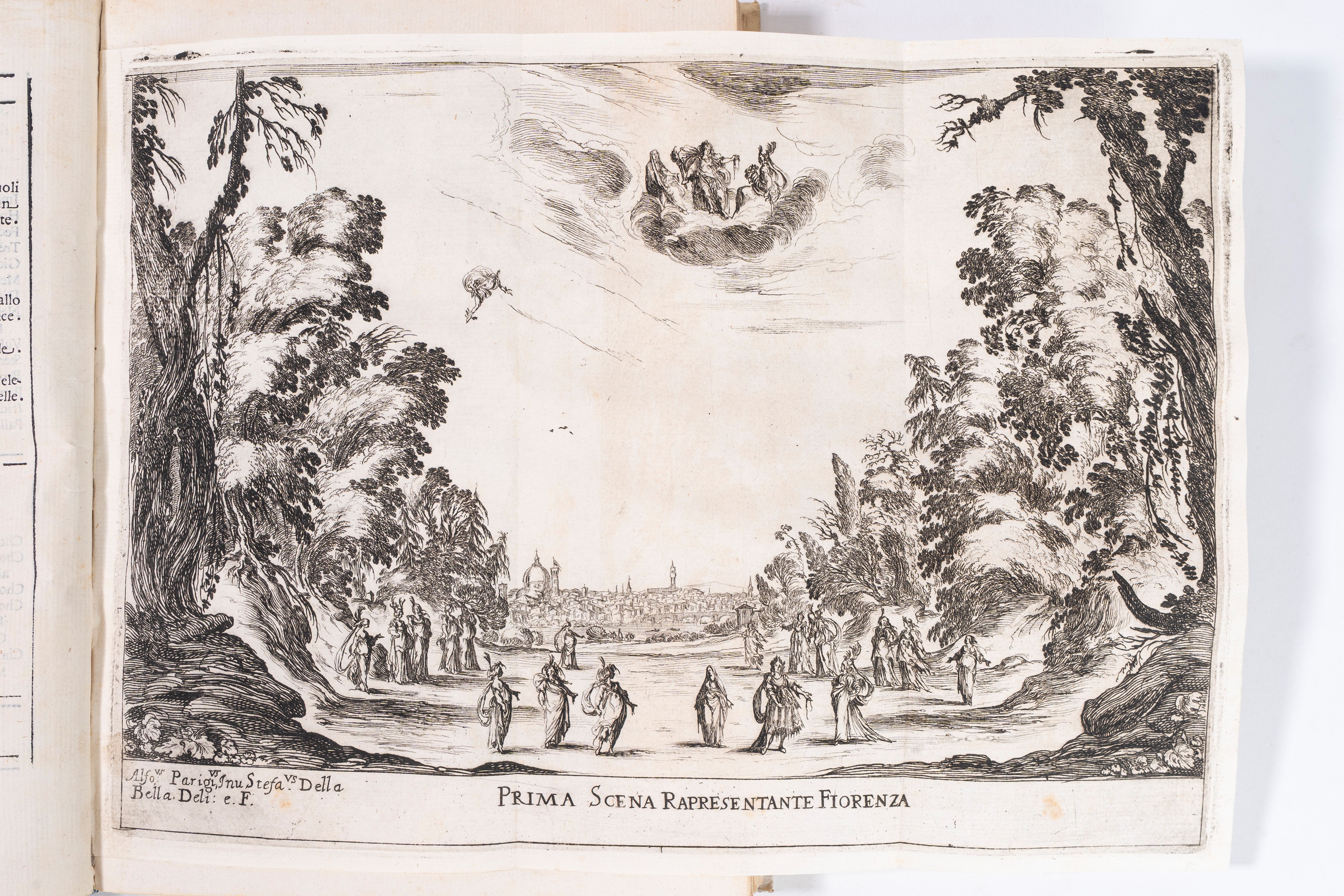
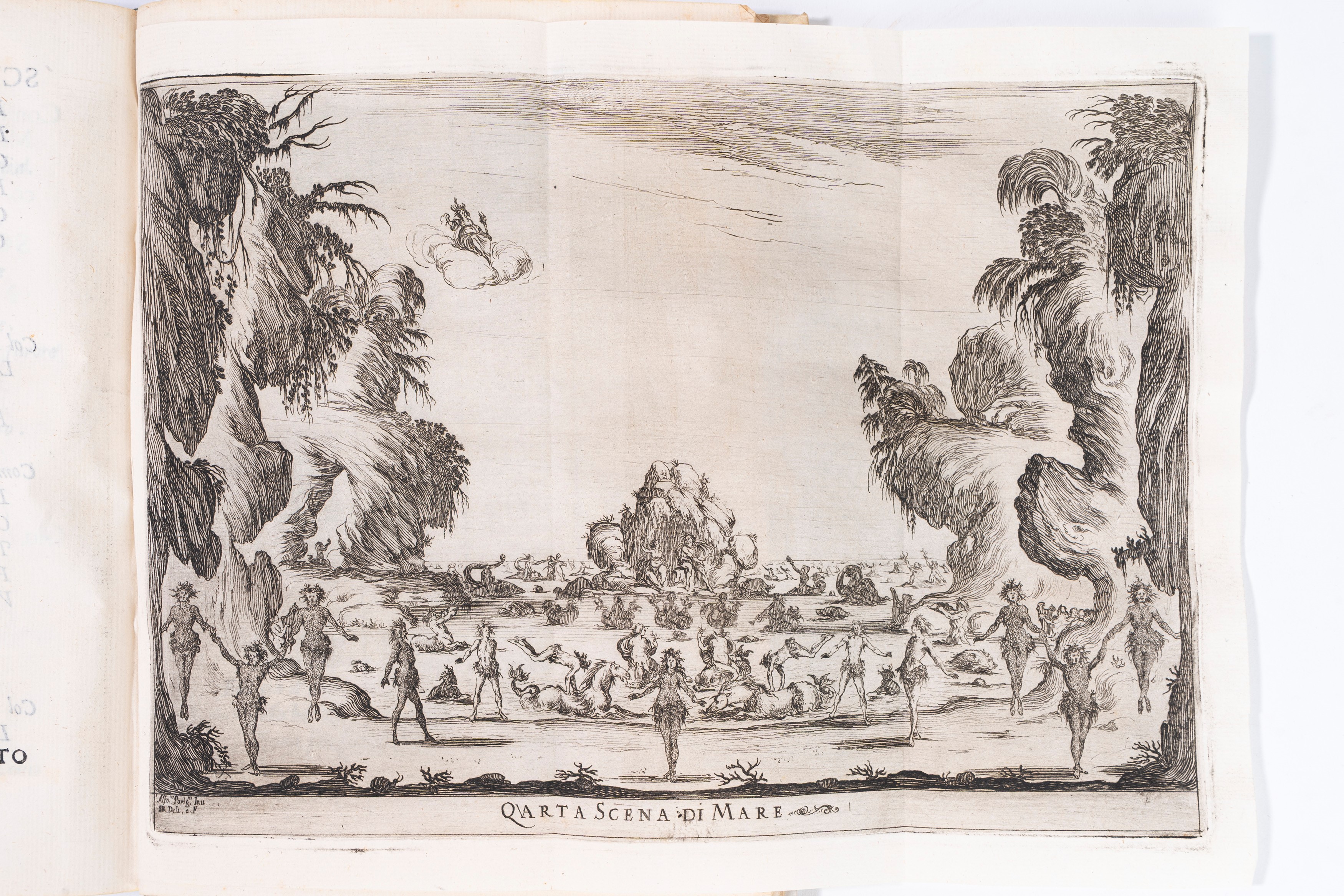
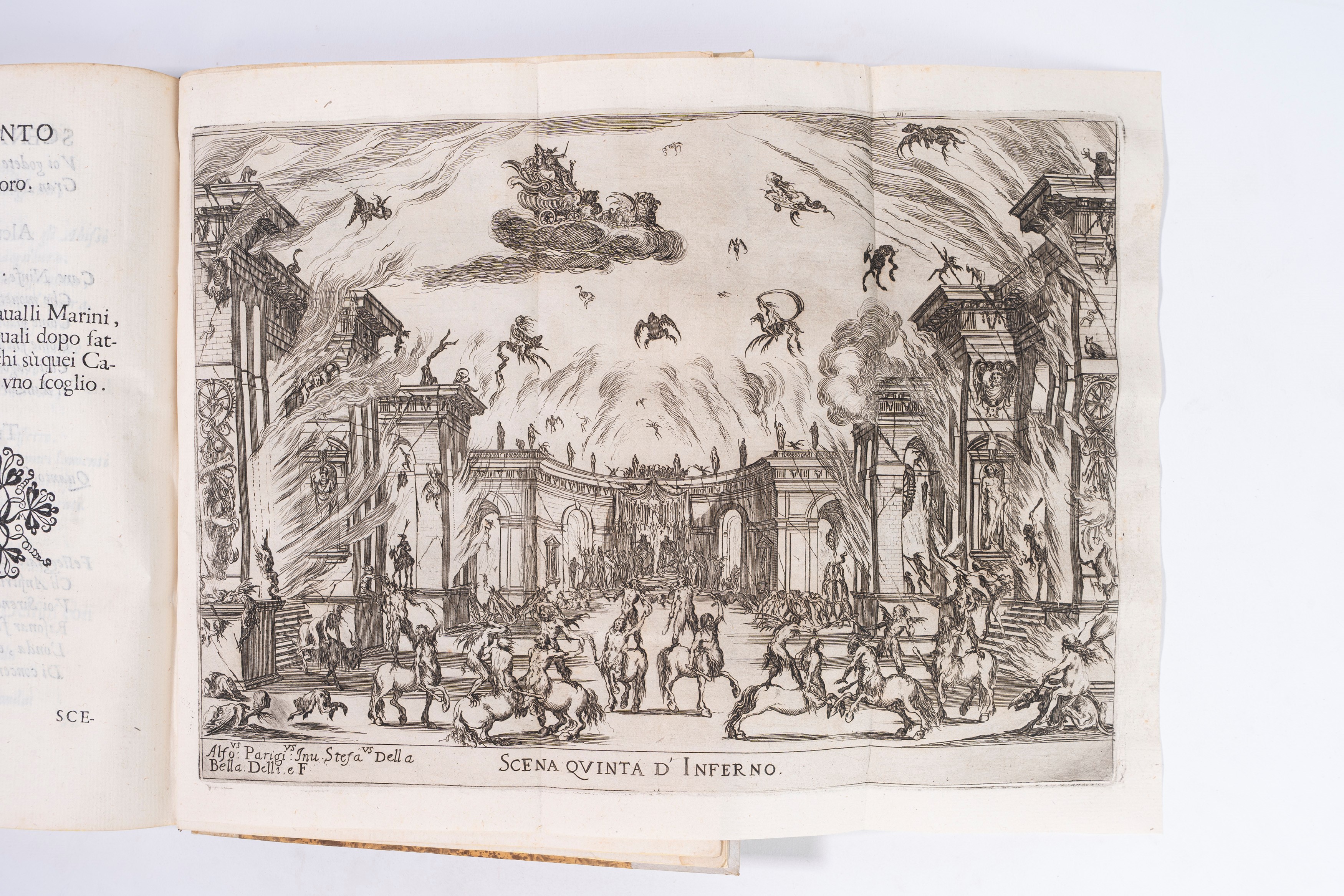
In Florence, by Amadore Massi and Lorenzo Landi, 1637. In 4to. Bound with: Rondinelli Francesco , Relation of the Marriage of the Gods... In Florence, in the new Massi Printing House, and Landi, 1637. Two works in one volume in 4to, 229x167 mm. I work: pages: [8] 104 + chalcographic frontispiece and 7 folded chalcographic plates, copper-engraved by Stefano Della Bella based on drawings by Alfonso Parigi. II work: pages: 50 [2]. Woodcut headpieces, tailpieces and initial letters. 19th century binding in parchment on cardboard, leather binding.
Specialist Notes
The only edition of the libretto for the grandiose court theatrical performance created on the occasion of the wedding of Ferdinando II de' Medici (1610-1670), son of Cosimo II de' Medici, with Vittoria della Rovere (1622-1694), Vulcano e Venere nel melodramma, which was performed on 8 July 1637 in the courtyard of Palazzo Pitti. The splendid engravings by Stefano della Bella are his first major work for the Medici court, after having succeeded Jacques Callot. The presence of the Relazione del Rondinelli, which accurately describes the sumptuous spectacle, is important.
Giovanni Carlo Coppola (1599-1651) was the librettist of a fable about the marriage of the gods Venus and Vulcan, Jupiter and Juno (in heaven), Neptune and Amphitrite (in the sea), and Pluto and Proserpina (in the underworld). The music was composed by Marco da Gagliano, choirmaster of the Medici court, but in reality five composers were commissioned to contribute, with Ferdinando Saracinelli, to the direction. Agnolo Ricci was the choreographer of the various dances that accompany the drama, and Alfonso Parigi designed the sets (including the elaborate stage machinery). These sets are reproduced on the folding plates and give an idea of the grandeur of the production.
Coppola's libretto forms the first part of the opera, while the second part is a description, attributed to Rondinelli, of the production as a whole, an extremely rare account of early operatic stagecraft. We learn, for example, that the production had some 150 singers and at least 25 dancers. Furthermore, this appears to be the first recorded use of the word "opera" to mean a musical drama, rather than "opera," which is its literal translation; the Oxford English Dictionary places the first use in this sense two years later, in 1639.
Brunet, II, 262; Clubb 311; The Place of the Theatre in Florence, pp. 139-143; Nagler, Theater Festivals of the Medici, pp.162-74; The New Grove Dictionary of Opera, III, 855.
Giovanni Carlo Coppola (1599-1651) was the librettist of a fable about the marriage of the gods Venus and Vulcan, Jupiter and Juno (in heaven), Neptune and Amphitrite (in the sea), and Pluto and Proserpina (in the underworld). The music was composed by Marco da Gagliano, choirmaster of the Medici court, but in reality five composers were commissioned to contribute, with Ferdinando Saracinelli, to the direction. Agnolo Ricci was the choreographer of the various dances that accompany the drama, and Alfonso Parigi designed the sets (including the elaborate stage machinery). These sets are reproduced on the folding plates and give an idea of the grandeur of the production.
Coppola's libretto forms the first part of the opera, while the second part is a description, attributed to Rondinelli, of the production as a whole, an extremely rare account of early operatic stagecraft. We learn, for example, that the production had some 150 singers and at least 25 dancers. Furthermore, this appears to be the first recorded use of the word "opera" to mean a musical drama, rather than "opera," which is its literal translation; the Oxford English Dictionary places the first use in this sense two years later, in 1639.
Brunet, II, 262; Clubb 311; The Place of the Theatre in Florence, pp. 139-143; Nagler, Theater Festivals of the Medici, pp.162-74; The New Grove Dictionary of Opera, III, 855.
Contact
Condition report
To request a Condition Report, please contact libriestampe@finarte.it
The department will provide you with a general report of the condition of the property described above. Please note that what Finarte declares with respect to the state of conservation of the objects corresponds only to a qualified opinion and that we are not professional conservators or restorers.
We urge you to consult with a restorer or conservator of your choice who will be better able to provide a detailed, professional report. We always suggest prospective buyers to inspect each lot to satisfy themselves as to condition during the exhibition days as indicated in the catalog.
Suggested lots
Caricamento lotti suggeriti...
More Lots
148