
Starting bid
€ 150
Sold
€ 915
The price includes buyer's premium
Do you have a similar item you would like to sell?
Information
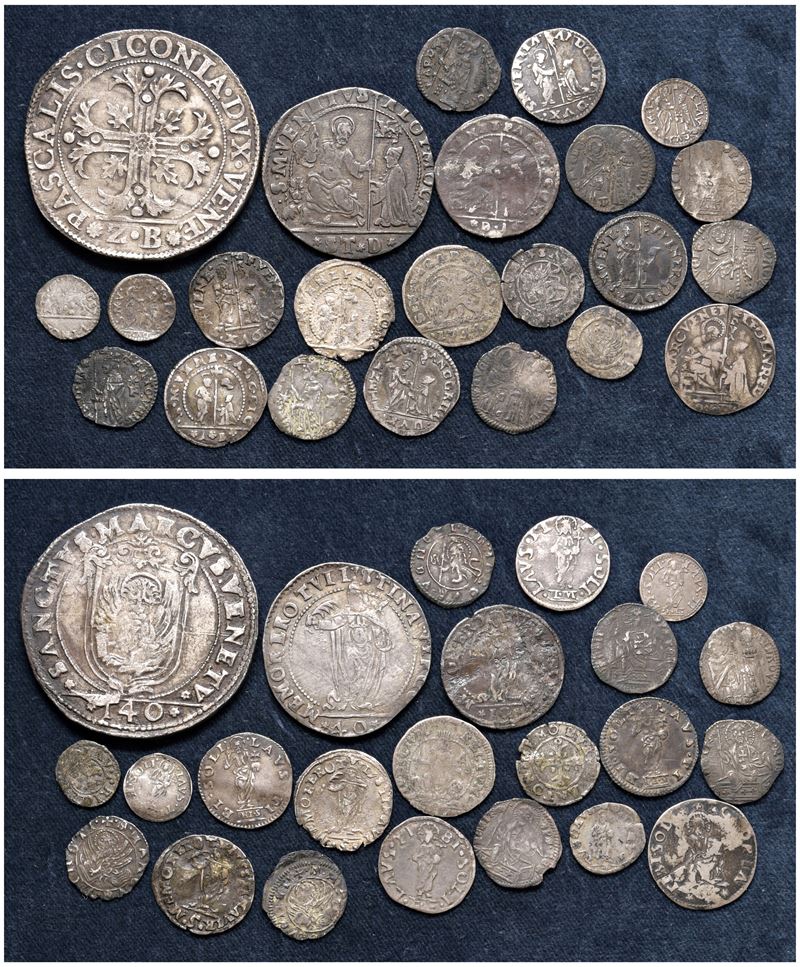
various metals
We report the presence of imitations or reproductions.*
*The coinage of the Republic of Venice, thanks to its stability and the high level of trust it enjoyed in international trade, was among the most widely imitated and counterfeited in the medieval and early modern world. This phenomenon was not a marginal aspect, but rather a direct consequence of the prestige achieved by Venetian coins, particularly the gold ducat, which for centuries became a reference currency in the Mediterranean area and beyond.
We report the presence of imitations or reproductions.*
Preservations from B to BB/SPL.
To be examined.
*The coinage of the Republic of Venice, thanks to its stability and the high level of trust it enjoyed in international trade, was among the most widely imitated and counterfeited in the medieval and early modern world. This phenomenon was not a marginal aspect, but rather a direct consequence of the prestige achieved by Venetian coins, particularly the gold ducat, which for centuries became a reference currency in the Mediterranean area and beyond.
From as early as the 13th century, the wide circulation of the Venetian ducat in the markets of the Levant, the Balkans, and the eastern Mediterranean encouraged the emergence of local imitations, often produced to meet practical needs of exchange. These issues reproduced the weight, fineness, and iconography of Venetian coins, while displaying a more simplified style and irregular legends. In many cases, these were not counterfeits in the strict sense, but coins functional to trade, created to replace a universally accepted means of payment that was not always readily available.
Alongside these productions, genuine contemporary counterfeits developed, intended to circulate fraudulently together with official coinage. These mainly affected widely used silver and billon denominations, through the reduction of fineness or the use of base metals. Their spread was encouraged by periods of economic crisis and by the difficulty of controlling an extremely vast commercial territory. The Republic responded with severe laws and exemplary punishments, fully aware that the credibility of its currency was an essential element of its economic strength.
In more recent times, with the rise of numismatic collecting between the 19th and 20th centuries, counterfeiting took on different aims. Notably, the scholar and forger Luigi Cigoi became famous for producing a very large number of forgeries intended for the antiquarian market.
In light of the above, we believe that eastern imitations and counterfeits, whether contemporary or more modern, represent an area of great interest for study and further research. Putting ourselves in the position of the collector who knowingly assembled such specimens, we wished to respect that collecting approach by re-presenting some of these imitations or reproductions—certainly not devoid of their own economic and collectible value—within mixed lots rich in authentic examples, thus offering a meaningful snapshot of the coinage in circulation at the time.
Contact
Suggested lots
Caricamento lotti suggeriti...
More Lots
221
Repubblica di Venezia
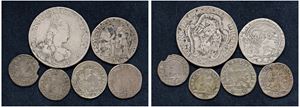
VARIOUS DOGES (18th century) – Lot of 6 coins, Venice.
Sold € 550
(buyer's premium not included)
222
Repubblica di Venezia
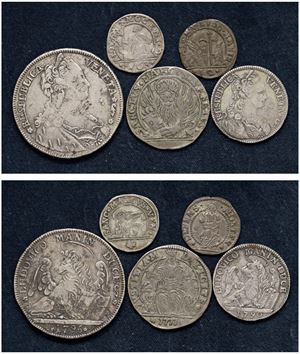
VARIOUS DOGES (18th century) – Lot of 5 coins, Venice.
Sold € 550
(buyer's premium not included)
223
Repubblica di Venezia
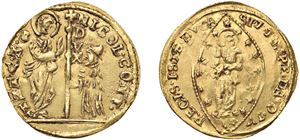
NICOLO' CONTARINI, doge XCVII (1630 - 1631) – Forgery attributed to Luigi Cigoi of the Zecchino...
Sold € 700
(buyer's premium not included)
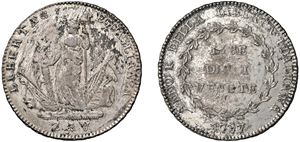
224
Municipalità provvisoria di Venezia (1797)
Ten Venetian lire 1797, Venice.
Sold € 550
(buyer's premium not included)