
13
Monete Greche e Puniche (shipping only in Italy)
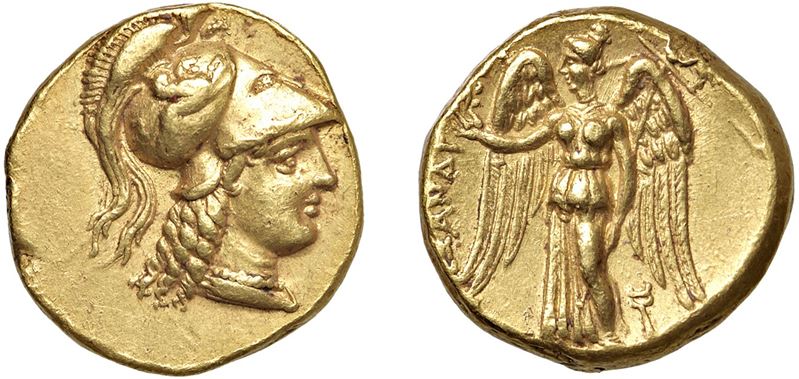
MACEDONIA – ALEXANDER THE GREAT (336-323 BC) - Stater. Issued under Balakros or Menes, circa 332-327 BC, Tarsus.
Starting bid
€ 1.500
Sold
€ 4.636
The price includes buyer's premium
Do you have a similar item you would like to sell?
Information
in gold
8.57 gr. - Diam. 15.90/16.80 mm.
Obverse: Head of Athena right, wearing Corinthian helmet; Reverse: Nike standing left, holding wreath in right hand; kerykeion (caduceus) beneath wing in right field.
From the prestigious “Caruso Collection”, which belonged to Comm. Enrico Caruso and was auctioned by C. & C. Canessa on 28 June 1923 and following, at their headquarters in Naples, lot 47.
Shipping only in Italy.
8.57 gr. - Diam. 15.90/16.80 mm.
Obverse: Head of Athena right, wearing Corinthian helmet; Reverse: Nike standing left, holding wreath in right hand; kerykeion (caduceus) beneath wing in right field.
Price 3458 (Sidon).
Little nick on the reverse edge.
BB/SPL.
From the prestigious “Caruso Collection”, which belonged to Comm. Enrico Caruso and was auctioned by C. & C. Canessa on 28 June 1923 and following, at their headquarters in Naples, lot 47.
Shipping only in Italy.
Newell initially assigned this coin group to the Sidon mint, including it among eight stater issues (in addition to two distaters) characterized by the absence of a signature or mint date, elements present on almost all other Sidonian mintages. Newell himself subsequently questioned this attribution, advancing the hypothesis that these issues could have come from an older mint located in the Damascus area, as also noted by G.F. Hill (JHS 43, 1923, p. 159).
Price, while formally continuing to follow Newell's original proposal, also expressed significant reservations about its reliability (Price, p. 436). A comprehensive reexamination of the issue was conducted by Le Rider in his recent synthesis of the coinage of Alexander the Great (Alexander the Great: Coinage, Finances, and Policy, Philadelphia 2007). Retracing the previous debate and integrating data from more recent studies, Le Rider argues in a reasoned manner that these eight gold issues should be attributed not to Sidon, but to the mint of Tarsus, where they would constitute the first mintings of Alexandrian-type staters (pp. 134–139).
This new attribution substantially changes the historical value of the issues. It is widely believed that Alexander began producing his new coin types shortly after the capture of Tarsus in 333 BC.
Precisely because of this city's central role, and on the basis of the evidence then available, Newell had initially assigned a large number of staters from the early Alexandrian period to Tarsus (ET Newell, “Tarsos under Alexander,” AJN 52, 1918). Subsequent scholarship, however, has relocated almost all of these issues to Macedonian circles (see Price, p. 371; Troxell, Studies, pp. 99–110).
The reassignment of the eight issues previously attributed to Sidon thus fills a significant gap in the gold documentation of Tarsus, identifying them not only as the first Alexandrian mintages, but likely as the first stater issues of Alexander the Great ever.
Contact
Suggested lots
Caricamento lotti suggeriti...
More Lots
14
Monete Romane Repubblicane (Shipping only in Italy)
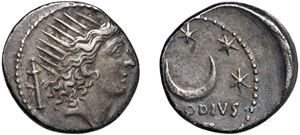
GENS CLAUDIA – C. Clodius Mf Turrinus (42 BC) - Denarius. Rome.
Sold € 130
(buyer's premium not included)
15
Monete Romane Repubblicane (Shipping only in Italy)
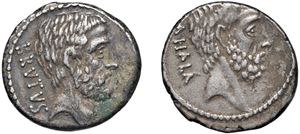
IMPERATORIALS - M. Junius Brutus (54 BC) - Denarius, Rome.
Sold € 400
(buyer's premium not included)
16
Monete dell'Impero Romano (shipping only in Italy)
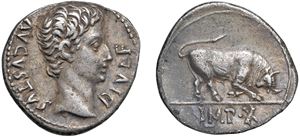
AUGUSTUS (27 BC - 14 AD) – Denarius, Lugdunum (Lyon).
Sold € 550
(buyer's premium not included)
17
Monete dell'Impero Romano (shipping only in Italy)
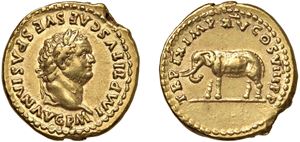
TITUS (79-81) – Aureus, n.d., Rome.
Sold € 13.000
(buyer's premium not included)