
Starting bid
€ 1.500
Sold
€ 5.490
The price includes buyer's premium
Do you have a similar item you would like to sell?
Information
in silver
8.38 gr. - Diam. 34.50 mm.
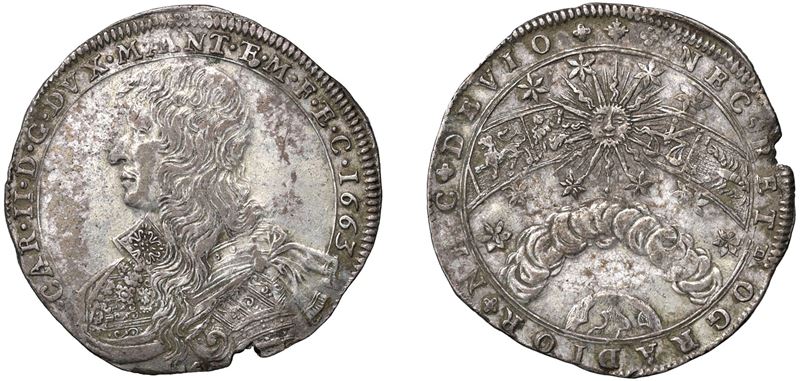
Obverse: Armored and robed bust left, with long hair; - Reverse: Sun in zodiac among stars; below, the Earth among clouds.
8.38 gr. - Diam. 34.50 mm.
Obverse: Armored and robed bust left, with long hair; - Reverse: Sun in zodiac among stars; below, the Earth among clouds.
MIR 695. CNI 16/17. Extremely rare.
Slightly missing planchet. This type appears very rarely on the market.
q.BB/BB.
Charles II of Gonzaga-Nevers (1629–1665) became Duke of Mantua and Montferrat in 1637, at the age of just eight, during a period of profound crisis for the Gonzaga state. The duchy had emerged devastated by the War of the Mantuan Succession (1628–1631), the imperial occupation, and the plague, events that had severely compromised the economy, demographics, and the very authority of the dynasty. In this context, a long and delicate regency unfolded, entrusted to his mother Maria Gonzaga, who exercised power with notable firmness and diplomatic skill, managing to preserve her son's legitimacy and ensure the continuity of the state.
With Charles II's assumption of power, monetary policy was able to take on a more ambitious and markedly representative character. It is within this framework that the issuance of the Zodiac quarter ducat fits in, one of the most original and iconographically complex coins of the Mantuan coinage of the 17th century.
The astrological theme, rare in Italian coinage, draws full inspiration from the earlier mintings of his father Charles I, created by the renowned engraver Gaspare Morone Mola. The quality of the dies, especially the rendering of the zodiac signs, indicates the involvement of high-level engravers working at the Mantua Mint, capable of translating a refined iconographic program into a compact space.
The choice of the Zodiac as a central theme should be read as a truly symbolic political statement: after years of regency and reconstruction, ducal power appears to have been reinstated in a stable order, not only earthly but universal. In this sense, the coin also ideally dialogues with the politics of Maria Gonzaga, who had worked to restore
continuity to the State, providing the son with a platform on which to reassert his authority.
Following the premature death of Charles II in 1665, the duchy gradually entered a phase of irreversible decline. This issue thus remains one of the finest numismatic testimonies of the period: not only an engraving masterpiece, but also a historical and ideological document, capable of condensing into a single issue the memory of the crisis, the legacy of the regency, and the ambition of a power that sought lasting legitimacy through the language of images.
Contact
Suggested lots
Caricamento lotti suggeriti...
More Lots
89
Ducato di Mantova
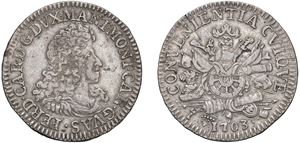
FERDINANDO CARLO GONZAGA-NEVERS (1669 - 1707) – Scudo 1703, II type, Mantua.
Sold € 500
(buyer's premium not included)
90
Ducato di Mantova
FERDINANDO CARLO GONZAGA-NEVERS (1669 - 1707) – Lot of 9 coins, Mantua.
Sold € 750
(buyer's premium not included)
91
Ducato di Mantova
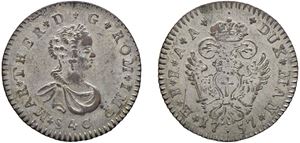
MARIA TERESA OF HABSBURG (1740 - 1780) – 40 soldi 1757, Mantua.
Sold € 5.500
(buyer's premium not included)
92
Ducato di Mantova
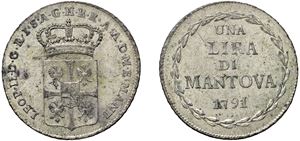
LEOPOLD II OF HABSBURG-LORRAINE (1790 - 1792) - Lira 1791, Mantua.
Sold € 500
(buyer's premium not included)