
Estimate
€ 7.000 - 10.000
Aggiudicato
Current bid Starting bid
€ 7.000
Your offer is the highest Your bid doesn't meet the reserve price La tua offerta è stata superata(0 bids, reserve not met)
At auction on Friday 26 June 2026 at 15:00
Information
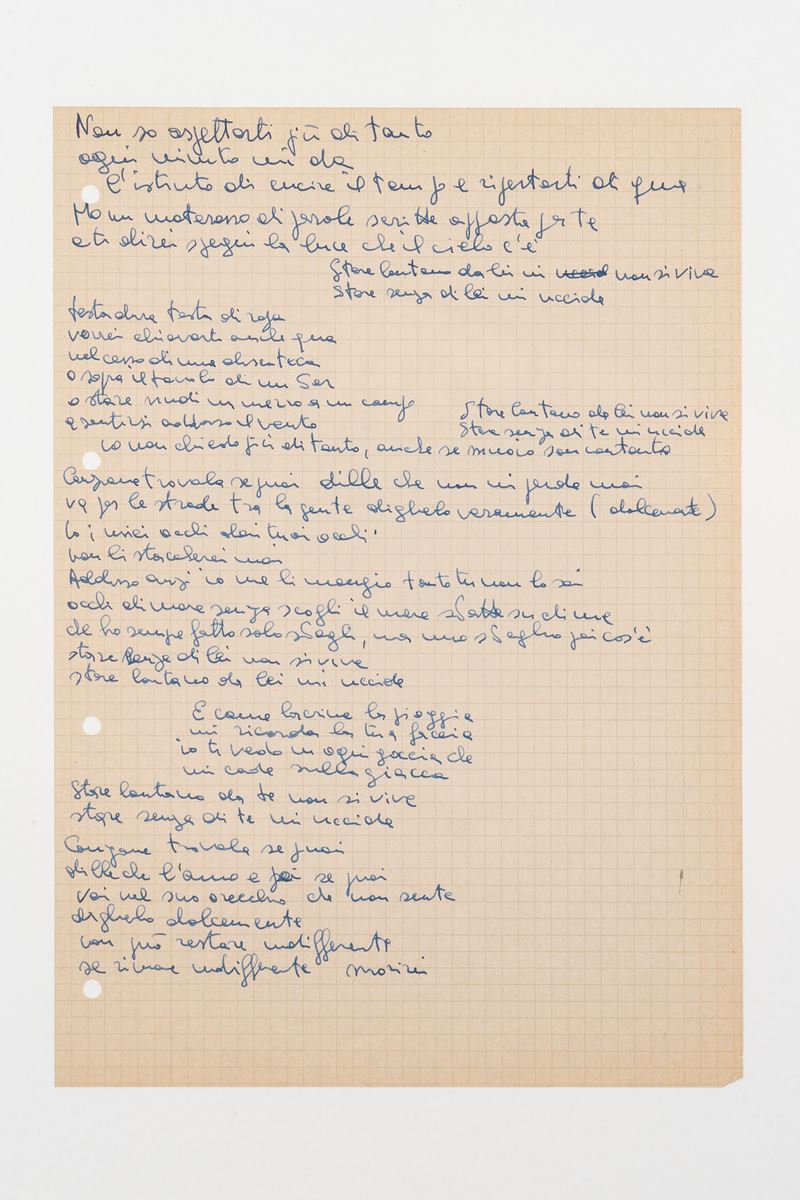
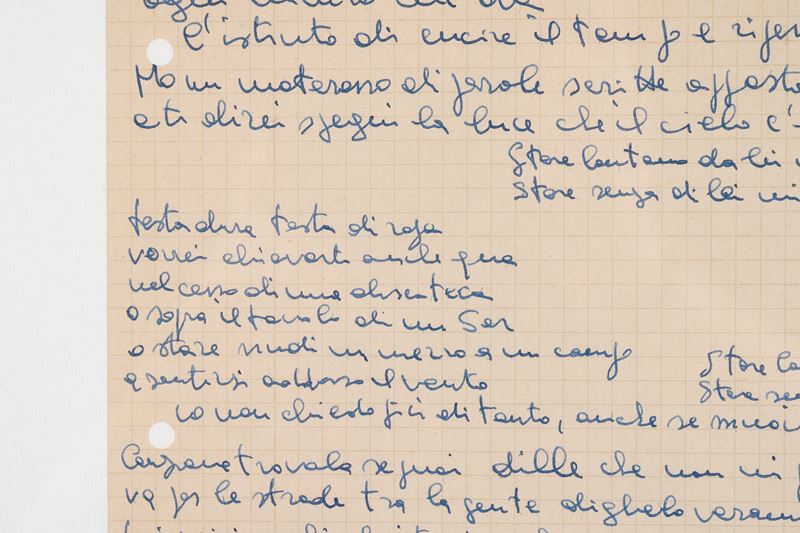
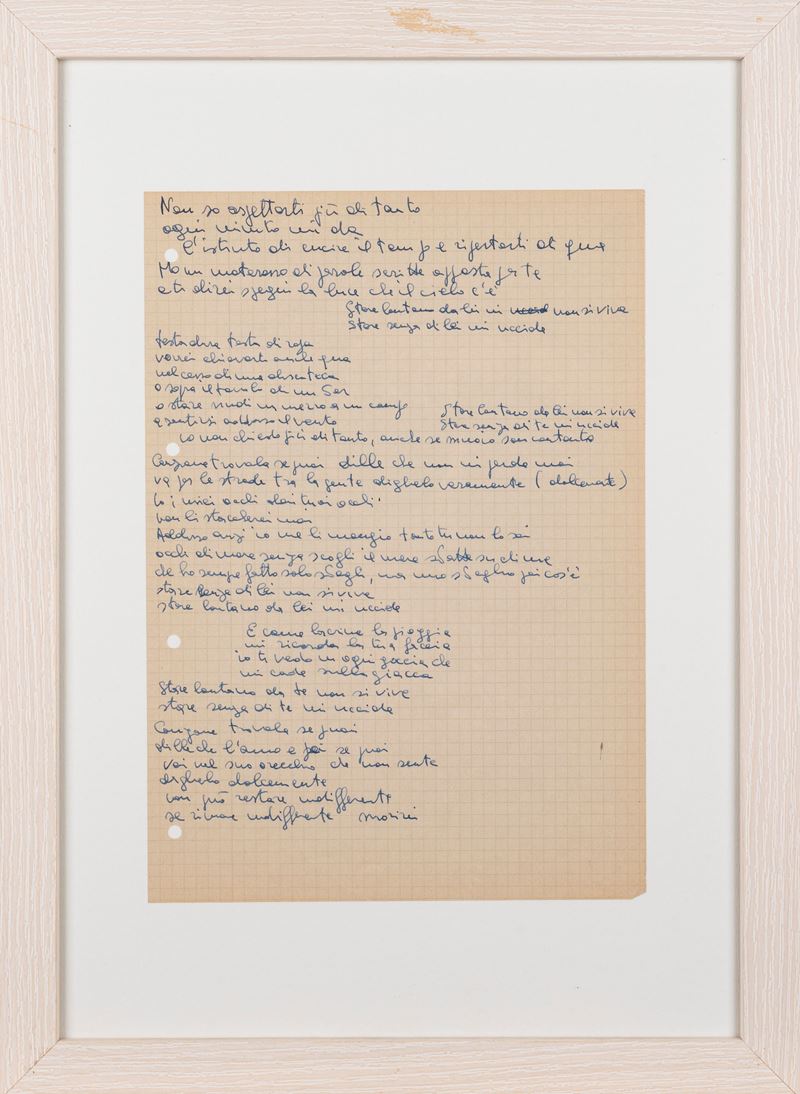
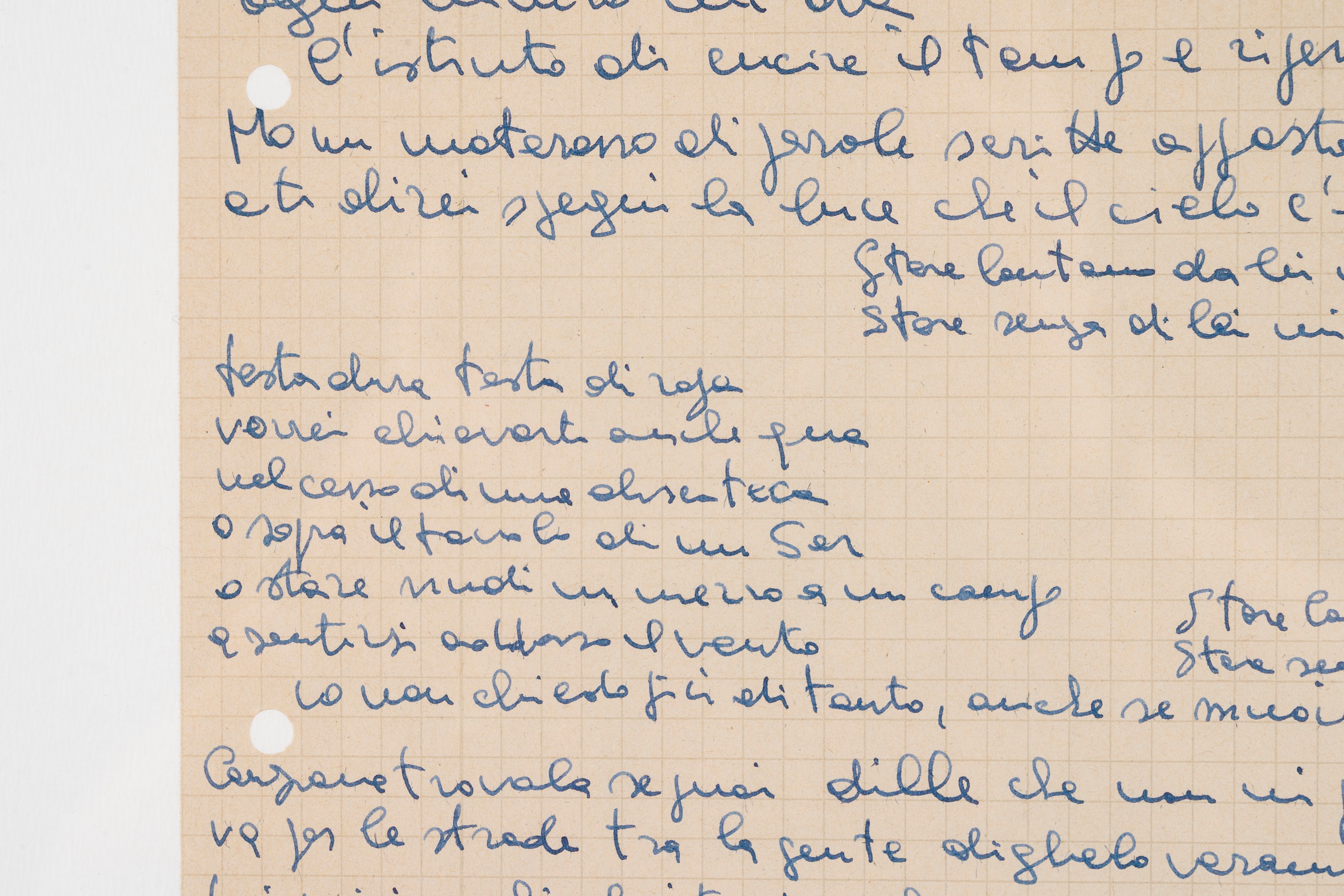
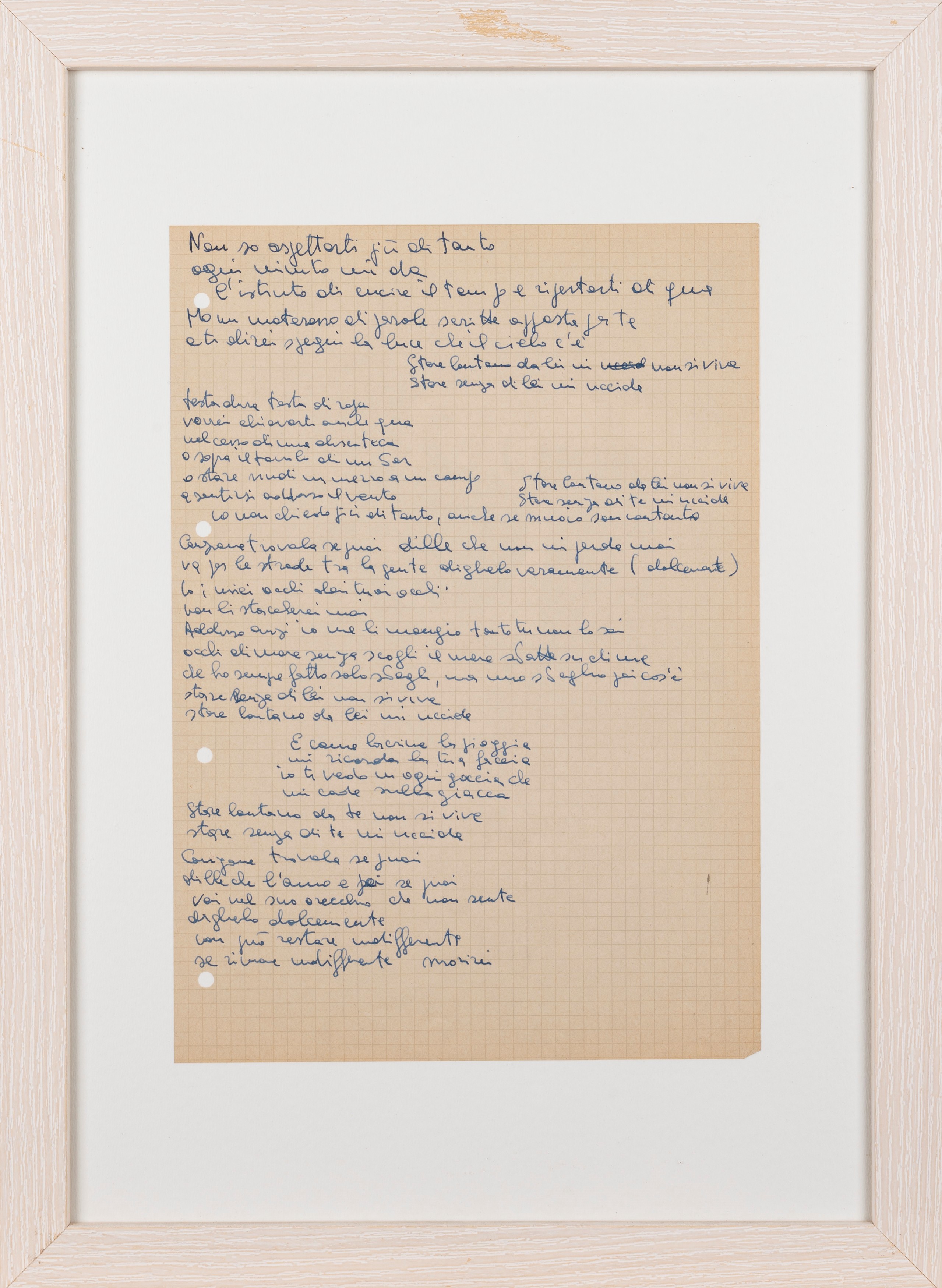
A page of squared paper with a clean copy in Lucio Dalla's handwriting of the famous "Canzone" , recorded in the summer of 1996 as a single, then included in the eponymous album "Canzone" in September 1996.
Specialist Notes
DALLA'S SECOND WIN EVER, AFTER CARUSO . WITH A VERY INTERESTING VARIANT.
In 2012, Il Sole 24 Ore published the ranking of Dalla's songs that had generated the highest royalties according to SIAE: 1. Caruso 2. Song 3. March 4, 1943 Caruso remains an unrivaled hit, but Canzone represents Dalla's second-biggest commercial success overall. Official sales figures for the single aren't available, but it plausibly sold (along with the album) no fewer than 1.5 million copies. Canzone is probably the second-highest-grossing song in Dalla's entire catalog after Caruso , according to the SIAE charts published by the business press, a sign of its enormous popularity over time, thanks in part to its numerous reinterpretations.
The present manuscript, faithful to the text of the hit, presents an interesting variant:
"(..) hard head, turnip head / I'd like to screw you here too / in the toilet of a nightclub / or on a bar table .." In the final version, chiavarti is transformed into a much more harmless amarti , with a significant semantic weakening. Censorship? Self-censorship? It's hard to say, certainly the form chiavarti would have had considerable expressive power, which instead appears blunted in the generic amarti.
"Canzone" is, on the surface, a simple declaration of love. In reality, it's one of Lucio Dalla's most intense songs, speaking above all of desire, absence, and the need for another. The protagonist can no longer bear being away from the woman he loves. He's not telling a specific story: he's pouring into music everything he wants to say to her and experience with her. The central idea is that the song itself becomes a messenger: "Canzone, cercala se puoi..." The song is sent "through the streets among the people" so that it can reach the loved one and communicate what he cannot say directly. The reference to the lyricism of the stilnovist period is subtle: in stilnovist poetry (and already in the preceding Provençal tradition), the motif of the poetic word that "travels" towards the beloved woman actually exists. In Canzone, the song is personified, "He wanders the streets among the people," he must reach the woman he loves as an emotional messenger: all these are motifs very close to the medieval topos reworked in a modern key. The real substantial difference is that while in the Stilnovo the word tends to idealize and spiritualize distance, in Dalla the song instead becomes a concrete object, almost urban and modern, which loses itself in the real world to reach someone, a concrete person.
In 2012, Il Sole 24 Ore published the ranking of Dalla's songs that had generated the highest royalties according to SIAE: 1. Caruso 2. Song 3. March 4, 1943 Caruso remains an unrivaled hit, but Canzone represents Dalla's second-biggest commercial success overall. Official sales figures for the single aren't available, but it plausibly sold (along with the album) no fewer than 1.5 million copies. Canzone is probably the second-highest-grossing song in Dalla's entire catalog after Caruso , according to the SIAE charts published by the business press, a sign of its enormous popularity over time, thanks in part to its numerous reinterpretations.
The present manuscript, faithful to the text of the hit, presents an interesting variant:
"(..) hard head, turnip head / I'd like to screw you here too / in the toilet of a nightclub / or on a bar table .." In the final version, chiavarti is transformed into a much more harmless amarti , with a significant semantic weakening. Censorship? Self-censorship? It's hard to say, certainly the form chiavarti would have had considerable expressive power, which instead appears blunted in the generic amarti.
"Canzone" is, on the surface, a simple declaration of love. In reality, it's one of Lucio Dalla's most intense songs, speaking above all of desire, absence, and the need for another. The protagonist can no longer bear being away from the woman he loves. He's not telling a specific story: he's pouring into music everything he wants to say to her and experience with her. The central idea is that the song itself becomes a messenger: "Canzone, cercala se puoi..." The song is sent "through the streets among the people" so that it can reach the loved one and communicate what he cannot say directly. The reference to the lyricism of the stilnovist period is subtle: in stilnovist poetry (and already in the preceding Provençal tradition), the motif of the poetic word that "travels" towards the beloved woman actually exists. In Canzone, the song is personified, "He wanders the streets among the people," he must reach the woman he loves as an emotional messenger: all these are motifs very close to the medieval topos reworked in a modern key. The real substantial difference is that while in the Stilnovo the word tends to idealize and spiritualize distance, in Dalla the song instead becomes a concrete object, almost urban and modern, which loses itself in the real world to reach someone, a concrete person.
Contact
Condition report
To request a Condition Report, please contact
The department will provide you with a general report of the condition of the property described above. Please note that what Finarte declares with respect to the state of conservation of the objects corresponds only to a qualified opinion and that we are not professional conservators or restorers.
We urge you to consult with a restorer or conservator of your choice who will be better able to provide a detailed, professional report. We always suggest prospective buyers to inspect each lot to satisfy themselves as to condition during the exhibition days as indicated in the catalog.
Suggested lots
Caricamento lotti suggeriti...
More Lots
106
Lucio Dalla
Lucio Dalla's Personal Fiat 500 Sport
Estimate € 7.000 - 10.000
Starting bid € 7.000
107
Dalla, Lucio (Bologna, 4 marzo 1943 – Montreux, 1º marzo 2012), 1983
Estimate € 250 - 300
Starting bid € 180
108
Battisti, Lucio (Poggio Bustone, 5 marzo 1943 – Milano, 9 settembre 1998), 1964-1965
Estimate € 2.000 - 2.500
Starting bid € 1.000

109