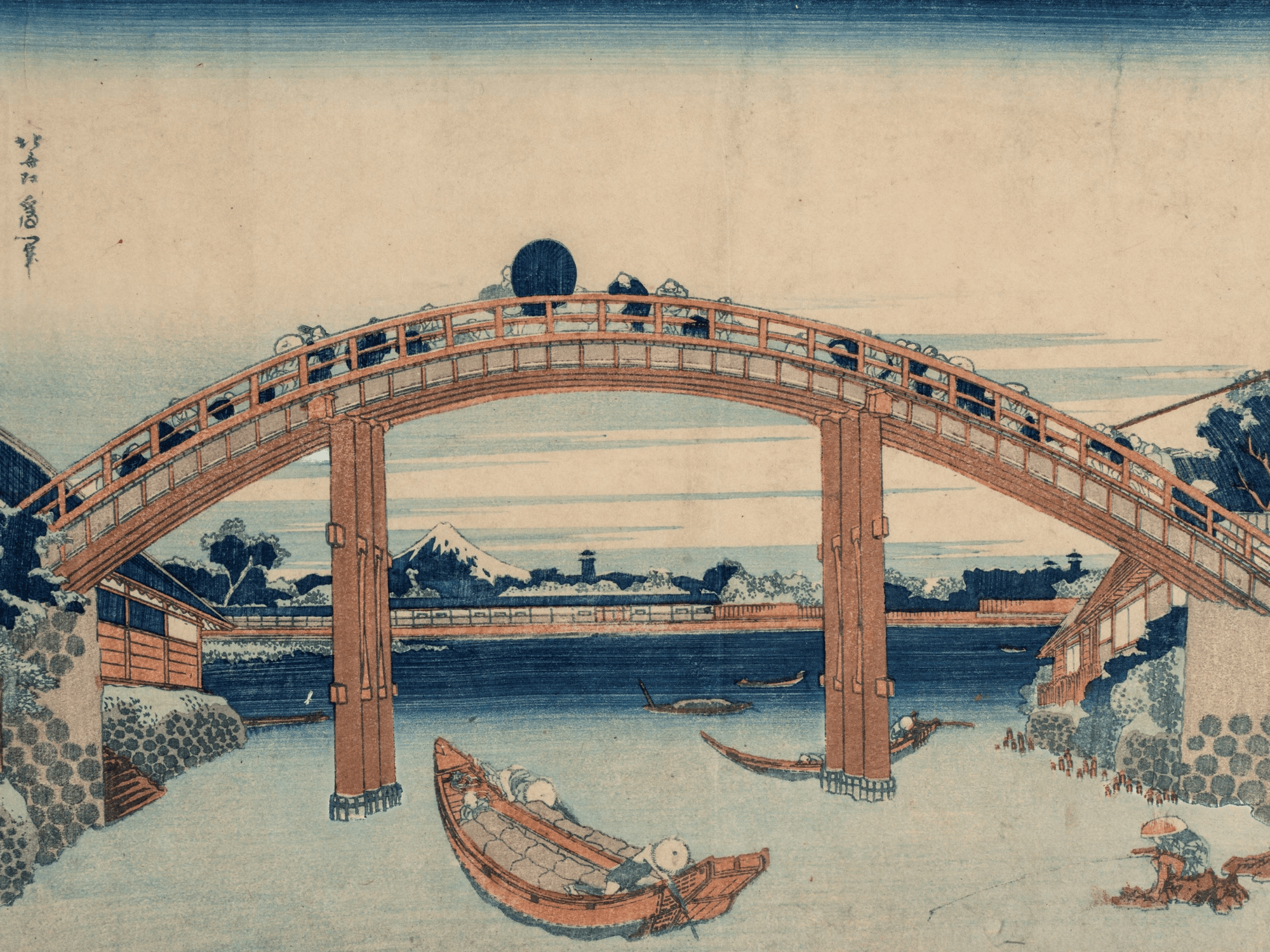
Katsushika Hokusai (1760–1849) is one of the few artists in history to have achieved truly global fame spanning centuries, cultures and media, from Monet’s collection to Apple emojis, from museum walls to the Japanese thousand-yen note. A supreme master of ukiyo-e and a tireless innovator, Hokusai redefined the Japanese landscape print, transforming it from a narrative backdrop into an autonomous subject with a visual language of extraordinary modernity. On April 29th, we bring two views from his most celebrated series to auction in Milan: Under the Mannen Bridge at Fukagawa and Senju, Musashi Province.
Here are five things you must know before bidding.
1. He drew them in his seventies
Hokusai began painting around the age of six and never really put his brush down. Over his lifetime he produced more than 30,000 works: paintings, woodblock prints, illustrated books and sketches — a staggering output, tragically reduced when a fire destroyed his studio and much of his archive in 1839. And yet the works for which he is remembered worldwide such as the Great Wave, the Red Fuji, and the views now at auction, all belong to his seventh decade of life. The Thirty-six Views of Mount Fuji were published from 1830 onwards, when Hokusai was seventy and signed himself Gakyō-Rōjin: “the old man mad about drawing.” Certain he had not yet reached true artistic maturity, he once wrote: “At ninety I’ll understand the inner meaning of all things, and at a hundred years old, I’ll reach a truly marvellous artistic knowledge.”
2. The colour that crossed the world
What makes these prints immediately recognisable is their unmistakable blue: bero-ai, or Prussian blue, a synthetic pigment imported from the Netherlands. During the Edo period Japan lived under near-total isolation (sakoku): the only port open to foreign trade was Nagasaki, and the only European partner allowed was the Dutch. Through that narrow channel came the engravings, the perspective techniques and the inks that Hokusai studied voraciously. Then, came Prussian blue with its chromatic intensity that no traditional Japanese pigment could match. In the prints now at auction, the blue outline in place of the conventional black is the hallmark of the earliest impressions, made when the woodblocks were still fresh and the colour at its most intense.
3. What the two views depict
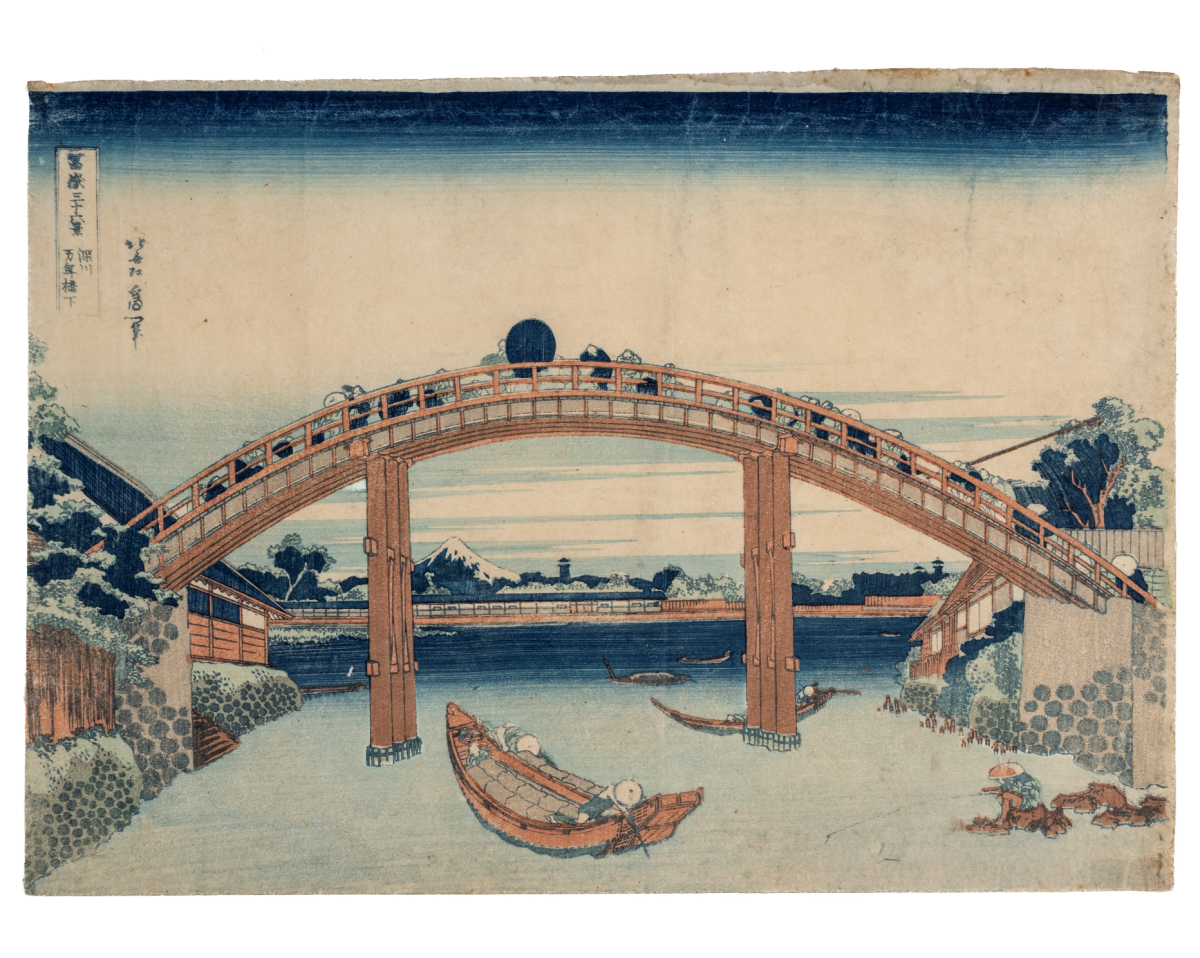
Under the Mannen Bridge at Fukagawa (ca. 1830–31) – Lot 135. The sixth view in the series adopts an almost photographic, low and frontal vantage point: the Mannen Bridge occupies the centre of the composition with its robust arch, supported by timber-framed pillars lashed together with thick rope. Crowds lean over the railings on one side peering down at the boats and the lone fisherman on the rocks below, on the other gazing toward the snow-capped Fuji on the horizon. The bridge connects the districts of Fukagawa and Fukagawa Kiyomizu, divided by the Onaki River; beyond the bridge flows the Sumida, behind which lay the lively district of Nakasu. A composition that balances monumental architecture and street-level life, with a perspectival confidence that anticipates photography by decades.
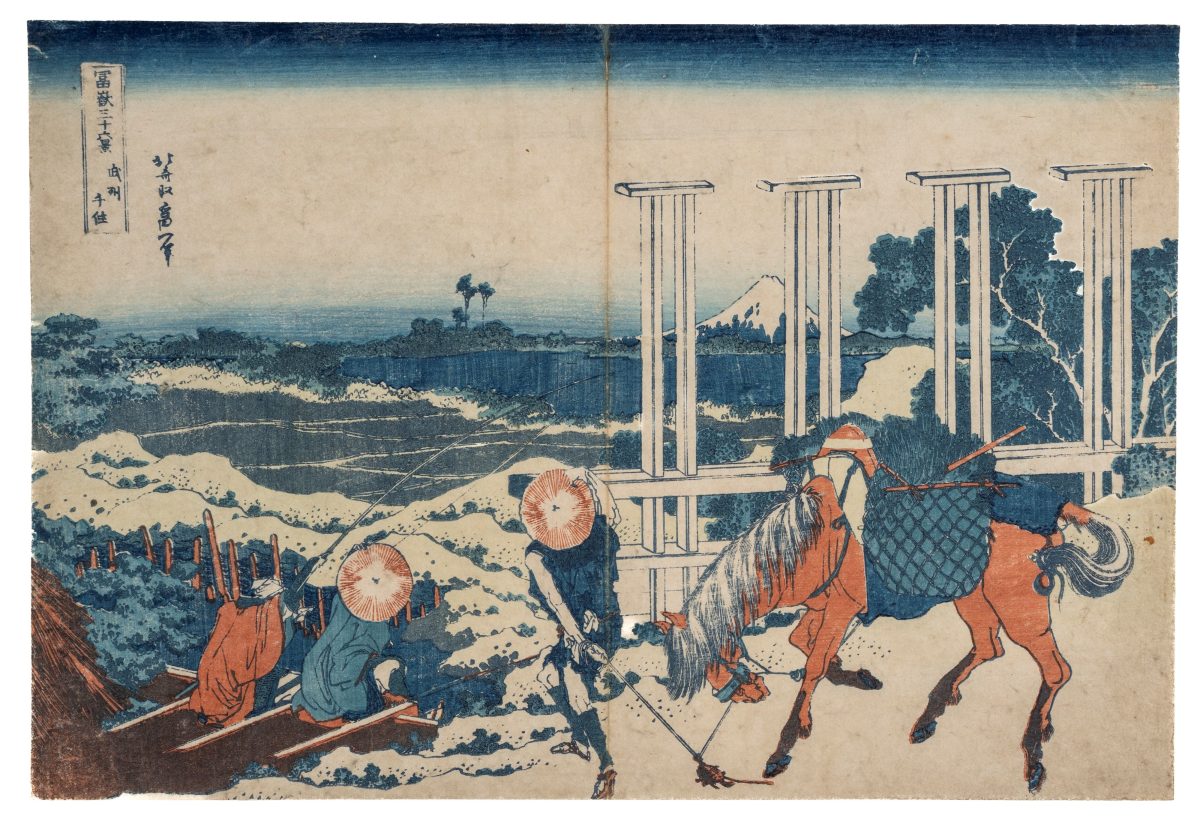
Senju, Musashi Province (ca. 1830–32) – Lot 134. The fourteenth view opens onto a wider scene. Senju was a crucial junction along the main routes into the capital Edo, and Hokusai renders it through a three-tiered horizontal composition — shore, river, sky — in which everything is still. Water surfaces are rendered in flat chromatic washes; farmers and fishermen move along the banks with quiet discretion; and in the background, the unmistakable silhouette of Fuji closes the horizon, unmoved as ever. Detail and synthesis, daily life and vastness: Hokusai holds it all in perfect equilibrium.
4. Thirty-six views. Forty-six prints
The Thirty-six Views of Mount Fuji are in fact forty-six. The series was so immediately successful that the publisher Nishimuraya Yohachi (Eijudo), the same house that published the works now at auction, added ten further plates to the original thirty-six without updating the title. Hokusai depicted Fuji from different provinces, seasons and weather conditions, always with the mountain as the fixed constant and human life as its counterpoint. Today, fewer than ten complete sets are believed to exist worldwide.
5. Hokusai’s place in the market
Hokusai’s landscape views from mature series are among the most sought-after works in the ukiyo-e market, with comparable impressions held in the permanent collections of the Metropolitan Museum of Art, the Museum of Fine Arts in Boston and the Art Institute of Chicago. The quality of the carving, the freshness of the colour and the blue outline of first-state impressions are what collectors look for.
Together, these two views offer a rare chance to acquire a coherent pair from one of the most celebrated series in the history of printmaking, and two windows onto Edo-period Japan, seen by a man who at seventy still believed his best work was ahead of him.