Estimate
€ 600 - 800
Sold
€ 2.032
The price includes buyer's premium
Do you have a similar item you would like to sell?
Information
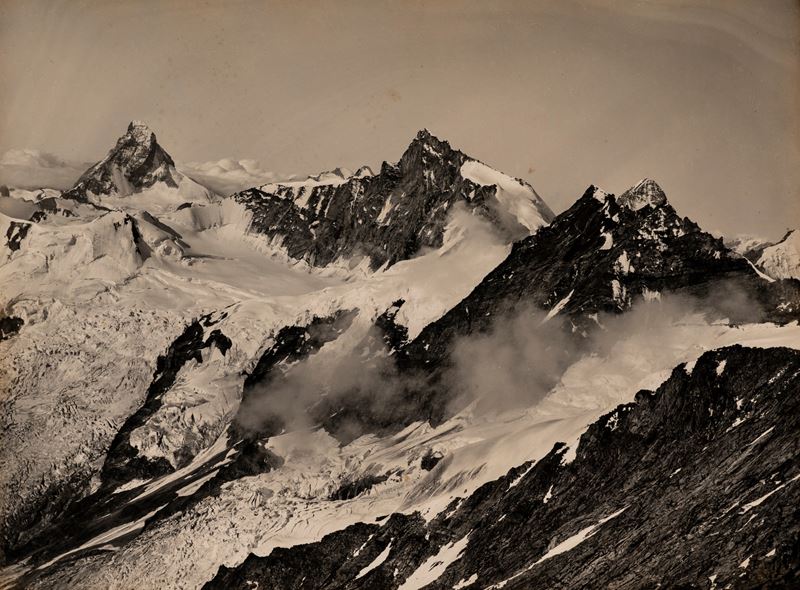
Gelatin silver print
cm 30 x 39,5 (cm 27,9 x 37,5 picture) | 11.8 x 15.5 in. (10.9 x 14,5 in. picture)
Photographer's credit blindstamp on the image
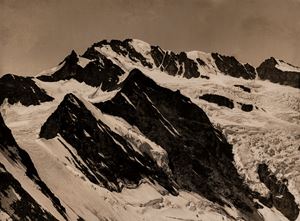
Vittorio Sella (Biella 1859 – 1943) inherited his passion for photography from his father, a textile entrepreneur and author of the treatise “Il plico fotografico” and combined it with the passion for the mountains acquired from his uncle Quirino, founder of the Italian Alpine Club (CAI). A skilled mountaineer, he used his 30x36 cm view camera to document the expeditions that took him between 1889 and 1909 to the Caucasus, Alaska, the Ruwenzori, the Karakoram, and both sides of the Alps. Over the years, he employed a variety of photographic techniques, from different-sized collodion plates to bromide plates, and even invented sophisticated transport systems, such as padded backpacks, to carry cameras, glass plates, and chemical supplies to mountain summits. His works had also great success at major international exhibitions, and it is thanks to him that this genre of photography came to be known as foto alpinismo (mountain photography), even when practiced far from the Alps. As an entrepreneur, he also managed the family’s textile mill and contributed to the founding of the Sella & Mosca winery.
cm 30 x 39,5 (cm 27,9 x 37,5 picture) | 11.8 x 15.5 in. (10.9 x 14,5 in. picture)
Photographer's credit blindstamp on the image
Vittorio Sella (Biella 1859 – 1943) inherited his passion for photography from his father, a textile entrepreneur and author of the treatise “Il plico fotografico” and combined it with the passion for the mountains acquired from his uncle Quirino, founder of the Italian Alpine Club (CAI). A skilled mountaineer, he used his 30x36 cm view camera to document the expeditions that took him between 1889 and 1909 to the Caucasus, Alaska, the Ruwenzori, the Karakoram, and both sides of the Alps. Over the years, he employed a variety of photographic techniques, from different-sized collodion plates to bromide plates, and even invented sophisticated transport systems, such as padded backpacks, to carry cameras, glass plates, and chemical supplies to mountain summits. His works had also great success at major international exhibitions, and it is thanks to him that this genre of photography came to be known as foto alpinismo (mountain photography), even when practiced far from the Alps. As an entrepreneur, he also managed the family’s textile mill and contributed to the founding of the Sella & Mosca winery.
It is hard to imagine today the difficulties faced by a photographer in the late 19th century who sought to capture the mountains in order to highlight their majesty. It was certainly possible to do so with small portable cameras (Sella himself carried a Kodak 9x12, but only for snapshots), yet to achieve results of such extraordinary quality as those presented here, one had to resort to bulky and cumbersome view cameras, as the large negatives were used to produce contact prints rich in astonishing detail. To achieve this, one also needed a certain ingenuity in devising systems to protect against the wind, which would shake the camera tripod, and the mountaineers’ own ability to reach the right vantage points: this is the case with the meticulous photograph of the Matterhorn and, three years later, of Gran Paradiso. The details are astonishing, as is that sense of depth which allows the viewer to feel fully immersed in the scene.
Contact
Suggested lots
Caricamento lotti suggeriti...