
5
Monete Greche e Puniche (shipping only in Italy)
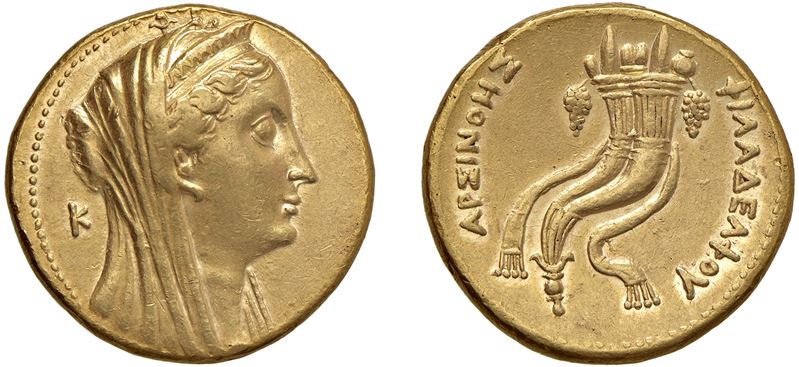
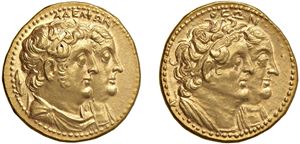
EGYPT - PTOLEMY II (285-246 BC) - Mnaieion or octodrachm in the name of Arsinoe II. Issue minted under Ptolemy II, circa 252-250 BC, Alexandria.
Starting bid
€ 8.000
Sold
€ 12.200
The price includes buyer's premium
Do you have a similar item you would like to sell?
Information
in gold
27.72 gr. - Diam. 27.00 mm.
Obverse: Veiled and diademed head right; in the field on the left, the letter K; - Reverse: double cornucopia decorated with ribbons.
Shipping only in Italy.
From the prestigious “Caruso Collection”, which belonged to Comm. Enrico Caruso and was auctioned by C. & C. Canessa on 28 June 1923 and following, at their headquarters in Naples, lot 97.
27.72 gr. - Diam. 27.00 mm.
Obverse: Veiled and diademed head right; in the field on the left, the letter K; - Reverse: double cornucopia decorated with ribbons.
Svoronos 475ε. CPE 390.
Good quality, with metal still shiny.
m.BB/q.SPL
Shipping only in Italy.
From the prestigious “Caruso Collection”, which belonged to Comm. Enrico Caruso and was auctioned by C. & C. Canessa on 28 June 1923 and following, at their headquarters in Naples, lot 97.
Arsinoe II, born in 316 BC to Ptolemy I and Berenice I, lived at the center of the political dynamics of the Hellenistic world from adolescence. While still very young, she was married to Lysimachus, king of Thrace, and subsequently united with her half-brother Ptolemy Keraunos, a figure known for his violence. The relationship with the latter quickly deteriorated: caught up in a conspiracy, Arsinoe was forced to abandon the political scene around 280 BC and take refuge in Egypt, then under the control of her younger brother Ptolemy II.
Gifted with great charisma, intelligence, and political skill, Arsinoe exerted a strong influence on Ptolemy II. After the elimination of his previous wife, accused of infidelity, the ruler married Arsinoe, likely around 276 BC. Although marriage between siblings was a consolidated practice in pharaonic tradition, it was exceptional in the Greek world, where it was reserved exclusively for deities: precisely for this reason, the union helped strengthen the Ptolemies' ideology of divine kingship.
Although she sometimes displayed considerable political cynicism, Arsinoe proved to be an energetic and competent ruler, actively participating in the government and taking a leading role in managing Egyptian foreign policy. Upon her death, dated to 270 or 268 BC, she was given full divine honors, accompanied by a large issue of gold coins depicting her veiled face. The small ram's horn protruding from the veil explicitly alludes to her deification, recalling the symbolism of the horn of Ammon associated with images of the deified Alexander.
Contact
Suggested lots
Caricamento lotti suggeriti...
More Lots
6
Monete Greche e Puniche (shipping only in Italy)
EGYPT - PTOLEMY II (285-246 BC) - Mnaieion or octodrama in the name of Arsinoe II. Posthumous issue...
Sold € 15.000
(buyer's premium not included)
7
Monete Greche e Puniche (shipping only in Italy)
EGYPT - PTOLEMY II (285-246 BC) - Mnaieion or octodrama in the name of Arsinoe II. Posthumous issue...
Sold € 7.500
(buyer's premium not included)
8
Monete Greche e Puniche (shipping only in Italy)
EGYPT - PTOLEMY II (285-246 BC) - Mnaieion or octodrama in the name of Arsinoe II. Posthumous...
Sold € 12.000
(buyer's premium not included)
9
Monete Greche e Puniche (shipping only in Italy)
EGYPT - PTOLEMY II (285-246 BC) - Mnaieion or octodrachm, Alexandria.
Sold € 12.000
(buyer's premium not included)