
21
Monete Bizantine e monete Barbariche (shipping only in Italy)
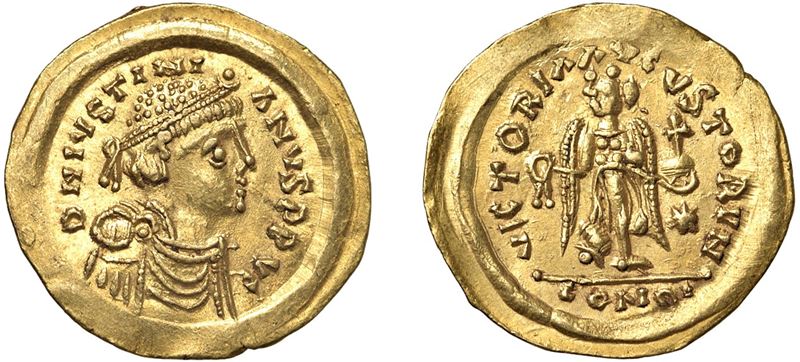
ISSUE OF UNCERTAIN ATTRIBUTION IN THE NAME OF JUSTINIAN – Tremissis.
Starting bid
€ 300
Sold
€ 1.708
The price includes buyer's premium
Do you have a similar item you would like to sell?
Information
in gold
1.45 gr. - Diam. 16.00 mm.
Shipping only in Italy.
1.45 gr. - Diam. 16.00 mm.
Obverse: Diademed, cuirassed, and draped bust right; Reverse: - Victory standing facing, holding a crown in her right hand and a globus cruciger in her left.
Sear 145. DOC 19/2.
A pleasant example, of beautiful style, due to slight variations in the portrait and the legend in our opinion it should be considered a Lombard imitation issue.
nice SPL.
Shipping only in Italy.
When the Lombards entered Italy after 568 AD, they lacked an autonomous monetary tradition comparable to that of Rome or Byzantine times. As Ermanno Arslan repeatedly emphasized, for the Lombards, coinage was not a structural element of state organization, but rather a pragmatic tool, adopted only to the extent that it served their purpose in integrating them into the Mediterranean economic and symbolic system. Consequently, in the first decades of their presence in Italy, Lombard gold coinage was predominantly more or less faithful imitations of the Byzantine tremissis then in circulation.
Indicative of this initial lack of a full "monetary culture" is the production prior to the arrival in Italy, carried out by Lombard goldsmiths active in the Pannonian area. These examples, often highly stylized in style, appear to have an essentially ornamental and symbolic function rather than a strictly monetary one: tremissis or pseudo-tremissis were in fact used as decorative elements for jewelry, necklaces, and ornaments, fitting into a cultural context in which the value of the metal and the prestige of the image prevailed over the economic use of money. Arslan has aptly emphasized that this production should not be interpreted in terms of artistic "decadence," but rather as an expression of a different relationship with the monetary object.
Lombard imitations predominantly reproduce imperial typologies from the Justinian and post-Justinian eras, with the bust of the emperor on the obverse and the figure of Victory on the reverse. However, the legends are often corrupted, fragmentary, or completely meaningless, a phenomenon that reflects an imperfect knowledge of Latin and, more generally, a limited understanding of the communicative value of coin writing.
This production fits perfectly into what numismatic historiography defines as the "pseudo-imperial" phase: despite the progressive consolidation of Lombard rule over large areas of northern and central Italy, Byzantine monetary models continued to be accepted and reproduced as the custodians of a universally recognized economic and symbolic authority.
The example presented here, however, is an imitation characterized by a highly artistic style, clearly distinguishing itself from cruder or merely ornamental productions. The iconographic variations in the imperial portrait, combined with a greater compositional coherence, allow it to be interpreted as the product of a Lombard workshop now integrated into the Italic context, and no longer attributable to the preceding Pannonian phases.
In this sense, stylistic comparisons with the famous tremissis found in the Castrum of Castelseprio, discovered in the drainage well dug near the apse of the church of San Giovanni Evangelista, are particularly significant. Scholars believe this specimen dates to the final decades of the 6th century.
Contact
Suggested lots
Caricamento lotti suggeriti...
More Lots
22
Monete Bizantine e monete Barbariche (shipping only in Italy)
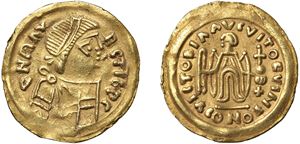
LOMBARDS – COINAGE IN THE NAME OF MAURITIUS TIBERIUS (582-602) - Tremissis. Issued during the...
Sold € 850
(buyer's premium not included)
23
Monete Bizantine e monete Barbariche (shipping only in Italy)
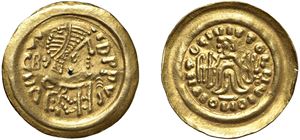
LOMBARDS – COINAGE IN THE NAME OF MAURITIUS TIBERIUS (582-602) - Tremissis. Issued during the...
Sold € 1.500
(buyer's premium not included)
24
Monete Bizantine e monete Barbariche (shipping only in Italy)
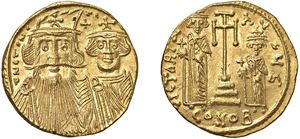
BYZANTINE EMPIRE – CONSTANS II (661-668) – Solidus, n.d., Constantinople.
Sold € 750
(buyer's premium not included)
25
Monete Antiche (shipping only in Italy)
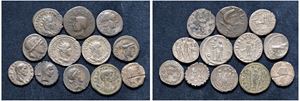
Interesting lot of 12 coins. Mixed coinage.
Sold € 750
(buyer's premium not included)