Information
h 43,8 cm
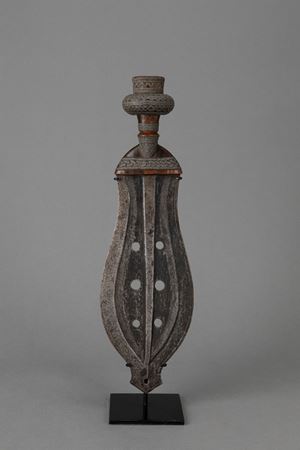
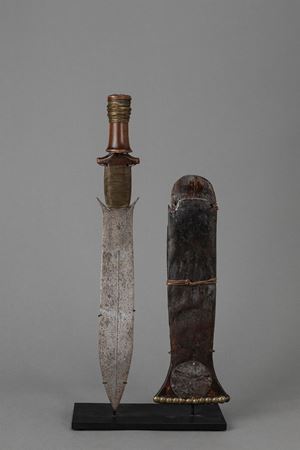
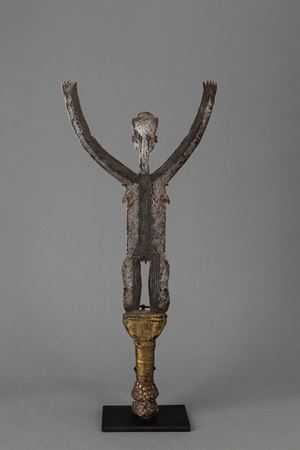
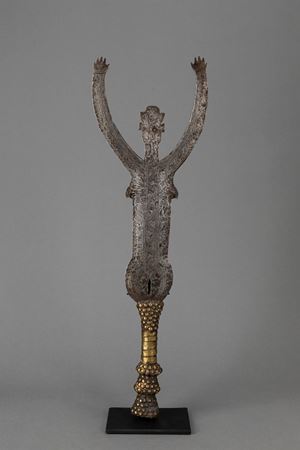
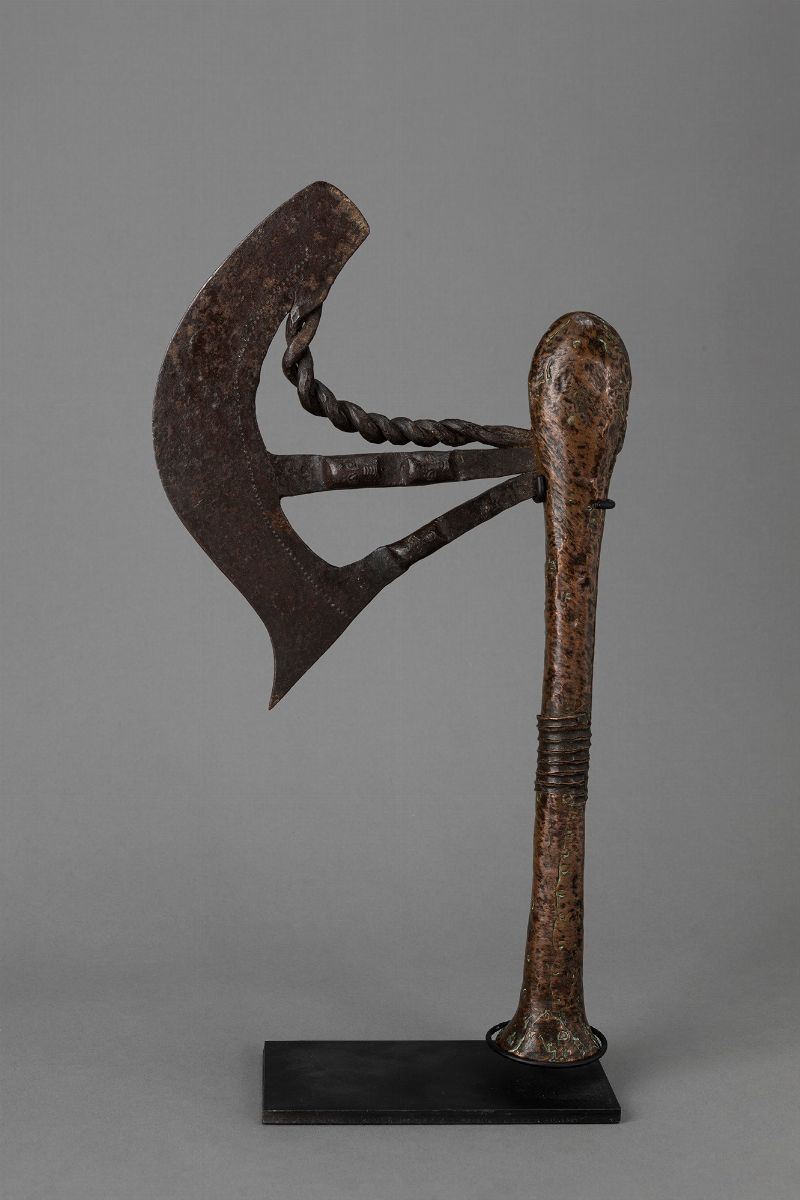
Parade axe
Asymmetrical forged iron blade with a series of knotted veining, wrapped in a spiral shape. Wooden handle covered with copper foil. Local name: Kasuyu.
The Songye (Basonge) are a group of around 100,000 people who live in a vast area of south-eastern Zimbabwe (formerly Zaire), marked by the courses of the Lwlaba and Lomami rivers.For many years, they have developed an impressive ability to produce iron weapons, particularly parade swords.These valuable objects were reserved for the heads of clans, shamans, judges, famous sculptors etc. and were used during community ceremonies to show off the prestige and social rank of their owners. These grand axes grew in fame at the start of the 1900s, and many were produced by Songye and Nsapo Nsapo blacksmiths, who made them with great ability.The support rods for the blade were first decorated with a chisel, then welded together at one end and finally joined to the blade.Some of the rods, as is the case in this example, were twisted around in a spiral shape.The blade is adorned with a series of pointed patterns made with a burin.The asymmetrical shape is less common.
Parade axe
Asymmetrical forged iron blade with a series of knotted veining, wrapped in a spiral shape. Wooden handle covered with copper foil. Local name: Kasuyu.
The Songye (Basonge) are a group of around 100,000 people who live in a vast area of south-eastern Zimbabwe (formerly Zaire), marked by the courses of the Lwlaba and Lomami rivers.For many years, they have developed an impressive ability to produce iron weapons, particularly parade swords.These valuable objects were reserved for the heads of clans, shamans, judges, famous sculptors etc. and were used during community ceremonies to show off the prestige and social rank of their owners. These grand axes grew in fame at the start of the 1900s, and many were produced by Songye and Nsapo Nsapo blacksmiths, who made them with great ability.The support rods for the blade were first decorated with a chisel, then welded together at one end and finally joined to the blade.Some of the rods, as is the case in this example, were twisted around in a spiral shape.The blade is adorned with a series of pointed patterns made with a burin.The asymmetrical shape is less common.
Literature
SOTHEBY’S, Art Africain et Océanien, Paris asta del 5 Maggio 2003, lotto 45 (472);
SOTHEBY’S, Art Africain et Océanien: Collection Peter et Veena Schnell - Vol. II, Paris asta del 3 Dicembre 2004, pag. 64, lotto 50 (494);
SOTHEBY’S, Art Africain et Océanien: Collection Peter et Veena Schnell - Vol. II, Paris asta del 3 Dicembre 2004, pag. 64, lotto 50 (494);
Contact
Condition report
To request a Condition Report, please contact arteafricana@finarte.it
The department will provide you with a general report of the condition of the property described above. Please note that what Finarte declares with respect to the state of conservation of the objects corresponds only to a qualified opinion and that we are not professional conservators or restorers.
We urge you to consult with a restorer or conservator of your choice who will be better able to provide a detailed, professional report. We always suggest prospective buyers to inspect each lot to satisfy themselves as to condition during the exhibition days as indicated in the catalog.
Suggested lots
Caricamento lotti suggeriti...